



Investors grow uneasy as Moody’s becomes the last major ratings agency to downgrade the U.S., citing mounting fiscal deficits and stalled political will to rein in spending.
NEW YORK, May 18 (Reuters) – Investor anxiety over America’s ballooning debt intensified Friday after Moody’s became the last of the three major credit ratings agencies to downgrade the United States’ sovereign credit rating. The one-notch cut adds fresh pressure on Washington as lawmakers negotiate a sweeping fiscal package dubbed the “Big Beautiful Bill.”
Citing the country’s surging $36 trillion debt and a lack of credible deficit reduction plans, Moody’s said it sees no meaningful fiscal course correction on the horizon. The downgrade follows similar actions by Fitch in 2023 and S&P in 2011.
The move comes amid contentious Congressional negotiations over a massive bill combining tax cuts, spending hikes, and safety-net reforms—potentially adding trillions to the federal deficit. Though the bill remains stalled, President Donald Trump has publicly urged unity to pass it.
“The bond market has been closely watching Washington this year,” said Carol Schleif, chief market strategist at BMO Private Wealth. “With this downgrade, bond vigilantes may now pressure lawmakers to adopt more fiscally responsible policies.”
Moody’s action is unlikely to force large-scale selling, said Gennadiy Goldberg of TD Securities, as many investment funds adjusted policies after S&P’s 2011 downgrade. Still, Goldberg added, “it puts renewed focus on fiscal policy and the uncertainty around the current legislation.”
Mounting Market Tensions
The downgrade adds urgency as Treasury yields reflect growing unease. Yields on 10-year Treasury notes remain elevated, with fiscal risk contributing to a rising term premium, noted Anthony Woodside of Legal & General Investment Management America.
Meanwhile, the Committee for a Responsible Federal Budget estimates the current bill could raise deficits by $3.3 trillion by 2034—or $5.2 trillion if temporary provisions are extended. Barclays pegs the revised 10-year cost at $2 trillion, a modest improvement over earlier estimates.
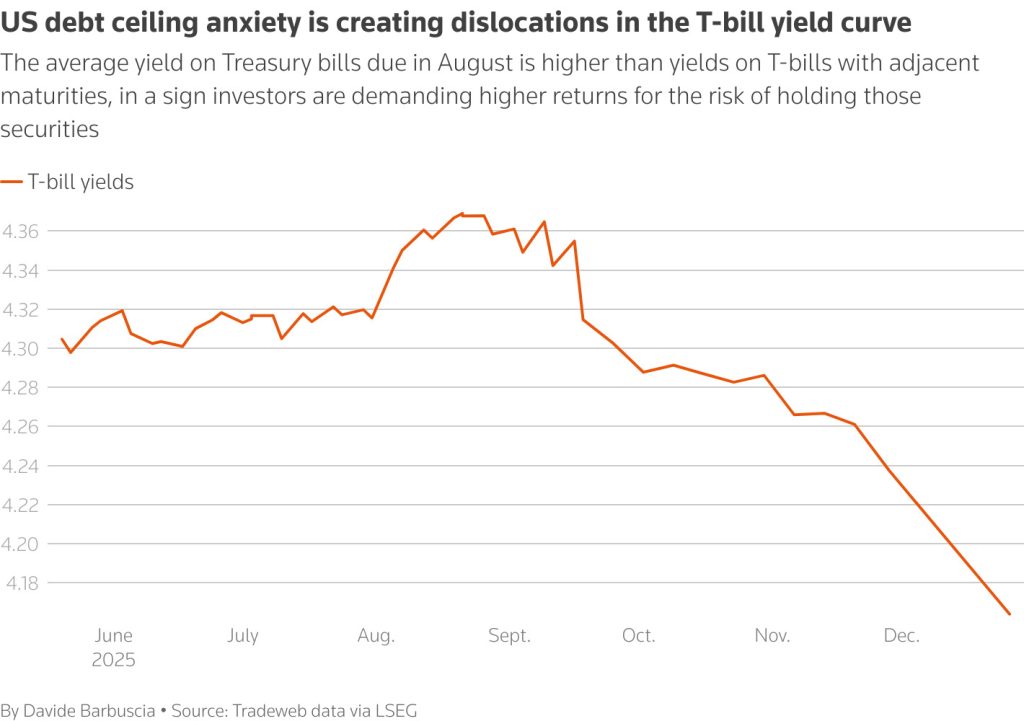
Treasury Secretary Scott Bessent has expressed concern about rising yields, and House Speaker Mike Johnson aims to pass the bill by May 26. The U.S. has already hit its statutory borrowing limit, with the so-called “X-date” — when the government could run out of cash — projected for August.
White House Pushback
The White House rejected Moody’s rationale. “The experts are wrong, just like they were about tariffs,” said Deputy Press Secretary Harrison Fields, pointing to job creation and investment as proof. Communications Director Steven Cheung dismissed the downgrade as “political,” calling out Moody’s economist Mark Zandi, though Zandi operates in a separate division and declined comment.
Despite the political posturing, market jitters are mounting. Yields on Treasury bills maturing in August now exceed surrounding maturities, indicating investor caution.
Structural Challenges Ahead
Experts say the bill’s reliance on extending Trump-era tax cuts with limited spending offsets makes long-term fiscal improvement unlikely. Morgan Stanley’s Michael Zezas described the bill as “politically viable but economically limited,” warning it may widen deficits without meaningful stimulus.
Guggenheim’s Anne Walsh echoed the concern. “Without a real process to reset spending levels, this path is unsustainable,” she said.
With the U.S. inching closer to a potential default window and political divides persisting, Moody’s downgrade could be just the start of a more volatile economic period for the world’s largest economy.