
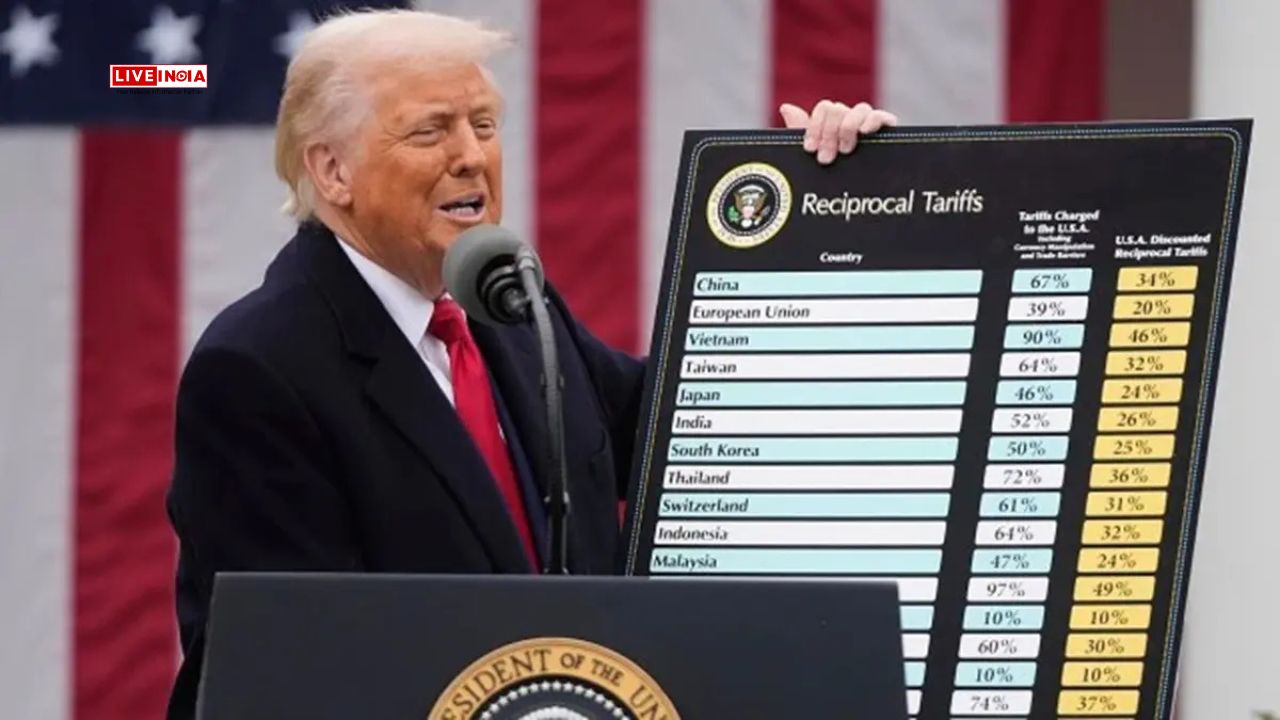


Despite $6 trillion stock market loss, Trump officials defend tariff move as strategic leverage; say dozens of nations now want to negotiate.
April 7, 2025: Top White House officials claimed Sunday that more than 50 countries have reached out to the United States for trade negotiations following President Donald Trump’s sweeping new tariff policy—despite mounting global backlash and a historic $6 trillion wipeout from American stock markets last week.
Appearing on major Sunday talk shows, Treasury Secretary Scott Bessent and other senior economic advisers defended the administration’s decision, calling it a smart reset in the global trade landscape. They dismissed concerns over market volatility and looming recession risks, instead hailing the tariffs as “maximum leverage”.
Also Read: Black Monday Revisited: What Happened in 1987 and Why Experts Fear a Repeat in 2025
“He’s created maximum leverage for himself,” said Bessent on NBC’s Meet the Press, adding that over 50 nations had contacted the White House to start fresh trade talks since the tariff plan was unveiled last Wednesday.
While officials did not name the countries involved, the sheer volume of interest, they argued, positions Trump as a central figure in reshaping global trade. However, analysts have warned that coordinating negotiations with dozens of countries at once may lead to prolonged economic uncertainty.
Also Read: Global Markets Crash as Panic Deepens Over Trump’s Tariff Blitz
Markets in Turmoil
The tariff policy, which includes a 10% baseline duty on all imports and country-specific reciprocal tariffs, has triggered swift retaliation from global players, particularly China, which imposed a 34% duty on all US imports.
In response, global stock indices saw massive declines, with US markets experiencing their worst week since the 2020 COVID-19 crash. Economists at JPMorgan revised their outlook, now expecting US GDP to shrink by 0.3% in 2025, a sharp drop from previous projections of 1.3% growth.
Officials Dismiss Recession Worries
Bessent insisted that despite the market freefall, strong jobs data and domestic consumer spending offer reasons for optimism. “There is no reason to think we’re heading into a recession based on the tariff action alone,” he said.
However, independent economists and institutional analysts are less convinced. Rising unemployment projections, inflation concerns, and fears of a prolonged global trade war have rattled investor confidence.
Trump Unfazed, Golfs Amid Global Panic
As pressure mounts, President Trump spent the weekend in Florida, golfing and sharing a video of his swing on social media—unbothered by the growing economic storm his policy has unleashed.
Global investors are now bracing for Monday’s market open in Asia, where Japan and South Korea are already facing heavy losses. Some fear a “Black Monday” scenario, especially as futures trading in Japan was suspended earlier due to circuit breakers being triggered.
What’s Next?
While India, Taiwan, and Indonesia have opted not to retaliate immediately, major economies like China and the European Union are preparing countermeasures. Trump’s strategy may have sparked momentum toward new negotiations, but at the cost of market confidence and global stability.
More updates are expected this week as countries finalize their response—and the world watches to see if Trump’s gamble pays off or further deepens the economic crisis.
Tags:
Donald Trump, US tariffs, global trade war, stock market crash, recession fears, trade talks, Trump 2025, Scott Bessent, Asian markets, China retaliation, global economy, White House, US GDP, unemployment rate