
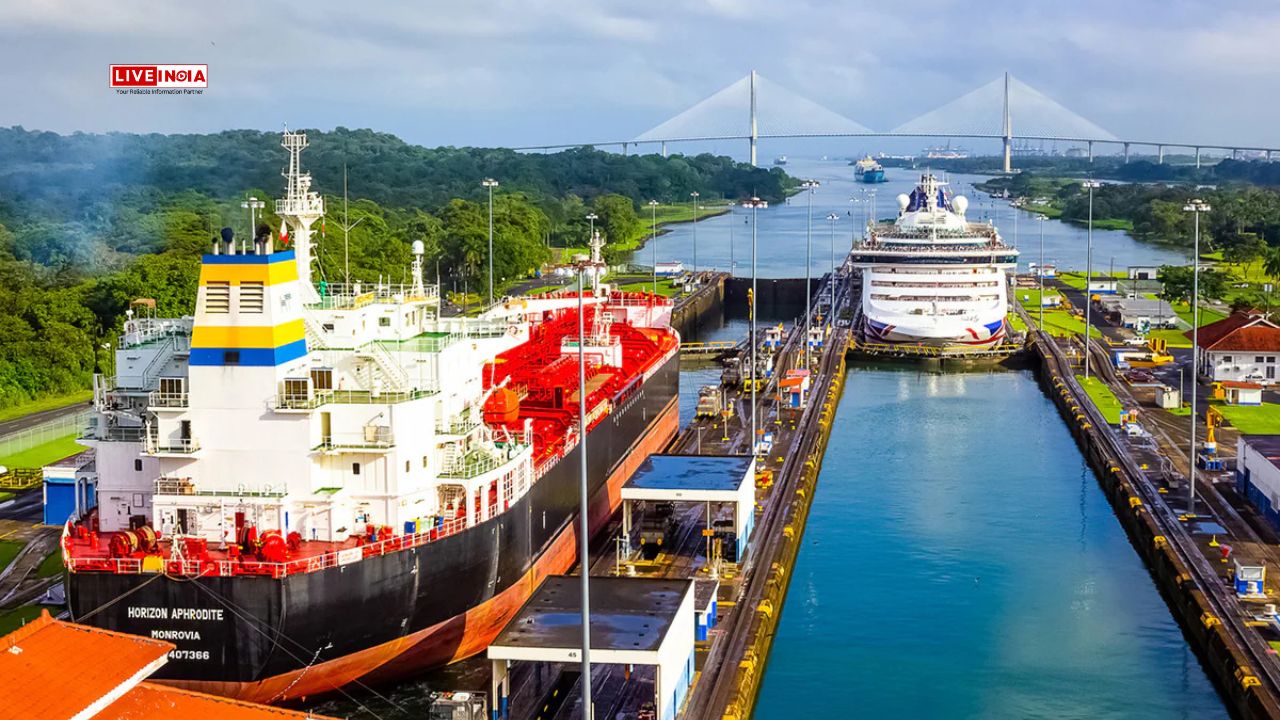


Pentagon chief Pete Hegseth, during his visit to Panama, declared a renewed US-Panama alliance to end China’s hold over the historic canal, calling it a national security priority
April 9, 2025: In a major geopolitical development, US Secretary of Defence Pete Hegseth announced that the United States and Panama will jointly take back control of the Panama Canal from Chinese influence, marking a strategic shift in one of the world’s most vital trade routes.
Also Read: Elon Musk Opposes Trump’s 50% Tariff Plan On China? Know More
Speaking in Panama City during the first visit by a US defense secretary to the country in decades, Hegseth met with President Jose Raul Mulino behind closed doors and visited the canal. He voiced strong concerns about China’s deepening commercial and strategic foothold in the region, accusing Beijing of using its investments as a cover for espionage.
“China did not build this canal. China does not operate this canal. And China will not weaponize this canal,” Hegseth declared. “Together, we will take back the Panama Canal from China’s influence.”
A Renewed Military Alliance
Hegseth also announced plans to deepen military cooperation with Panama’s forces. He emphasized that Chinese firms’ presence in canal operations posed a risk, with potential implications for global naval logistics and US national security.
Also Read: China Vows to “Fight to the End” as Trump’s 104% Tariffs Spark Global Economic Showdown
His comments come amid a broader Trump administration push to counter Beijing’s influence across Latin America and reassert US dominance over strategic infrastructure. President Trump himself has hinted at military options to secure access to the canal, especially in a scenario involving a conflict in Asia where rapid naval deployment through the canal would be crucial.
Panama’s Strategic Shift
Panama, under President Mulino, has moved swiftly to align more closely with Washington:
- Exited China’s Belt and Road Initiative earlier this year.
- Accepted US deportation flights to stem migrant flows.
- Supported American-led buyout of Chinese ports, including a key $22.8 billion deal led by BlackRock involving Hong Kong’s CK Hutchison holdings near the canal.
Mulino’s stance has been praised by US officials, who view him as a willing partner in reducing Beijing’s economic footprint in Central America.
Why the Panama Canal Matters
Built by the US over a century ago and handed to Panama in 1999, the Panama Canal remains a strategic artery, enabling ships to pass between the Atlantic and Pacific Oceans.
Analysts say Chinese control over ports and surrounding infrastructure could offer Beijing intelligence-gathering capabilities, logistical advantages, and even the potential to disrupt US naval movement in times of war—especially if tensions escalate in the Indo-Pacific.
A recent report revealed that US military patrols around the canal may resume, coordinated with Panamanian security forces, as part of the new strategic framework.
China, for its part, has condemned the US-led takeover of Hutchison’s port assets and is reportedly preparing an antitrust review of the BlackRock deal.
As tensions grow, the Panama Canal has become a new frontline in the geopolitical battle for global influence between the United States and China.
Tags:
Panama Canal, US-China tensions, Pete Hegseth, Jose Raul Mulino, Pentagon, Trump administration, Belt and Road exit, China influence, Panama US deal, BlackRock CK Hutchison, military cooperation, global trade routes