


Mark Jenkin’s latest feature blends eerie time travel, family grief, and haunting visuals, anchored by George MacKay’s powerful performance in a Cornish fishing village trapped between past and present.
Mark Jenkin has always been a filmmaker obsessed with memory, isolation, and the sea. His last work, the enigmatic Enys Men (2022), was a hypnotic meditation that confounded as much as it fascinated. With his latest feature, Rose of Nevada, Jenkin turns to a more grounded narrative—but without abandoning the elliptical, dreamlike style that defines his artistry.
This isn’t exactly a ghost story, though it carries the weight of one. Instead, Rose of Nevada is a film about time, grief, and belonging, wrapped in the haunting atmosphere of Cornwall’s decaying fishing communities.
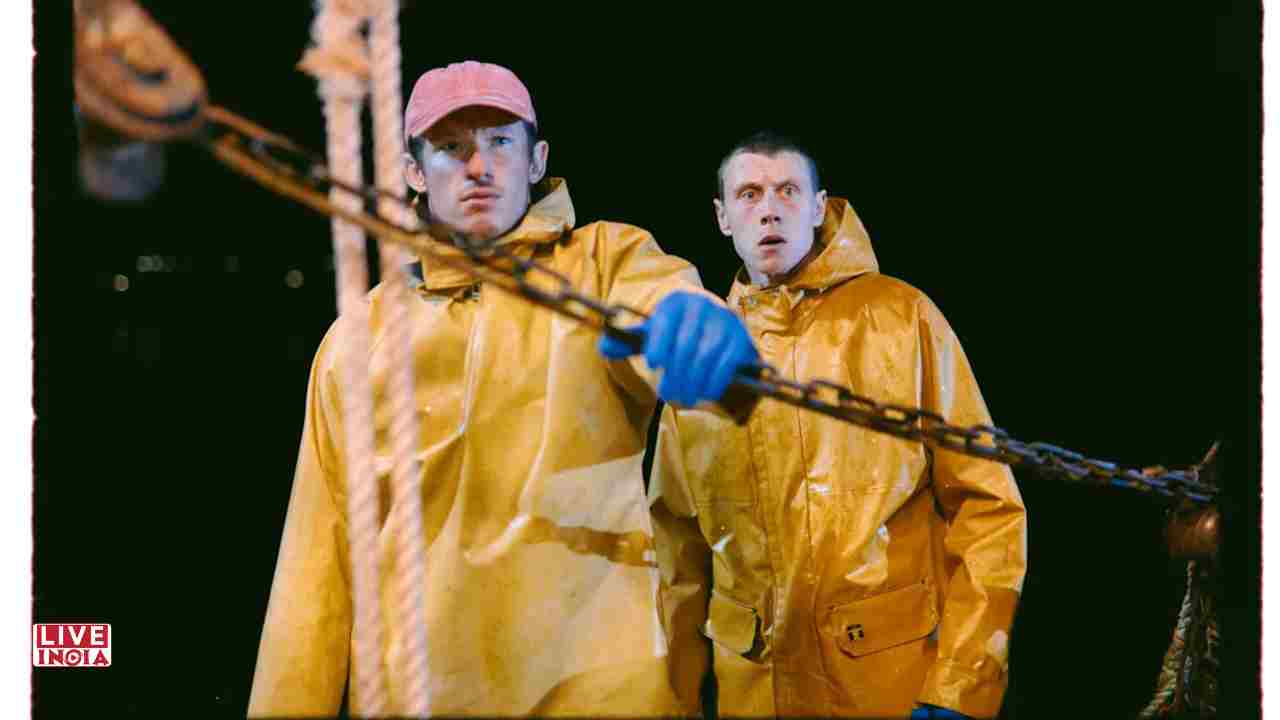
At its center is George MacKay (1917, The Beast), who delivers a quietly devastating performance as Nick, a struggling fisherman. His home life is in disarray—his roof leaks, his wife and daughter rely on a food bank, and his town feels like it’s falling apart around him. Into this world drifts Liam (played by Callum Turner, The Boys in the Boat), a stranger with no past, no money, and no place to stay. Their lives collide on the shore where the impossible happens: a small boat named Rose of Nevada—lost at sea 30 years earlier—suddenly reappears.
That boat carried two men who never returned. One was the husband of Tina (Rosalind Eleazar), whose daughters grew up without a memory of their father. The other was the son of the Richards family (Mary Woodvine and Adrian Rawlins). Mrs. Richards, frail and half-lost to time herself, whispers chillingly: “My boy’s coming home.” It is Jenkin’s first whispered promise of the supernatural.
The story quickly slides into unsettling waters. When Nick and Liam set sail aboard the recovered vessel, Nick finds a cryptic warning carved into the wood: “Get Off the Boat Now.” What follows is Jenkin at his most daring—Nick and Liam return to shore only to find themselves in 1993. Their crumbling town has sprung back to life: the food bank is once again a post office, the shabby bar is bustling with locals, and the streets hum with an energy that has long since vanished. But can they return to the present—or are they stranded in a past that doesn’t belong to them?
MacKay is magnetic throughout, grounding the film with a raw, human ache. His haunted expression carries the burden of a man desperate to return to his family yet uncertain whether the past is unraveling his identity. Turner plays Liam as an enigma—his blankness at first frustrating, but later essential as questions about his origins deepen in the 1993 timeline. Eleazar, meanwhile, brings poise and mystery to Tina, leaving audiences unsure how much she knows, or how much she chooses not to confront.
Jenkin, as always, layers meaning through imagery. Photographs of the two men lost at sea recur throughout the film, blurring the line between memory, vision, and reality. Are they fragments of the past, or warnings for the present? Nick’s dreams, which bleed into memory, only thicken the ambiguity.
Visually, Rose of Nevada is breathtaking—scratchy textures of rusted chains and rotting wood, bold compositions of the boat adrift, and unsettling close-ups of fish, gutted and staring lifelessly back at the audience. At times, the lingering shots test patience, but they also reinforce the film’s meditation on life, death, and the cycles of the sea.
And then there is sound. Jenkin, who wrote, directed, shot, edited, and designed the film himself, crafts an auditory landscape of ticking clocks, thumping rhythms, and tones that hang in the air like unfinished prayers. It is this soundscape, as much as the images, that turns the film into something spectral—never quite horror, but always unnervingly supernatural.
In his director’s statement, Jenkin described Rose of Nevada as a story about “personal sacrifice, the power of community, and what it means to be part of society today.” Those themes may not always surface clearly, but they reverberate in every frame. His films are never puzzles to be solved, but experiences to be absorbed.
Ultimately, Rose of Nevada is not just a story about fishermen or time travel. It’s about loss, about what communities carry with them across generations, and about the impossibility of truly escaping the weight of the past. Haunting, enigmatic, and quietly profound—it’s Jenkin at his most ambitious, and perhaps his most human.