
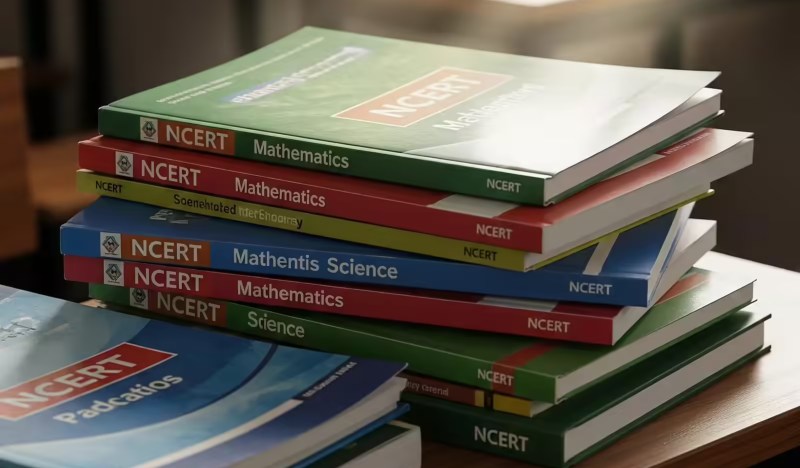


The National Council of Educational Research and Training (NCERT) has officially released a new Class 9 science textbook titled Exploration, set to be implemented in the 2026–27 academic session.
Aligned with the National Education Policy (NEP) 2020 and the National Curriculum Framework (NCF-SE) 2023, the 13-chapter book represents a major shift from the 2006 edition. The new curriculum prioritizes experiential learning, data analysis, and the integration of India’s traditional knowledge systems with modern scientific principles.
Key Curriculum Changes: What’s In and What’s Out
The restructuring aims to create a more cohesive learning journey across the secondary level (Classes 9 and 10).
| Status | Chapters / Topics |
| New Additions | Reproduction: How Life Continues (moved from Class 10); Earth as a System; Diversity and Classification (reintroduced). |
| Retained/Revised | Cells, Tissues, Motion, Mixtures, Force, Work & Energy, Atoms, and Sound. |
| Removed (Class 9) | Gravitation and Improvement in Food Resources (moved to the Class 10 curriculum for next year). |
Integrating Indian Contributions & Traditional Wisdom
A standout feature of Exploration is its focus on the “Indianization” of scientific history, highlighting that science has deep roots in the subcontinent.
Indian Scientists: Dedicated sections on C.V. Raman, Meghnad Saha, and Homi Jehangir Bhabha.
Institutional Pride: Case studies on the Bhabha Atomic Research Centre (BARC) and the Indian Institute of Tropical Meteorology (IITM).
Ancient Concepts: * Aryabhatiya (5th Century CE): Used to introduce the concept of speed.
Acharya Kanada: His concept of paramanu (atom) from the Vaisesika Sutras is taught alongside modern atomic theory.
Traditional Tech: The deg-bhapka distillation method from Kannauj’s perfume industry illustrates chemical separation.
A Shift from Rote Learning to Inquiry
NCERT Director Dinesh Prasad Saklani emphasized that the book is designed to foster a “holistic understanding” of the relationship between science and society.
“Exploration aligns with NEP 2020 by promoting experiential and inquiry-based learning… It highlights the interrelationship between science, technology, and society.” — Dinesh Prasad Saklani, Foreword.
Educational Highlights:
Real-Life Application: Activities include analyzing local environmental data and understanding hygiene (including menstruation and prevention of unwanted pregnancies) in the reproduction chapter.
Introductory Chapter: A new opening chapter focuses purely on the scientific method, teaching students how to think like scientists before diving into core concepts.