
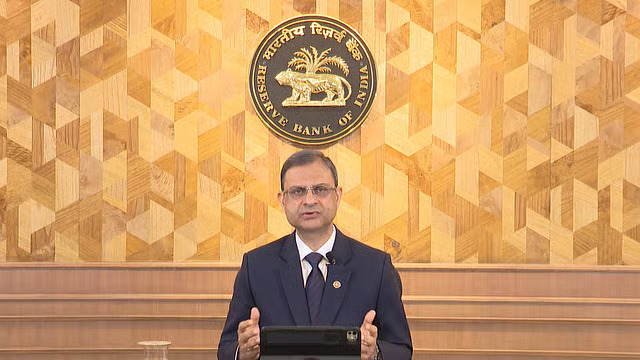


Reserve Bank of India Governor Sanjay Malhotra on Wednesday expressed confidence that interest rates in India are likely to remain low over the medium to long term, citing stable inflation and strong macroeconomic fundamentals.
Speaking at a post-monetary policy press conference, Malhotra said India’s economic outlook remains resilient despite global uncertainties, particularly those linked to the recent conflict involving Iran.
RBI Keeps Repo Rate Unchanged At 5.25%
Earlier in the day, the RBI’s six-member Monetary Policy Committee (MPC) unanimously decided to keep the benchmark repo rate unchanged at 5.25%, maintaining a cautious “wait-and-watch” approach.
The decision comes amid heightened global uncertainty caused by the six-week-long West Asia conflict, which pushed crude oil prices higher, weakened the rupee and disrupted global trade flows.
Malhotra noted that policymakers are carefully monitoring evolving global conditions before making any significant changes to interest rates.
“We are in a neutral state… possibility either way cannot be ruled out, but it is quite possible that low rates would continue for a long time,” he said.
Strong Economic Fundamentals Support Low Rates
The RBI Governor highlighted that India’s strong structural and macroeconomic fundamentals support the possibility of maintaining lower interest rates in the foreseeable future.
He credited measures taken by the government, the RBI and other institutions for strengthening the economy.
“Structurally, long-term macroeconomic fundamentals remain very strong and continue to drive growth while keeping price pressures contained,” Malhotra said.
He added that even in the short to medium term, interest rates are likely to remain favourable due to controlled inflationary pressures.
GDP Growth Projected At 6.9%
Despite global headwinds, the RBI has projected India’s Gross Domestic Product (GDP) growth at 6.9% for the current financial year.
This projection is slightly lower than the earlier estimate of 7.6% growth for FY26, reflecting the impact of external uncertainties such as geopolitical tensions and fluctuating crude prices.
At the same time, inflation is estimated at 4.6% for FY27 (April 2026–March 2027), comfortably within the RBI’s target range of 2% to 6%.
Ceasefire Impact Considered In Policy Outlook
Malhotra confirmed that the recent ceasefire agreement between the United States and Iran — announced by Donald Trump — was factored into the RBI’s monetary policy review.
The ceasefire is expected to stabilise global energy markets and ease pressures on inflation, which had risen due to sharp increases in crude oil prices during the conflict.
Rate Cut Transmission By Banks Remains Strong
Commenting on the transmission of earlier rate cuts, Malhotra said banks have passed on most of the benefits to borrowers.
According to RBI data, banks have reduced lending rates by around 90 basis points against a total 125 basis points reduction in the repo rate.
On the deposit side, rate transmission has been even stronger, exceeding 100 basis points, which the Governor described as satisfactory.
RBI Measures To Manage Rupee Volatility
The RBI Governor also addressed recent steps taken to manage volatility in the foreign exchange market.
He clarified that these measures were temporary and introduced solely to prevent excessive fluctuations in the rupee.
“These steps were taken to check excessive volatility of the rupee, and they are not structural changes. We remain committed to broadening and deepening financial markets,” he said.
He added that the volatility was particularly visible in the final weeks of last month due to global market uncertainty.
Outlook Remains Stable Despite Global Risks
Overall, the RBI’s stance reflects cautious optimism, balancing domestic economic strength with external risks.
With inflation under control and growth projections remaining healthy, policymakers believe India is well-positioned to maintain stable interest rates in the coming years, even as global geopolitical developments continue to evolve.