
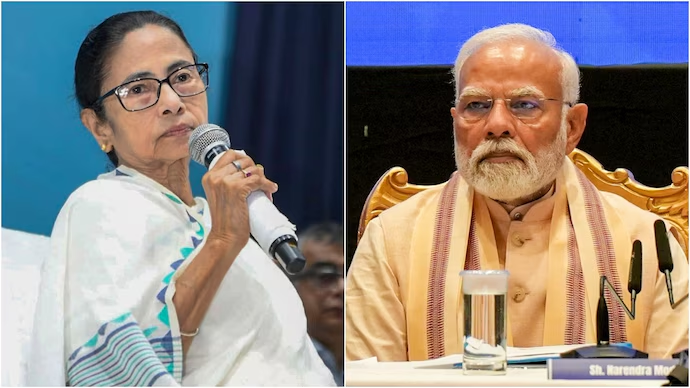


The proposed Uniform Civil Code has emerged as a major political flashpoint in West Bengal ahead of assembly elections, with a war of words intensifying between the Trinamool Congress (TMC) and the Bharatiya Janata Party (BJP).
TMC chief and Chief Minister Mamata Banerjee launched a strong attack on the BJP, saying her party would revoke the UCC if the BJP loses its majority in the future. She accused the Centre of attempting to impose a uniform system that could override religious and cultural diversity.
Her remarks came shortly after Prime Minister Narendra Modi reiterated the BJP’s promise to implement the UCC in the state, arguing it would help end “appeasement politics.”
Allegations Over Bhabanipur Nomination
Banerjee also alleged that attempts were made to invalidate her nomination from the Bhabanipur seat in south Kolkata. She claimed that false affidavits were filed to block her candidature, though the effort ultimately failed.
Election authorities confirmed that complaints had been submitted challenging her nomination, alleging suppression of details related to pending cases. However, officials did not disclose the identities of the complainants.
Cultural Debate Around UCC
Addressing rallies across the state, Banerjee criticised the BJP’s UCC push, arguing that India’s diverse traditions cannot be governed under a single uniform framework. She highlighted differences in customs across communities, warning that such a move could undermine religious freedom and cultural practices.
She also questioned the fairness of the electoral process, alleging irregularities and calling the ongoing revision exercises a “scam.”
BJP Hits Back
The BJP dismissed the allegations as baseless, with party leaders claiming Banerjee is attempting to deflect attention due to electoral pressure. They maintained that the UCC is aimed at ensuring equality and legal uniformity across communities.
With elections approaching, the UCC debate has become a central campaign issue in West Bengal, reflecting a broader national conversation on law, identity, and governance.