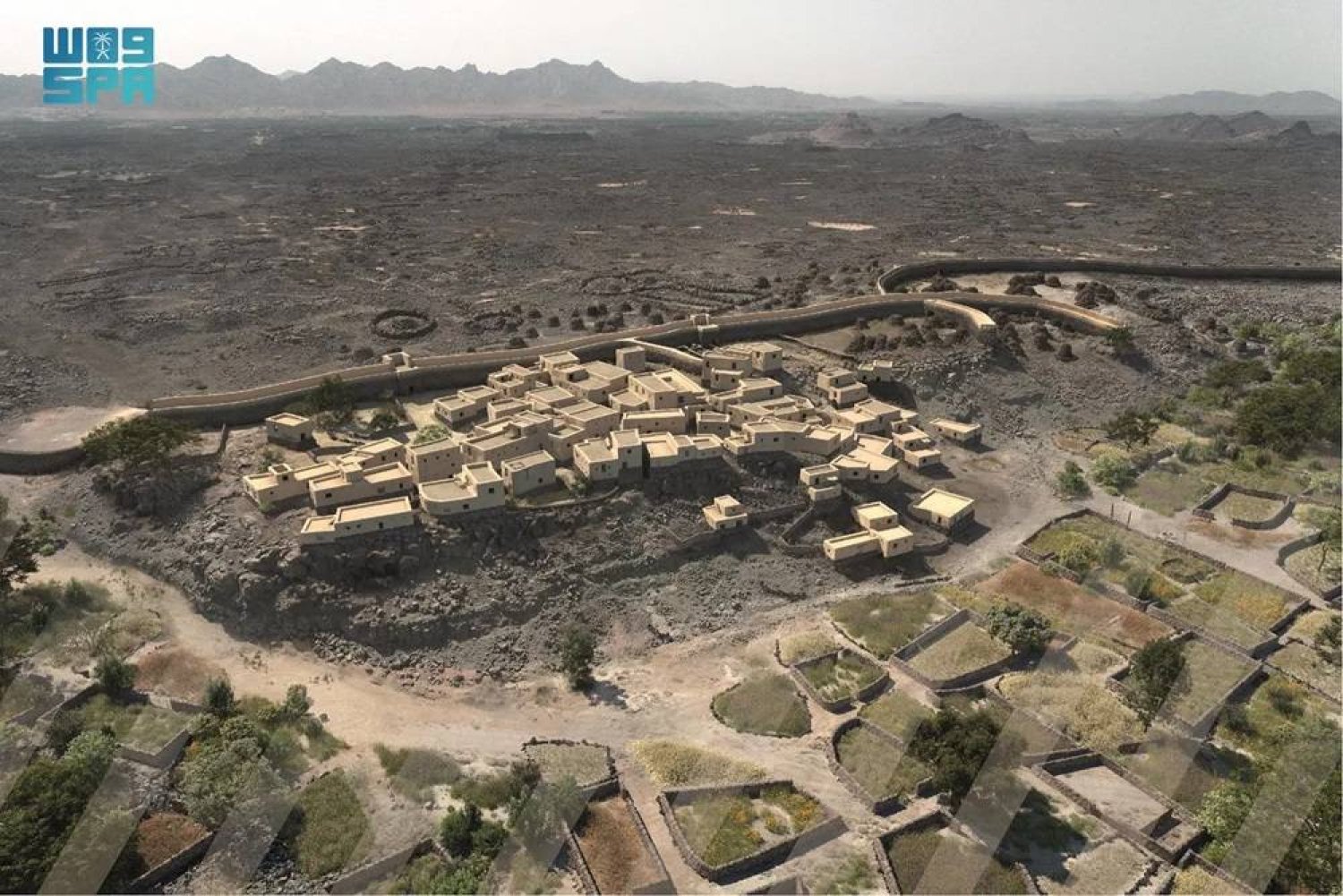
Bronze Age Town Unearthed in Saudi Arabia’s Khaybar Oasis
Riyadh [Saudi Arabia], November 3, 2024: The Royal Commission for AlUla (RCU) has announced a groundbreaking archaeological discovery: the remains of a Bronze Age town in the Khaybar Oasis in northwest Saudi Arabia. Published in the journal PLOS ONE, the find sheds light on ancient urban life in the region, offering new insights into the evolution of societies in the Arabian Peninsula.
At a press conference held at the Saudi Press Agency’s conference center in Riyadh, RCU highlighted how this discovery enhances Saudi Arabia’s prominence in global archaeology and underscores the Kingdom’s dedication to preserving cultural heritage. “The discovery is proof of the Kingdom’s commitment to safeguarding its cultural and historical heritage, as well as its desire to exchange knowledge and experience with the international community,” RCU representatives emphasized, aligning the initiative with Saudi Arabia’s Vision 2030 goals of promoting cultural richness and historical preservation.
This ancient town, named Al-Natah, spans approximately 2.6 hectares and was home to an estimated 500 residents. Excavations uncovered distinct zones within the settlement, separating residential areas from funerary zones, revealing a structured, community-oriented lifestyle between 2400 and 1500 BC. Al-Natah’s residents engaged in agriculture and trade, illustrating a significant shift from nomadic pastoral life to permanent urban settlements—a socio-economic transformation previously underestimated in Bronze Age Arabia.
The Khaybar Longue Durée Archaeological Project, directed by Dr. Guillaume Charloux from the French National Centre for Scientific Research and Dr. Munirah AlMushawh, archaeological survey manager at RCU, spearheaded the study. Their findings challenge earlier perceptions that northwestern Arabia was predominantly nomadic. “The transition from a mobile pastoral life to a settled urban life in the region… challenges the previous notion that pastoral and nomadic society was the dominant socio-economic model in northwestern Arabia during the early and middle Bronze Age,” Dr. Charloux noted.
The strategic location of the Khaybar Oasis, near the Harrat Khaybar volcanic field, formed a vital trading and agricultural hub. Remains of the town were found on the northern edge of the oasis, protected by a 15-km-long stone wall. Surrounded by basalt rock for millennia, the site was a central point for trade, agriculture, and community life, serving as a fortified center linked to other ancient cities like Tayma.
In partnership with the French Agency for the Development of AlUla (AFALULA) and the French National Centre for Scientific Research (CNRS), this discovery is expected to strengthen international archaeological collaboration. The findings underscore the need to share and preserve such heritage globally, contributing to a deeper understanding of human civilization.
Indirect Muscat negotiations face agenda dispute as US urges citizens to leave Iran February 6,…
Production house rejects claims linking Delhi missing girls rumours to film publicity February 6, 2026:…
‘Tere Sang’ teaser goes viral ahead of Valentine’s Week release February 6, 2026: Singer Arijit…
Former Bigg Boss 9 contestant and singer Suyyash Rai has sparked a social media firestorm…
Congress MLC says Siddaramaiah will remain CM for full five-year term February 6, 2026: Congress…
In a major legal blow, Bollywood actor Rajpal Yadav surrendered to the Tihar Jail authorities…