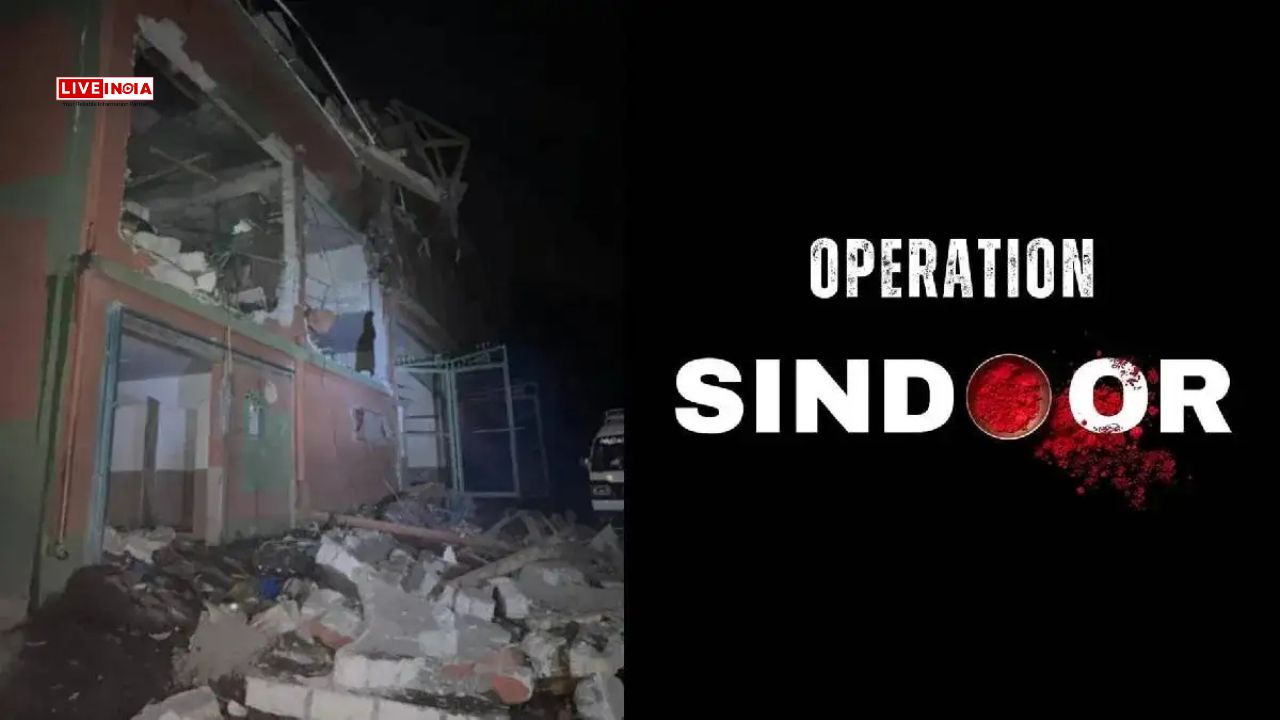
Pakistan's HQ-9 Air Defence Systems Damaged Amid Operation Sindoor; Misinformation Campaign Exposed
May 7, 2025: New Delhi – In a deeply symbolic gesture of national grief and resolve, India named its retaliatory strikes on terrorist camps in Pakistan and Pakistan-Occupied Kashmir ‘Operation Sindoor’ — an emotionally charged reference to the vermilion mark worn by married Hindu women as a symbol of matrimony.
Also Read: Operation Sindoor: “Hope It Ends Quickly” Trump Reacts, UN Calls For Calm
The name honours the 25 women widowed in the April 22 Pahalgam attack, in which 26 civilians — including tourists and a pony handler — were executed after being asked their religion.
The Indian Army’s official artwork for Operation Sindoor shows the word written in bold capital letters, with one ‘O’ shaped like a bowl of spilled vermilion, signifying the brutal erasure of marital bonds and innocence in the attack.
One of the most harrowing images to emerge from the massacre was of newlywed Himanshi Narwal, with her wedding bangles still on, sitting beside the body of her husband, Navy officer Lieutenant Vinay Narwal. Similar stories of heartbreak came from wives like Pallavi Rao, Shital Kalathiya, Sohini Adhikari, Aishanya Dwivedi, and Pragati Jagdale.
Speaking after the strikes, Aishanya Dwivedi said:
“This is a real tribute to my husband. Wherever he is, he’ll be at peace today.”
Sangita Ganbote, widow of Kaustubh Ganbote, added:
“The name itself is a tribute to the sacrifice of our husbands. I thank the Prime Minister for delivering justice.”
Executed at 1:44 AM, the tri-services precision strike was India’s first such coordinated military action since the 1971 war. The Army, Navy, and Air Force struck nine terror bases, avoiding Pakistani military targets while destroying camps operated by Lashkar-e-Taiba, Jaish-e-Mohammed, and Hizbul Mujahideen.
India stated the strikes were “measured and non-escalatory,” but firm in resolve. Intelligence had linked The Resistance Front, a LeT proxy, to the Pahalgam attack.
PM Narendra Modi, who had vowed those responsible would receive “a punishment they cannot imagine,” monitored the operation closely.
“This was not just an attack on tourists — it was an attack on the soul of India,” the PM had said, warning of a calibrated but fierce response.
Following the strikes, Pakistan retaliated with artillery shelling along the Line of Control, killing three civilians in Indian villages. ISPR chief Lt Gen Ahmed Sharif Chaudhary confirmed Indian strikes in Kotli, Muridke, Bahawalpur, Chak Amru, Gulpur, Bhimber, Sialkot, and Muzaffarabad.
Pakistani Prime Minister Shehbaz Sharif condemned the operation as “an act of war,” vowing a forceful response.
Soon after the strikes, the Indian Army posted on X:
“Justice is served. Jai Hind.”
Defence Minister Rajnath Singh echoed:
“Bharat Mata Ki Jai.”
Operation Sindoor is more than a military maneuver — it is India’s tribute to grief, resilience, and justice.
Tags: Operation Sindoor, Pahalgam attack, India Pakistan conflict, Indian Air Force, Lashkar-e-Taiba, Jaish-e-Mohammed, Narendra Modi, S Jaishankar, Indian Army, symbolism in warfare, OperationSindoor,
Sunny Deol and Akshaye Khanna face off in a high-stakes courtroom drama of ethics and…
No refund for Vande Bharat and Amrit Bharat tickets cancelled within eight hours of departure…
Services to four destinations suspended till February 28 over regional security concerns February 3, 2026:…
Eight Opposition MPs suspended after repeated disruptions over national security debate February 3, 2026: The…
Makers consider recast after Deepika Padukone’s exit from Kalki 2898 AD 2 February 3, 2026:…
Former India captain calls award a special moment, vows to keep winning matches for the…