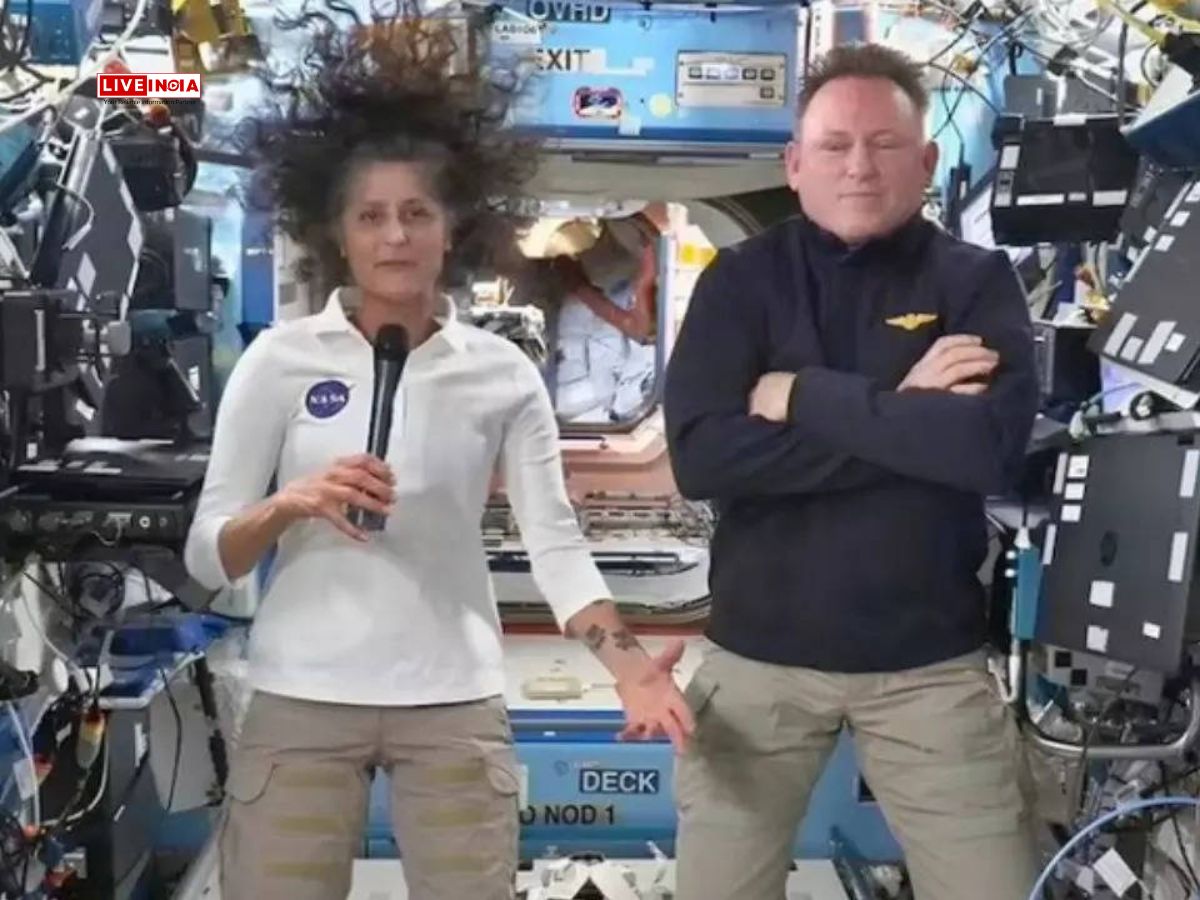
Painful Return Awaits Stranded Astronauts, Sunita Williams and Butch Wilmore: ‘Baby Feet,’ Bone Loss & More
March 16, 2025: After spending an unexpected nine months in space, US astronauts Sunita Williams and Butch Wilmore are set to return to Earth next week—but their homecoming won’t be easy. Originally planned as an eight-day mission, their prolonged stay aboard the International Space Station (ISS) due to technical difficulties has put their bodies through immense stress.
As NASA’s Crew-10 prepares to enter the ISS on Sunday (March 16) after launching from the Kennedy Space Center in Florida aboard the Falcon 9 rocket, experts warn that Williams and Wilmore may face severe physiological challenges upon re-entering Earth’s gravity.
One of the most immediate effects of prolonged weightlessness is “baby feet”, a condition where the soles of an astronaut’s feet become unusually soft and sensitive due to the lack of pressure and friction in space.
Also Read: Trump Authorizes Elon Musk to Rescue Stranded U.S. Astronauts from ISS
On Earth, constant contact with surfaces hardens the soles of our feet, providing protection from pain and wear. However, in space, this hardened skin peels away, leaving behind tender, vulnerable skin. Walking on solid ground after months in microgravity can become an extremely painful process, taking weeks or even months for the feet to toughen up again.
Another major challenge will be bone density loss. NASA studies show that astronauts lose approximately 1% of bone mass per month in space unless rigorous countermeasures, such as resistance exercises, are taken.
Similarly, muscles weaken significantly since they do not have to work as hard in a zero-gravity environment. Everyday movements on Earth—such as standing and walking—require muscular effort, which is absent in space. Upon their return, astronauts often struggle with basic movements, needing rehabilitation to regain full strength.
In space, the absence of gravity also alters blood flow, reducing blood volume and causing fluid retention in the upper body. This can lead to blood clots and pressure-related vision changes, which is why many astronauts develop eyesight problems post-mission.
Fluids that typically drain downward on Earth tend to accumulate in the head and eyes in space, sometimes leading to flattened eyeballs and weakened vision—a phenomenon that has been documented in several returning astronauts.
Beyond the visible physical changes, astronauts face the long-term risk of radiation exposure. Unlike on Earth, where the magnetic field and atmosphere shield humans from harmful cosmic radiation, space travelers are exposed to three types of radiation:
This increased radiation exposure raises concerns about potential DNA damage and long-term health risks, including an increased chance of developing cancer.
While space agencies have developed extensive rehabilitation programs to help astronauts readjust, Sunita Williams and Butch Wilmore’s return will be far from smooth. From painful walking difficulties to weakened bones and muscles, their recovery journey will be a testament to the toll of extended space travel—and a crucial learning experience for future long-duration missions to Mars and beyond.
NASA, Sunita Williams, Butch Wilmore, ISS astronauts, space travel effects, microgravity impact, astronaut rehabilitation, radiation exposure, bone density loss, baby feet, vision impairment, space exploration, Falcon 9, Crew-10
Intercepted drone debris causes minor damage amid rising West Asia tensions March 13, 2026: Explosions…
Unverified reports say Iran’s Supreme Leader was hurt in Tehran airstrike March 13, 2026: Reports…
Single identity proof now enough for passengers booked on the same PNR March 12, 2026:…
Plea challenges case against journalist over alleged WhatsApp remarks on Hindu beliefs March 12, 2026:…
Star spinner to marry childhood sweetheart in Mussoorie after T20 World Cup triumph March 12,…
Actor Gaurav Khanna, who won Bigg Boss 19, has clarified that he has already received…