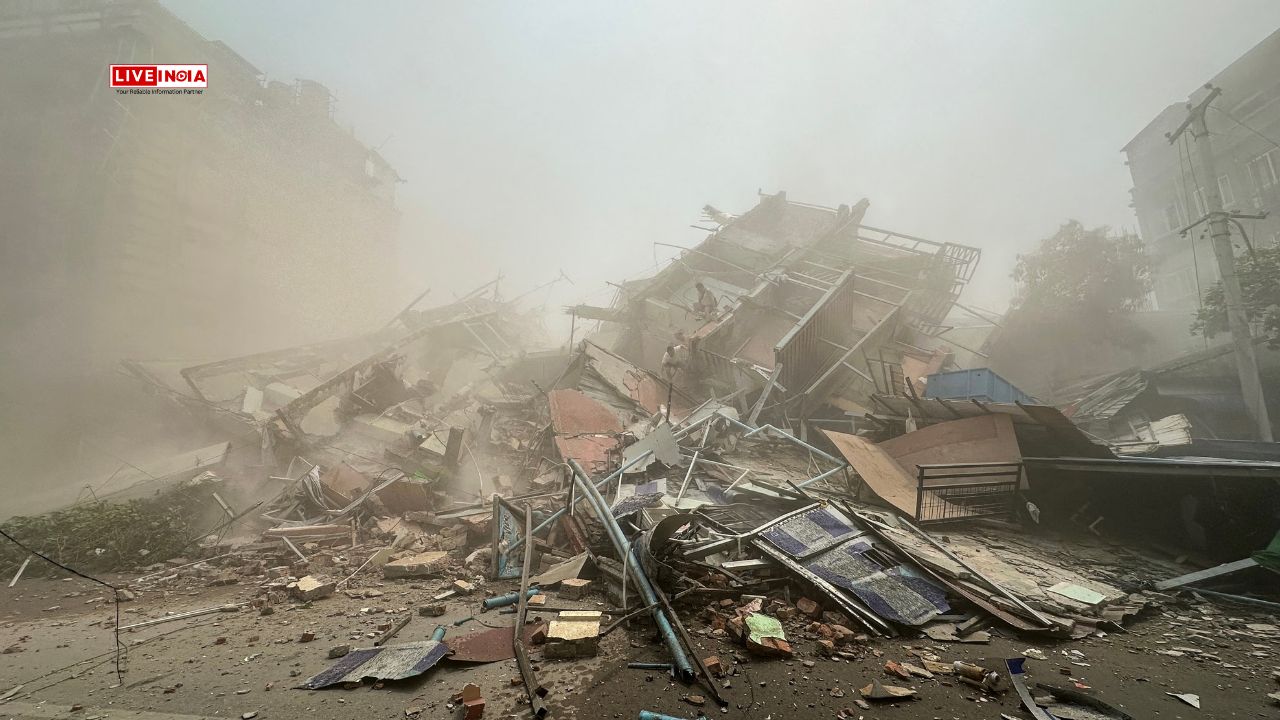
Why Myanmar’s Earthquake Was So Catastrophic: Scientists Explain the Seismic Forces
March 30, 2025: Myanmar’s devastating 7.7-magnitude earthquake, which struck near Mandalay on Friday, has claimed nearly 1,700 lives, injured thousands, and left hundreds missing. With projections from the U.S. Geological Survey (USGS) suggesting the final toll could surpass 10,000, scientists have now explained why this earthquake proved so deadly.
According to geologists, the quake was caused by “strike-slip faulting”—a type of horizontal ground movement—along the boundary between the India and Eurasia tectonic plates. The rupture occurred at a shallow depth of just 10 km, allowing seismic energy to reach the surface almost undiminished, resulting in intense ground shaking and widespread destruction.
The Sagaing Fault, a major fault line that runs 1,200 km across Myanmar, was identified as the likely source. This fault behaves much like California’s San Andreas Fault and has been responsible for several major quakes in the past. “The greater the rupture area, the more intense the earthquake,” explained Rebecca Bell, tectonics expert at Imperial College London.
Unlike a singular “point” on a map, these earthquakes rupture across a broad fault zone. The fault movement in this event is believed to have extended 200 km in length and 20 km in width, amplifying its impact. This, combined with Myanmar’s poorly prepared infrastructure, has hampered rescue efforts and worsened the crisis.
Myanmar has been in political turmoil since the 2021 military coup, with a fragile economy, crumbling health system, and over 3.5 million displaced citizens. These factors have severely limited the country’s ability to respond to natural disasters.
Bridges, roads, and railways have been damaged, further impeding international relief and rescue operations. Hospitals are overwhelmed, and entire communities have been left isolated.
Geologists note that Myanmar is no stranger to strong earthquakes. At least six quakes of magnitude 7 or higher have struck within 250 km of this latest epicenter since 1900. The most recent major event, in 1990, destroyed 32 buildings. A magnitude 7.9 quake in 1912 and a 7.7 quake in 1988 caused similar devastation.
Experts like Roger Musson of the British Geological Survey warn that focusing only on the epicenter is misleading. “The seismic waves emanate along the entire fault line,” he said, adding that the shallow depth and extensive rupture area made this quake exceptionally deadly.
Musson also cautioned that without better urban planning, building standards, and disaster preparedness, future earthquakes in the region could be equally catastrophic.
Myanmar earthquake, 7.7 magnitude quake, Mandalay earthquake, tectonic plates, strike-slip fault, Sagaing Fault, seismic disaster, earthquake science, infrastructure collapse, Myanmar crisis, tectonic movement, disaster response, Asia earthquake history, civil war impact, earthquake prediction
New 90-page law permits domestic discipline, dismantles key protections for women February 19, 2026: Nearly…
PM outlines ethics-led framework at India AI Impact Summit 2026 February 19, 2026: Narendra Modi…
In an exclusive interview on Thursday, February 19, 2026, eliminated contestant Bebika Dhurve hit back…
In a major off-field storm, former Pakistan all-rounder Imad Wasim is facing grave allegations from…
The Mitchell Marsh-led side will head home earlier than expected, but their hopes of competing…
LaMelo Ball, the star point guard for the Charlotte Hornets, emerged unscathed from a dramatic…