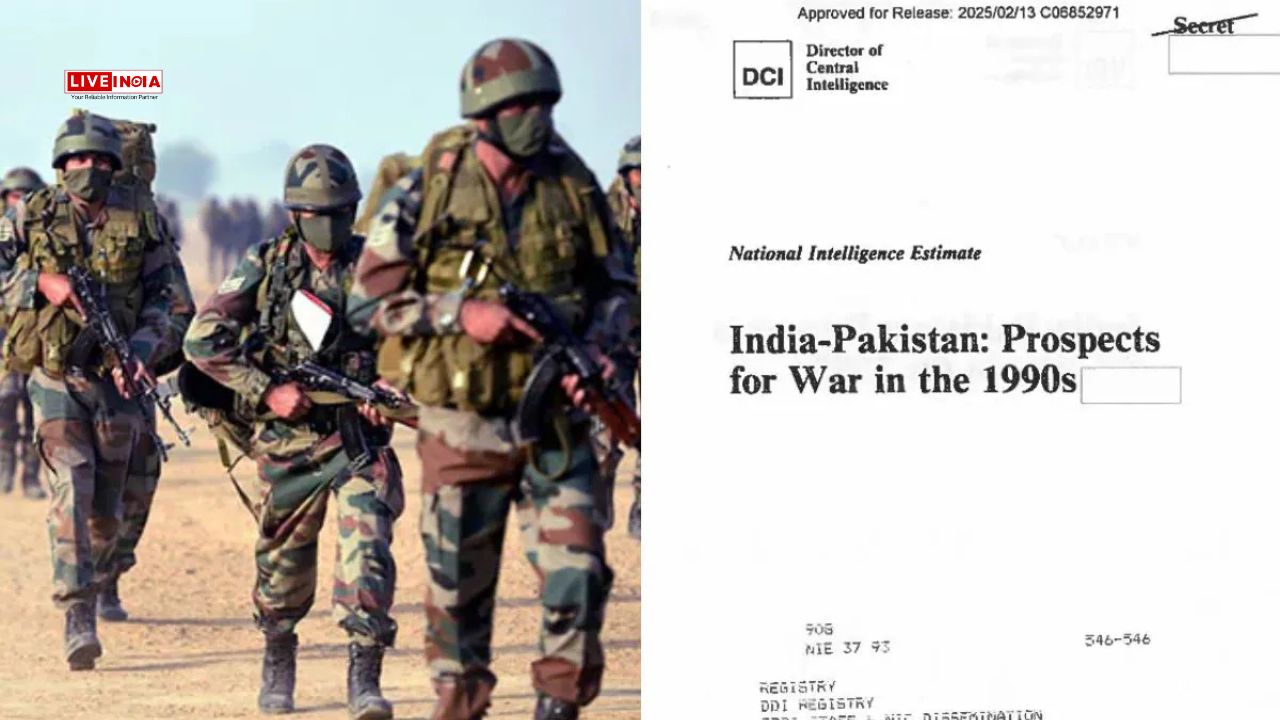
1993 CIA Report Warned of Pakistan’s Deep Fear of India—And Predicted Proxy Wars Over Kashmir
New Delhi, May 1, 2025:
As India reels from the Pahalgam terror attack that left 26 civilians dead, a newly resurfaced declassified CIA document from 1993 offers chilling foresight. The document, a National Intelligence Estimate (NIE) prepared under veteran CIA analyst Bruce Riedel, warned that Pakistan’s fear of India—not military aggression or ideology—was the most dangerous trigger in the region.
Also Read: What Did Jaishankar Say in Call With US Secretary Marco Rubio? Read On
Buried within the now-public assessment is a prediction eerily similar to today’s crisis: a high-impact terror attack could ignite a conflict that neither side wants—with Kashmir as the likely flashpoint.
Drafted at a time of regional instability—post-Babri Masjid in India and rising political chaos in Pakistan—the NIE warned that war was unlikely but not impossible. The document estimated a 20% chance of full-scale war but raised alarms over miscalculations, terror incidents, or communal violence triggering a chain reaction.
Critically, the assessment said Pakistan might sponsor proxy groups to “liberate Kashmir,” using terrorism as a tool of asymmetric warfare. The document does not mention today’s TRF (The Resistance Front), but it aligns with the same strategy once used by Lashkar-e-Taiba, the group linked to the Pahalgam killings.
At the heart of the NIE was this insight: Pakistan fears India’s rise—economically, militarily, and diplomatically. In 1993, India under PV Narasimha Rao and finance minister Manmohan Singh was stabilising and growing. Pakistan, in contrast, battled military coups, economic instability, and radicalisation.
The CIA concluded that this imbalance could push Pakistan toward nuclear brinkmanship or Islamist alliances, not from ideology but desperation. If cornered, Pakistan might “join with militants” to distract the public and provoke India, the report warned.
The NIE wasn’t a secret among spies—it was intended to brief President Bill Clinton and the US State Department. By 2000, when Clinton visited India, the Chittisinghpura massacre in Kashmir—executed by LeT—proved the warning right. The report had predicted a “spectacular terrorist outrage that one side could attribute to the other” could tip the balance.
It also doubted the effectiveness of nuclear pacts or hotlines, saying real-world trust between India and Pakistan was too thin for protocols to matter in crisis.
More than 30 years later, the warnings of the 1993 CIA report feel uncannily relevant. With India taking strong diplomatic measures after Pahalgam—suspending the Indus Waters Treaty, closing border checkpoints, and scaling down missions—Delhi policymakers are revisiting a scenario the CIA outlined decades ago.
What was once analysis now reads like a manual for the present—a stark reminder that while leadership and geopolitics may change, the underlying fears driving nations can endure for generations.
1993 CIA Pakistan report, Pakistan fear of India, CIA declassified NIE, Kashmir conflict prediction, Pahalgam terror attack, Lashkar-e-Taiba, TRF Pakistan, proxy war CIA warning, India Pakistan war risk, Bruce Riedel CIA
Senior party leader Lucky Oberoi killed in daylight attack outside gurdwara, police launch manhunt February…
The powerhouse duo of Neena Gupta and Sanjay Mishra has returned to the silver screen…
Actor says film targets a flawed character, not the Brahmin community, as makers pull promotions…
Women accuse Lalitpur resident of serial marriages, dowry fraud and abandonment February 6, 2026: A…
In a significant development for the upcoming Netflix film Ghooskhor Pandat, lead actor Manoj Bajpayee…
In a revelation that has added a heroic layer to Royal Challengers Bengaluru's (RCB) historic…