
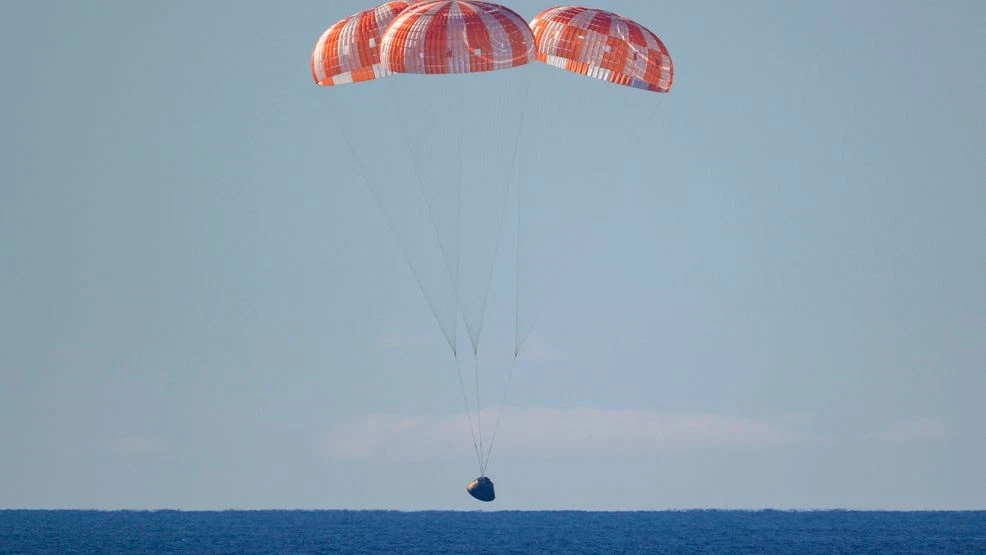


After a historic 10-day journey that pushed the boundaries of human spaceflight, the Artemis II crew safely splashed down in the Pacific Ocean off the coast of San Diego at 5:07 p.m. PDT on Friday (5:37 a.m. IST on Saturday, April 11).
The successful recovery of the Orion spacecraft marks the conclusion of the first crewed lunar mission in over 50 years, paving the way for a permanent human presence on the Moon.
The Final Descent: A Flawless Re-entry
Returning from deep space is one of the most perilous phases of any mission. The Orion capsule faced grueling conditions during its descent:
Extreme Velocity: The spacecraft entered the Earth’s atmosphere at speeds exceeding 30 times the speed of sound (M≈32).
Inferno Temperatures: The heat shield was tested to its limit, withstanding friction-induced heat reaching nearly 5,000°F (2,760°C)—roughly half the surface temperature of the Sun.
The “Blackout” Success: Unlike previous trials, the communication blackout during re-entry ended exactly as predicted, with Mission Control regaining contact with Commander Reid Wiseman as the parachutes deployed.
Mission Accomplishments: A Journey for the Record Books
The mission, which launched on April 1, 2026, achieved several monumental milestones:
The Distance Record: The crew traveled 252,756 miles (406,771 km) from Earth, breaking the 1970 record set by Apollo 13 for the farthest distance humans have ever traveled into space.
Lunar Observations: During their flyby of the Moon’s far side, the astronauts documented thousands of high-resolution images and witnessed rare meteorite impacts on the lunar surface.
Cosmic Coincidence: The crew captured unique footage of a solar eclipse from their vantage point in deep space.
Recovery and Health Status
Following splashdown, the USS John P. Murtha arrived at the scene for recovery operations.
Crew Status: Commander Wiseman reported that the crew is “stable and green,” a technical term indicating they are in excellent health and all systems functioned correctly.
Medical Evaluation: Astronauts Victor Glover, Christina Koch, and Jeremy Hansen are currently undergoing standard medical check-ups on the recovery vessel before being flown back to Houston.
What’s Next for Artemis?
With Artemis II successfully validating the Orion capsule’s life-support and heat-shield systems, NASA will now focus on Artemis III, scheduled for late 2027. That mission aims to land the first woman and the first person of color on the lunar South Pole.
“They’re in great condition… this was the ultimate test of our systems before we go back to land,” — Rob Navias, NASA.