
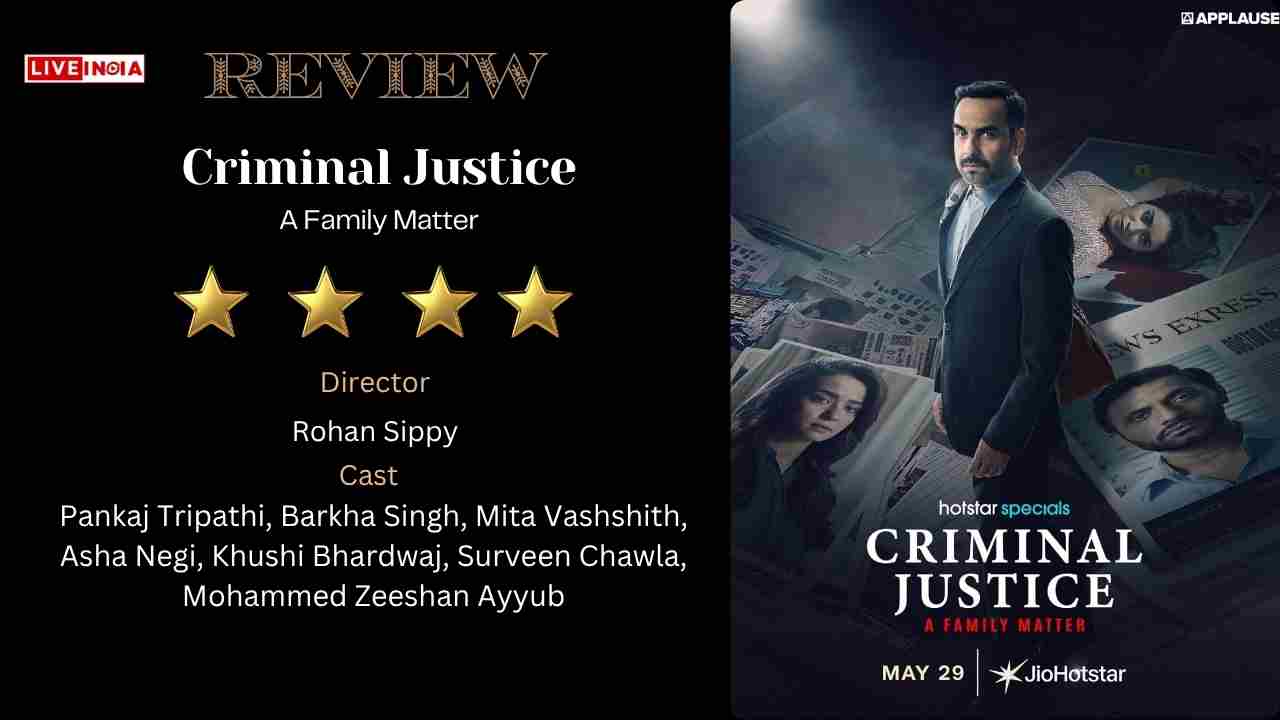


Season 4 of Criminal Justice delves deep into love, betrayal, and family trauma while reaffirming Pankaj Tripathi’s role as the series’ moral compass
The fourth season of Criminal Justice, titled A Family Matter, reaffirms the franchise’s enduring formula while also taking some fresh thematic detours. At the center of it all is Pankaj Tripathi, once again delivering a magnetic performance as Madhav Mishra, the everyman lawyer with a razor-sharp mind and a heart of gold.
Directed by Rohan Sippy and written by a team including Harman Wadala, Sandeep Jain, and Sameer Mishra, this eight-episode season sees Madhav Mishra take on a heart-wrenching case involving a passionate love affair that ends in murder. As courtroom tensions mount, Madhav faces two fierce legal opponents in a battle that’s as much about the law as it is about the messy truths of family.
The story kicks off with the death of Roshini Saluja (Asha Negi), found blood-soaked in the arms of Dr. Raj Nagpal (Mohammed Zeeshan Ayyub), her lover and the prime suspect. Roshini had also been the caretaker of Raj’s daughter Ira (Khushi Bhardwaj), a child with Asperger’s syndrome. With Raj’s estranged wife Anju (Surveen Chawla) convinced of his innocence, she turns to Madhav Mishra to defend him.
The narrative skillfully weaves a dual thread: the legal intrigue of a murder case and the emotional complexity of a family grappling with trauma, betrayal, and the challenges of raising a neurodivergent child. The layers of these intertwined narratives provide a rich canvas for the courtroom drama, even as some of the middle episodes meander.
Pankaj Tripathi is the franchise’s unshakeable backbone. His portrayal of Madhav Mishra is once again a masterclass—equal parts sharp, empathetic, and quietly humorous. His chemistry with assistants played by Barkha Singh and Aatm Prakash Mishra infuses warmth and gentle humor into the proceedings. Khushboo Atre, as Madhav’s supportive wife, provides welcome comic relief and emotional grounding.
Mohammed Zeeshan Ayyub delivers a nuanced performance, capturing the turmoil of a man caught between guilt, grief, and the weight of injustice. Surveen Chawla’s restrained yet powerful portrayal of Anju adds gravitas, while Khushi Bhardwaj’s authenticity as Ira is both moving and believable. Asha Negi brings sincerity to Roshini’s role, though her character arc feels underwritten and emotionally rushed.
The legal face-offs are particularly riveting. Mita Vashisht and Shweta Basu Prasad bring both authority and subtlety to their roles as Madhav’s courtroom adversaries, creating an intellectual chess match that’s captivating to watch. Meanwhile, Kalyanee Mulay stands out as investigating officer Gauri Karmakar, portraying a no-nonsense cop with a relentless quest for the truth.
Rohan Sippy’s direction leans into a restrained, character-centric approach that sidesteps melodrama in favor of emotional realism. The writing team’s decision to tackle heavy themes like infidelity, mental health, and the messy truth of relationships gives this season an emotional depth that sets it apart. However, the pacing stumbles occasionally, especially in the mid-season episodes, as the narrative shifts focus to secondary plotlines.
Yet this slow-burn approach ultimately pays off. The final episodes ramp up the tension, with well-crafted courtroom arguments that challenge the characters’ (and viewers’) assumptions and highlight the show’s commitment to nuanced storytelling.
Criminal Justice: A Family Matter might not be the most breakneck season of the franchise, but it’s certainly one of the most emotionally resonant. It surpasses the previous season, Adhura Sach, in narrative cohesion and depth, prioritizing insight over spectacle. If you’re drawn to layered characters, human flaws, and grounded courtroom drama, this season is a rewarding watch.
For fans of Criminal Justice, this is yet another chapter of smart, empathetic storytelling—and Pankaj Tripathi’s Madhav Mishra remains the soul of it all, reminding us that sometimes the greatest victories come not from winning the case, but from understanding the people involved.