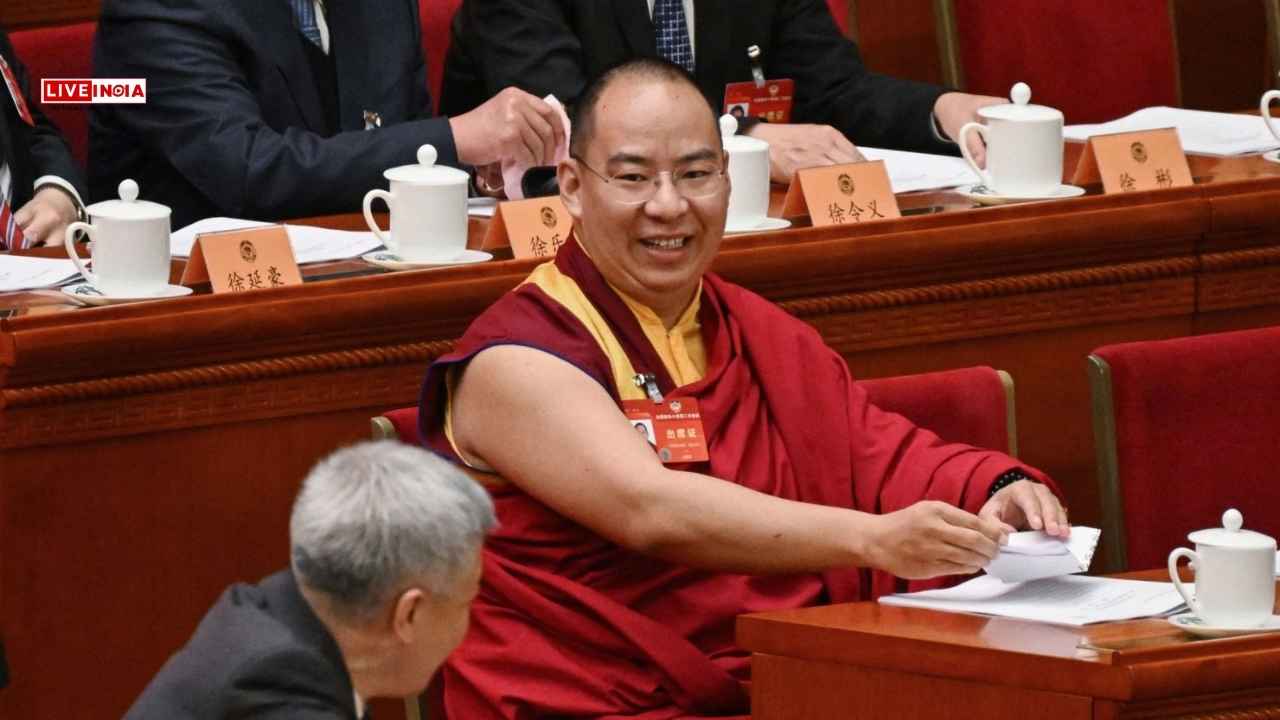
Dalai Lama Succession Row Deepens: Who Is China’s Appointed Panchen Lama Gyaltsen Norbu?
Beijing/New Delhi | July 8, 2025:
The question of who will succeed the 14th Dalai Lama has taken center stage again as Beijing aggressively promotes Gyaltsen Norbu — its appointed 11th Panchen Lama — as the second-highest figure in Tibetan Buddhism. This move continues to draw criticism and concern from the global Tibetan exile community, spiritual leaders, and international observers.
Also Read: Can China Decide the Next Dalai Lama? Here’s What He Says
Gyaltsen Norbu was chosen by the Chinese government in 1995, after rejecting the Dalai Lama’s selection, Gedhun Choekyi Nyima — a six-year-old boy who mysteriously disappeared shortly after his recognition and has not been seen in three decades.
Norbu has since become a prominent public figure in China, aligning closely with the Chinese Communist Party (CCP). He has taken part in high-level political meetings, including a recent gathering with President Xi Jinping, where he pledged allegiance to the party’s objectives of “ethnic unity” and “sinicisation of religion” — a controversial campaign to make Tibetan Buddhism align more closely with Chinese state ideology.
Also Read: India Backs Freedom, But Will It Challenge China on Dalai Lama?
The 14th Dalai Lama, currently based in India, has repeatedly asserted that only the Gaden Phodrang Trust — the institution of the Dalai Lama — holds the legitimate right to recognize his successor. He has also maintained that his reincarnation will not occur within Chinese territory, calling Beijing’s attempts to control Tibetan Buddhism’s future illegitimate and politically motivated.
China, however, has countered with a firm stance. Its Foreign Ministry declared that any succession must “comply with Chinese laws, religious rituals, and historical conventions,” signaling its intent to orchestrate the reincarnation process to retain control over Tibet’s spiritual landscape.
Also Read: India Backs Dalai Lama’s Position On Successor, Contradicting China
Norbu’s recent statements echo Beijing’s narrative. He has publicly vowed to advance the sinicisation of Tibetan Buddhism, uphold Xi Jinping’s teachings, and contribute to the unity of the Chinese nation. Despite his prominence in state media, he lacks acceptance among most ethnic Tibetans, who remain loyal to the Dalai Lama’s spiritual authority.
Experts see Norbu’s elevation as part of China’s long-term plan to manipulate the reincarnation process and prepare for a post-Dalai Lama era — one more favorable to Beijing’s control. Tibetans in exile view this as an attempt to erase cultural and religious autonomy, particularly as the aging Dalai Lama approaches the twilight of his life.
This succession battle holds profound implications not just for Tibet’s future, but for the global struggle between religious freedom and state control.
Dalai Lama, Gyaltsen Norbu, Panchen Lama, Tibetan Buddhism, China Tibet conflict, Sinicisation of religion, Gedhun Choekyi Nyima, Xi Jinping, Tibet succession crisis, religious freedom, Chinese Communist Party
#DalaiLamaSuccession #PanchenLama #Tibet #TibetanBuddhism #GyaltsenNorbu #ReligiousFreedom #ChinaTibetConflict #FreeTibet #GedhunChoekyiNyima #Sinicisation #XiJinping
In a deeply moving interview on the On Purpose podcast on February 5, 2026, singer…
On February 5, 2026, Prime Minister Narendra Modi addressed the Rajya Sabha to reply to…
In a shocking development for fans of the newly launched reality show The 50, veteran…
In a viral Instagram video shared on February 4, 2026, comedian Samay Raina delivered a…
New details have emerged in the investigation of the firing incident outside filmmaker Rohit Shetty’s…
Singer Talwiinder, the enigmatic masked voice behind hits like Khayaal, has finally addressed the whirlwind…