
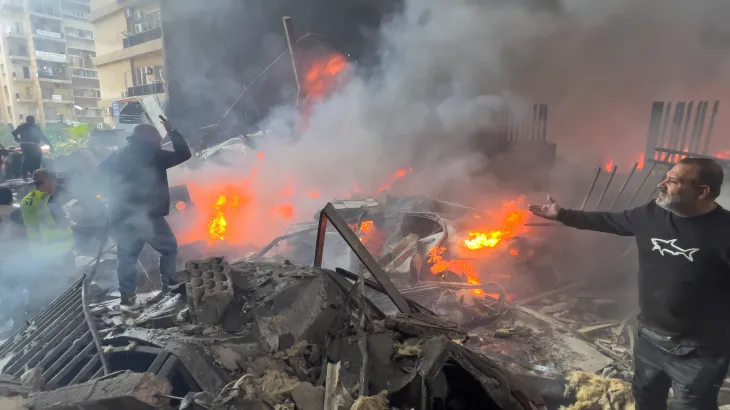


Even as the United States and Iran agreed to a two-week truce covering key conflict issues, Israel continued heavy airstrikes across Lebanon, targeting Hezbollah positions and escalating regional tensions.
Israel Continues Attacks Despite US-Iran Truce
The two-week ceasefire between the United States and Iran has brought a pause to direct hostilities between the two nations, covering critical issues such as the Strait of Hormuz blockade, sanctions, aerial strikes, and wartime losses. The agreement effectively halted five weeks of intense conflict between the two sides.
However, the ceasefire has not translated into calm across the broader region. Israel, while supporting US President Donald Trump’s decision to suspend strikes against Iran, has continued military operations in Lebanon, launching fresh and powerful attacks near Beirut.
Israeli officials clarified that the ceasefire agreement with Iran does not extend to Lebanon, where operations against the Iran-backed Hezbollah remain active.
Why Israel Is Attacking Lebanon
On Wednesday, Israeli forces carried out their heaviest strikes in Lebanon since the current conflict began last month. According to reports, more than 100 Hezbollah command centres and military installations were targeted across Beirut.
The scale and intensity of the strikes reminded many residents of the Israeli invasion of Beirut in 1982, one of the most significant military operations in Lebanon’s modern history.
The attacks reportedly came without warning, triggering widespread panic. Residents fled streets as explosions rocked neighbourhoods, while motorists honked to clear roads for emergency movement.
A Beirut resident, Yasser Abdallah, described the chaos and devastation following the strikes.
“I saw the blast, it was very strong, and there were children killed, some with their hands cut off,” he said while speaking to AFP.
Israel Says Ceasefire Does Not Apply To Lebanon
Israeli leadership has made it clear that the ceasefire agreement does not cover military activity in Lebanon.
Israeli Prime Minister Benjamin Netanyahu confirmed that operations against Hezbollah would continue despite the US-Iran truce.
Meanwhile, Israeli military spokesperson Avichay Adraee reiterated this position in an official statement.
“The battle in Lebanon continues, and the ceasefire does not include Lebanon,” he said.
At the same time, Iranian state-linked Fars News Agency warned that Tehran could withdraw from the ceasefire if Israeli attacks on Lebanon persist.
Iran’s Foreign Minister Abbas Araghchi also raised concerns about Israel’s actions during a phone call with General Asim Munir, Pakistan’s army chief.
Evacuations And Expansion Plans In Southern Lebanon
Israel had earlier issued evacuation orders covering nearly 15% of Lebanese territory since March 2. These orders mainly targeted areas in southern Lebanon and suburbs south of Beirut.
Israeli authorities have stated that they aim to establish a security zone extending up to the Litani River, which they believe is necessary to protect northern Israeli communities from cross-border attacks.
Rising Casualties And Massive Displacement
The continued strikes have resulted in severe human losses and displacement.
According to available reports:
- More than 1,500 people have been killed in Israel’s air and ground operations across Lebanon.
- Among the victims were over 130 children and more than 100 women.
- Over 1.2 million people have been displaced due to ongoing conflict.
By late March, sources told Reuters that more than 400 Hezbollah fighters had been killed in Israeli operations.
Israel, meanwhile, reported that 10 of its soldiers were killed in southern Lebanon during the same period.
Hezbollah Conflict Continues Despite Iran Ceasefire
The latest escalation marks the biggest blow to Hezbollah since a major incident in September 2024 Hezbollah pager explosions, when thousands of communication devices used by the group exploded simultaneously.
The current conflict in Lebanon began on March 2, when Hezbollah launched rockets into Israel in solidarity with Iran, triggering Israeli retaliation and expanded military operations.
With Israel continuing its strikes despite the broader US-Iran truce, regional stability remains uncertain, raising fears that the conflict could widen further across the Middle East.