
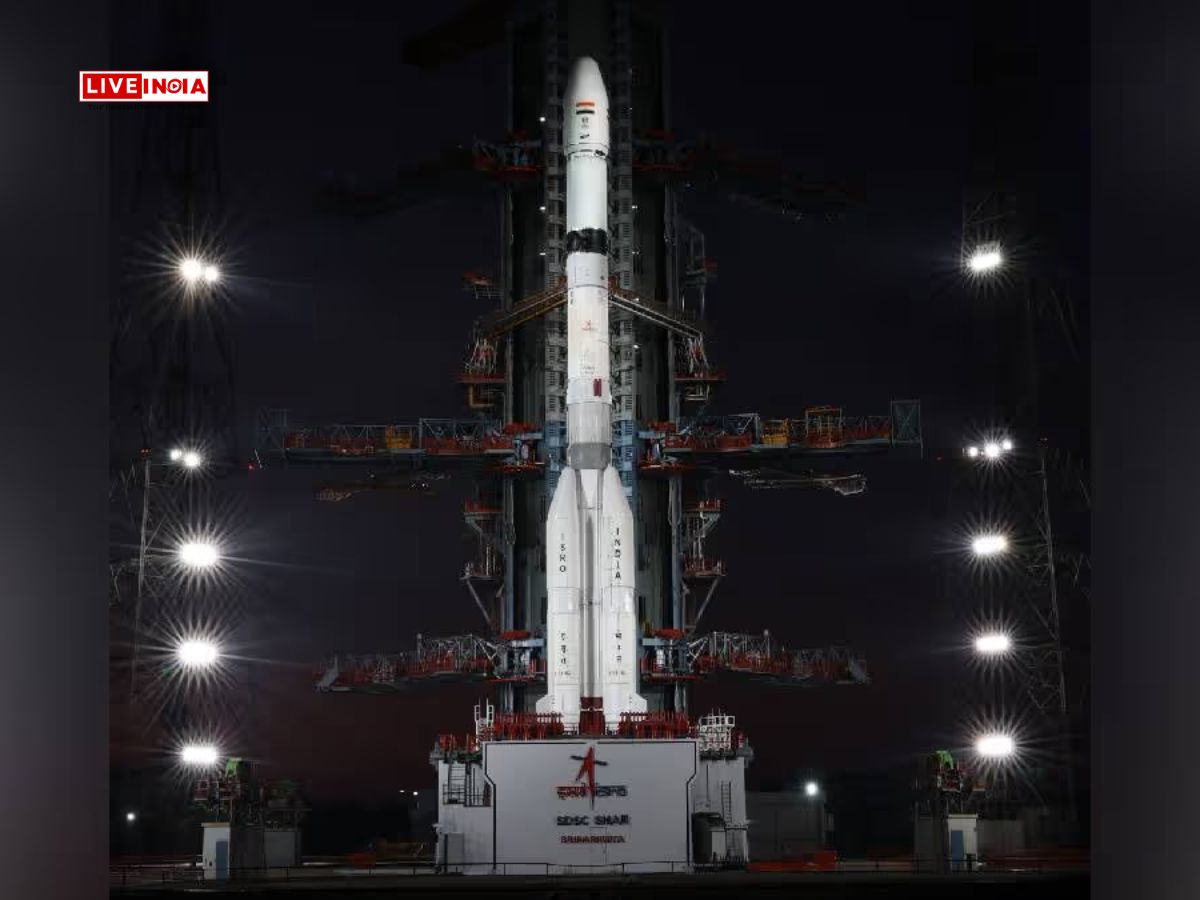


The GSLV rocket, carrying the NVS-02 satellite, marks ISRO’s milestone 100th mission, enhancing India’s navigation capabilities under NavIC.
January 28, 2025: The Indian Space Research Organisation (ISRO) has begun the countdown for its landmark 100th mission from the Satish Dhawan Space Centre in Sriharikota, Andhra Pradesh. Scheduled for January 29, 2025, at 6:23 am, the Geosynchronous Satellite Launch Vehicle (GSLV) rocket will carry the NVS-02 navigation satellite, showcasing India’s prowess in space technology.
Also Read: Satellites Prepare for Space ‘Handshake’! ISRO’s SpaDeX Mission On Verge of History
The 27-hour countdown commenced at 2:53 am on January 28, setting the stage for this historic launch. This mission is also the first under ISRO’s new chairman, V. Narayanan, who assumed office earlier this month.
Also Read: V Narayanan Appointed as New ISRO Chief: Set to Succeed S Somanath on January 14
About the GSLV Mission
The GSLV-F15 rocket, with an indigenous cryogenic upper stage, is embarking on its 17th flight. The navigation satellite NVS-02 is the second in the Navigation with Indian Constellation (NavIC) series, designed to enhance positioning, velocity, and timing services across the Indian subcontinent and up to 1,500 km beyond.
Standing at 50.9 meters tall, the GSLV-F15 follows the success of the GSLV-F12 mission in May 2023, which carried the NVS-01 satellite, the first of NavIC’s second-generation satellites.
The NVS-02 satellite, developed by the U R Rao Satellite Centre, weighs approximately 2,250 kg and features advanced payloads in L1, L5, S, and C bands.
Key Applications of NVS-02 Satellite
According to ISRO, the NVS-02 satellite will serve various critical applications, including:
- Terrestrial, aerial, and maritime navigation
- Precision agriculture
- Fleet management
- Location-based mobile services
- Orbit determination for satellites
- Internet of Things (IoT) applications
- Emergency and timing services
NavIC, which consists of five second-generation satellites, aims to augment India’s navigation capabilities, ensuring continuity of services with enhanced features.
The 100th mission is a monumental step for ISRO, solidifying its legacy of innovation and excellence in space exploration while addressing key national and global challenges.
Tags:
ISRO 100th mission, GSLV launch, NVS-02 satellite, NavIC system, V. Narayanan, Indian space technology, navigation satellite, India space advancements