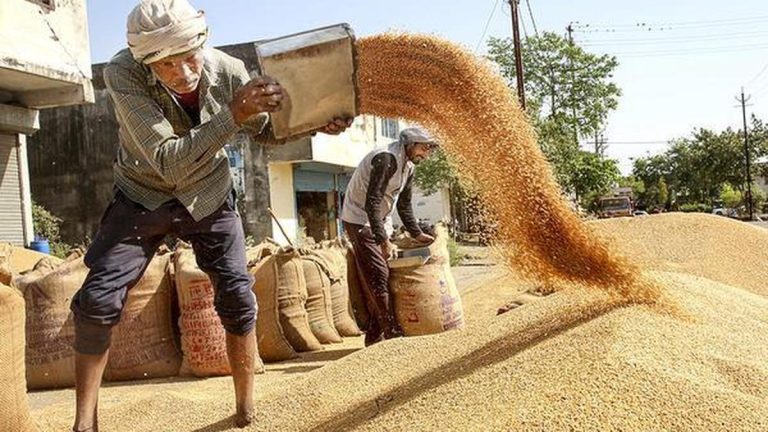
Government claims of farmer relief in Madhya Pradesh are increasingly being questioned as delayed procurement, falling wheat prices, and rigid loan repayment rules have pushed nearly 6.2 lakh farmers into debt.
While the state government has announced zero-interest crop loans and procurement at Minimum Support Price (MSP), farmers on the ground say that the system is failing them at the most critical phase of the harvest cycle.
At the Karond Mandi in Bhopal, farmers bringing wheat are facing severe distress. The MSP for wheat this season has been fixed at Rs 2,625 per quintal, along with an additional Rs 40 bonus by the state government. However, traders are offering only between Rs 2,000 and Rs 2,200 per quintal.
With procurement yet to fully begin across all regions, farmers say they are being forced to sell at lower prices to meet urgent financial commitments.
Procurement Delays Add To Farmers’ Financial Stress
The procurement process itself has worsened the crisis. While procurement started on April 9 in select divisions such as Indore division, Ujjain division, Bhopal division, and Narmadapuram division, it is scheduled to begin only on April 15 in other areas — a delay of nearly 25 days compared to last year.
Farmers say the delay has made it difficult to repay loans on time.
Jagdish Gurjar from Sehore said the situation has affected entire villages.
“We don’t have any cash. We will only get money and be able to repay our loans once our grain is sold. I am a defaulter, and in fact, our entire village has become defaulters,” he said.
Similarly, Bikram Singh Gurjar from Azmat Nagar highlighted the growing pressure from financial commitments.
“We will incur overdue charges on our loans. There are weddings and ceremonies coming up in our households, and this situation will create significant difficulties,” he added.
Farmers Fear Turning To Private Moneylenders
For many farmers, the consequences have become severe, forcing them to consider private borrowing.
Devraj Gurjar from Imaliya said the delay in wheat procurement has left him with no alternative.
“I am a defaulter because the government hasn’t purchased our wheat and nothing can move forward until the grain is sold. Where are we supposed to get loans now? We will be forced to turn to private moneylenders,” he said.
He added that with wheat selling at Rs 2,100–Rs 2,200 per quintal, sustaining household expenses has become extremely difficult.
A similar situation has been reported at the Agar Malwa Mandi in the Ujjain division, where farmers like Kamal Gurjar and Shobhan Singh said mounting debt is becoming unmanageable.
“The debt amounts to Rs 2–3 lakh. We will end up paying interest upon interest. If procurement had been carried out earlier, it would have been to our advantage,” Kamal Gurjar said.
Shobhan Singh added that prices in mandis have dropped well below expectations.
“The government had promised Rs 2,700 per quintal, but fixed it at Rs 2,500. In the mandi, it is dropping to Rs 2,000 and Rs 2,200,” he said.
Traders Cite Moisture Levels And Market Rates
Traders, however, attribute lower prices to quality issues and market dynamics.
Vijay Kothari, a trader at the mandi, explained that moisture content in wheat affects pricing.
“The produce arriving right now varies in moisture. Some is wet, some is dry. The average rate is around Rs 2,300. Produce with higher moisture fetches lower prices. Traders set rates based on mill prices,” he said.
Loan Deadlines Increasing Financial Pressure
Banking data reflects the growing financial strain among farmers. Those who fail to repay loans by March lose eligibility for zero-interest benefits and face higher interest rates.
Ashok Kumbhakar, a cooperative credit society manager, explained the structure.
“The due date for Kharif loans is March 28. If repayment is not made in March, 6 per cent interest applies, and by April it rises to 12 per cent. If the loan becomes overdue, the farmer cannot avail interest waiver benefits,” he said.
Data shows nearly Rs 450 crore remains unpaid across 55 districts, with about 80 per cent of defaulters being small farmers.
Meanwhile, 19.04 lakh farmers have registered for procurement this year, with a procurement target of 78 lakh metric tonnes. However, procurement progress has remained slow so far.
Political War Intensifies Over Procurement Delays
The issue has triggered a political confrontation between the ruling and opposition parties.
State chief of BJP Kisan Morcha, Jaipal Singh Chavda, said delays were caused by logistical challenges.
“Given the global scenario, specifically the shortage of gunny bags, there has been a delay in procurement. The government is addressing the issue and will resolve these challenges,” he said.
However, Jitu Patwari from the Indian National Congress sharply criticised the government.
He alleged that large quantities of wheat were sold in the open market at significantly lower prices.
“1.5 million quintals of wheat were sold between Rs 1,800 and Rs 2,000, causing losses of Rs 600 per quintal to farmers. You could not even arrange gunny bags on time. What bigger example of incompetence is there?” he said.
Farmers Say Crisis Is About Survival, Not Policy
For farmers across Madhya Pradesh, the crisis has moved beyond policy announcements to everyday survival. Delays in procurement, falling prices, and mounting penalties have widened the gap between government promises and ground realities.
As procurement continues to lag and financial penalties increase, farmers fear deeper debt cycles — raising concerns about long-term economic stability in rural regions.