
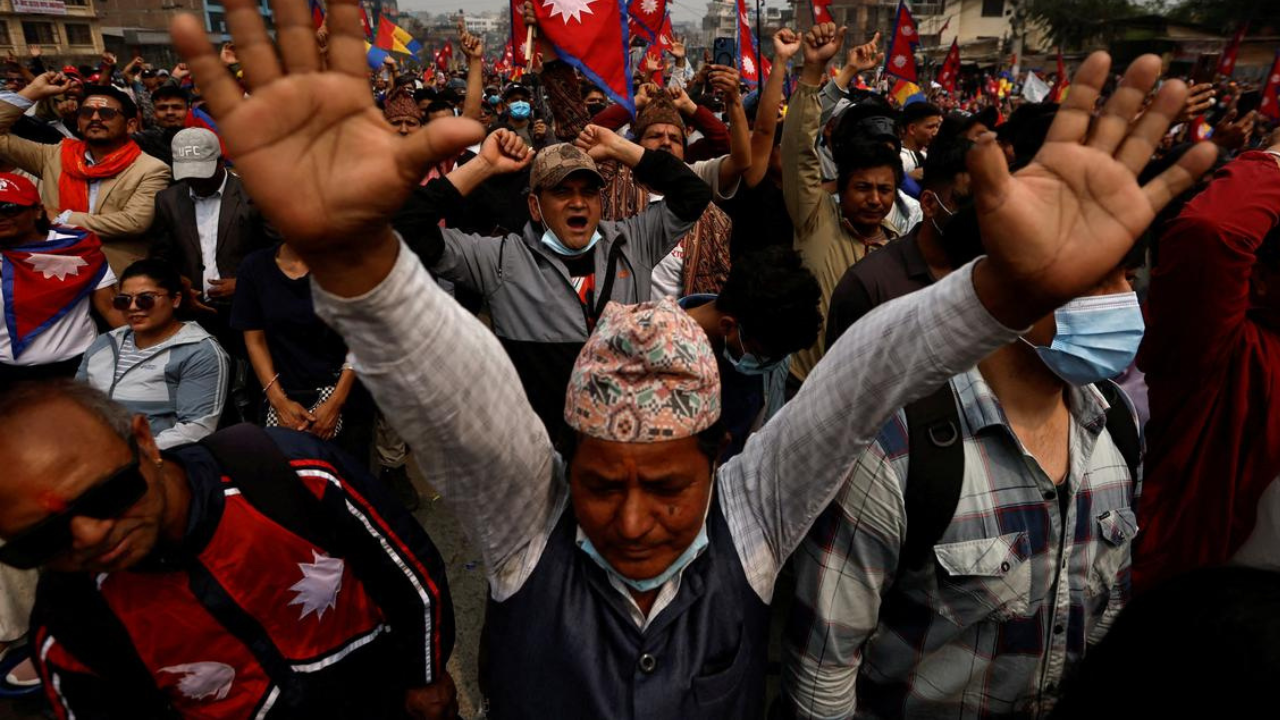


May 2, 2025: Amid a resurgence in royalist sentiment, the Nepal government has reaffirmed its commitment to the federal democratic republican system and expressed its intent to move forward with a constitution amendment process based on national consensus.
In a joint session of the Federal Parliament, President Ram Chandra Paudel, presenting the annual plans and policies of the KP Sharma Oli-led government, announced the constitution would undergo a review aimed at strengthening governance and correcting its weaknesses. The initiative seeks to safeguard democratic gains achieved through the people’s struggles and sacrifices.
“This government is determined to protect the far-reaching achievements brought about by the sacrifices, struggles, and movements of the Nepali people,” President Paudel declared, indirectly referencing the growing royalist movement. He emphasized that the amendment would not dismantle but reinforce the strengths of the constitution while addressing its shortcomings through a consensual approach.
The government’s announcement follows a violent pro-monarchy demonstration in Kathmandu on March 28, which resulted in two fatalities and widespread vandalism. The Rastriya Prajatantra Party (RPP), a long-standing pro-monarchy and pro-Hindu state advocate, has been at the forefront of the renewed call for the reinstatement of kingship. Following the violence, over a dozen RPP leaders and cadres were arrested.
The RPP, which traces its roots back to the 1990s post-monarchy era, has fluctuated in political strength—gaining 8 seats in the 2008 Constituent Assembly, 13 in 2013, 1 in 2017, and 14 in 2022. Despite the monarchy’s abolishment in 2008, the party continues to argue for the restoration of the Hindu state and monarchy, calling the two interconnected pillars of Nepal’s identity.
Nepal, with a population of 30.55 million, remains overwhelmingly Hindu (81.19% as per the 2022 census). The monarchy, particularly under the Shah dynasty, had long held religious and cultural significance, with the monarch regarded as an incarnation of Lord Bishnu.
The country’s transition to a republic was formalized on May 28, 2008, following the People’s Movement II, which forced then-King Gyanendra Shah to relinquish power after his controversial 2005 royal coup. The uprising, which led to 18 deaths and over 4,000 injuries, marked the end of a two-century-old monarchy and ushered in secular, republican governance.
Despite these shifts, royalist factions continue to exert influence, revealing a nation still grappling with its identity and future political structure. The government’s latest move to amend the constitution aims to stabilize the current system while attempting to bridge deepening societal divides.