Operation Sindoor: Inside India’s Strike on Terror Strongholds from Bahawalpur to Kotli
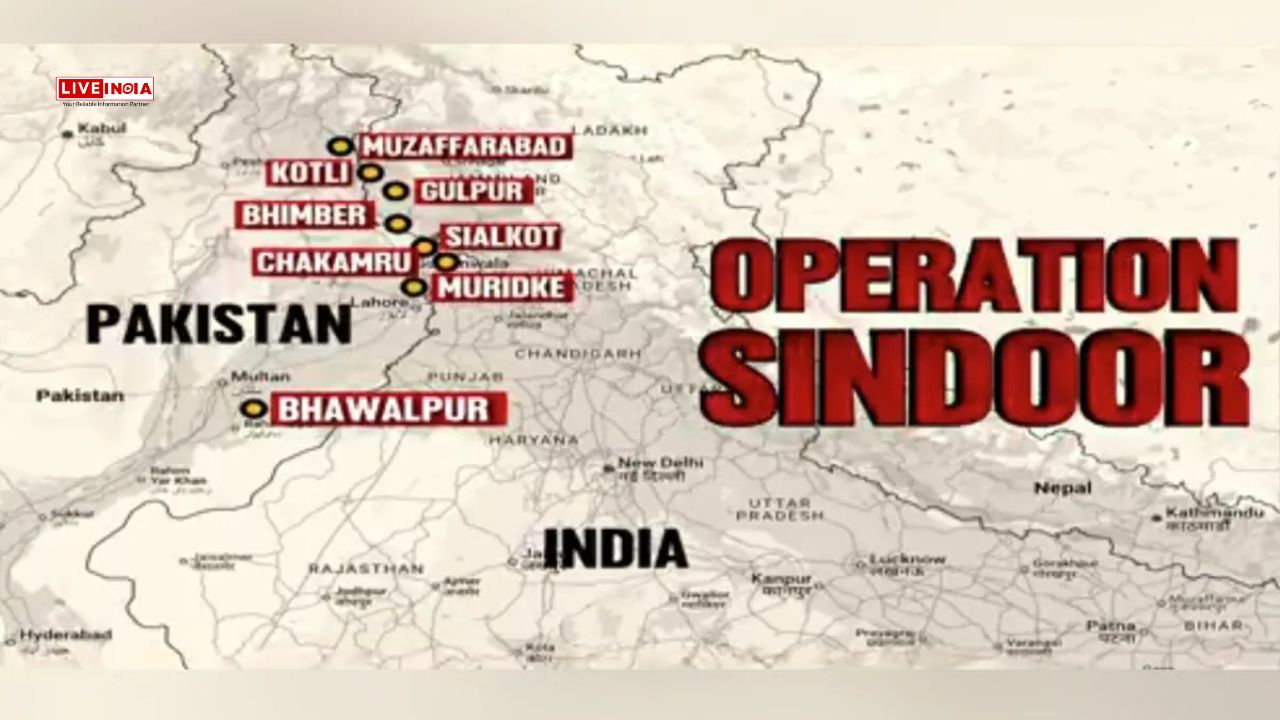
May 7, 2025: New Delhi – In a decisive and unprecedented military action following the Pahalgam terror attack that claimed 26 civilian lives, India launched Operation Sindoor in the early hours of Wednesday. The tri-services offensive, involving the Army, Navy, and Air Force, targeted nine terror-affiliated sites across Pakistan and Pakistan-Occupied Kashmir (PoK) with precision long-range standoff weapons.
This strategic response marks India’s most significant cross-border strike since the 2016 Uri retaliation and the 2019 Balakot airstrikes.
All nine sites selected had documented links to terror networks like Lashkar-e-Taiba (LeT), Jaish-e-Mohammed (JeM), and Hizbul Mujahideen (HM), and were chosen after thorough intelligence assessments.
Home to Jaish-e-Mohammed, led by Masood Azhar, Bahawalpur has been a key planning and indoctrination centre for major attacks on Indian soil, including the 2001 Parliament attack and 2019 Pulwama bombing.
Located near Lahore, Markaz Taiba in Muridke is the central base of LeT and its front Jamaat-ud-Dawa, sprawling across 200+ acres. It’s widely known as the training ground for the 26/11 Mumbai attackers.
“Tears of Justice”: Families of Pahalgam Terror Victims Hail Operation Sindoor
Two facilities in Kotli – Markaz Abbas (JeM) and Maskar Raheel Shahid (HM) – were identified as training grounds for suicide bombers and insurgents.
Acting as a staging base for attacks in Rajouri and Poonch, this camp has been under Indian surveillance since 2023 for its repeated use as an infiltration launch site.
Linked to recent attacks in Kashmir’s Sonmarg, Gulmarg, and Pahalgam, this camp served as a tactical training facility for LeT recruits.
These areas functioned as entry points for cross-border insurgents moving into India via LoC breaches.
Used by remnants of Hizbul Mujahideen, the camp in Mehmoona continued low-scale training activities with support from regional sympathisers.
An advanced operations base tied to Jaish activities in the Kashmir Valley.
At 1:44 AM, India executed the strikes with synchronized precision, ensuring no Pakistani military infrastructure was hit, focusing exclusively on terror-linked targets. This is the first tri-services offensive of such scale since the 1971 Indo-Pak war.
In the aftermath, Indian officials launched a diplomatic outreach, briefing global powers including the US, UK, Russia, Saudi Arabia, and the UAE about the legitimacy and necessity of the operation.
Tags: Operation Sindoor, India Pakistan, Pahalgam attack, Bahawalpur, Kotli, Muridke, Lashkar-e-Taiba, Jaish-e-Mohammed, Hizbul Mujahideen, Indian Army, terrorism, surgical strikes, PahalgamTerrorAttack,
Sunny Deol and Akshaye Khanna face off in a high-stakes courtroom drama of ethics and…
No refund for Vande Bharat and Amrit Bharat tickets cancelled within eight hours of departure…
Services to four destinations suspended till February 28 over regional security concerns February 3, 2026:…
Eight Opposition MPs suspended after repeated disruptions over national security debate February 3, 2026: The…
Makers consider recast after Deepika Padukone’s exit from Kalki 2898 AD 2 February 3, 2026:…
Former India captain calls award a special moment, vows to keep winning matches for the…