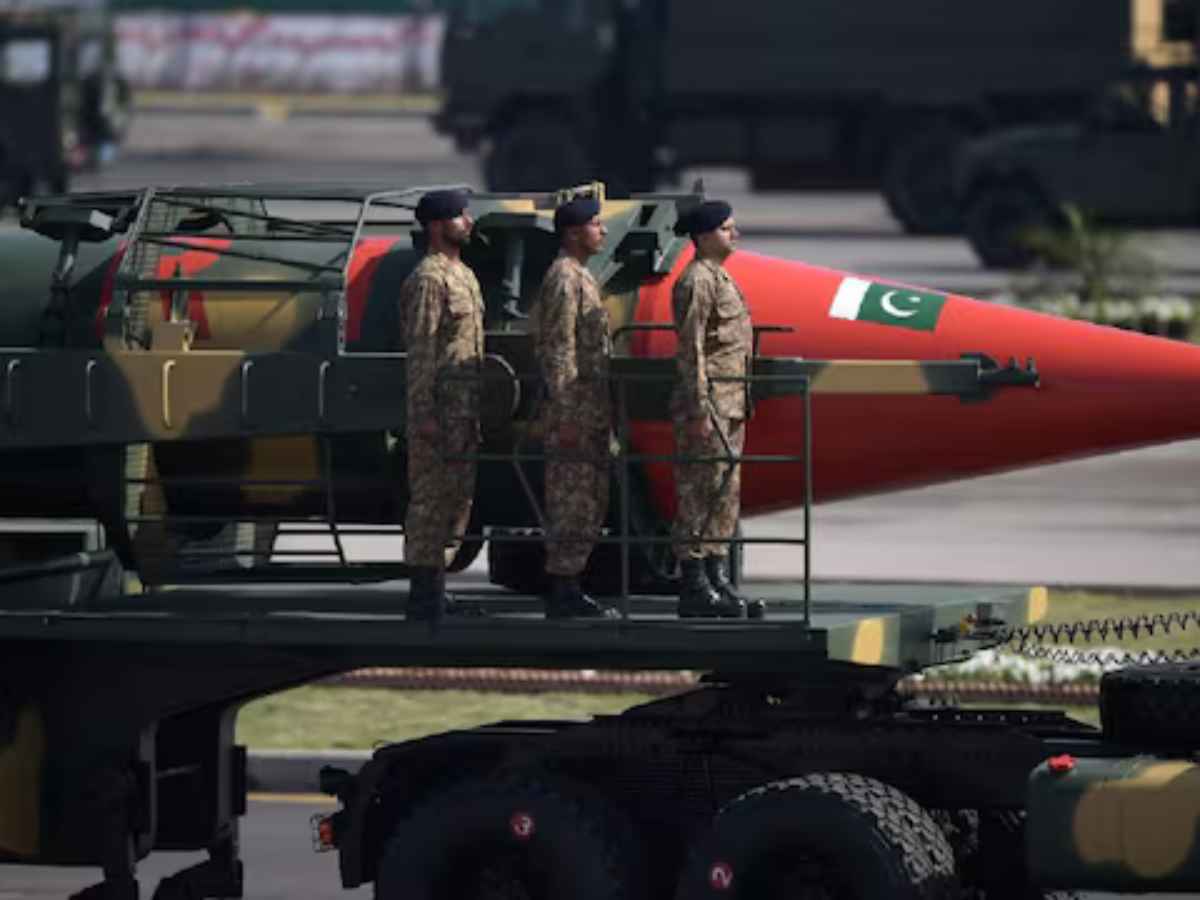
Pakistan Secretly Developing Nuclear Ballistic Missile That Is Capable of Targeting US
June 25, 2025: Pakistan is reportedly developing a nuclear-capable intercontinental ballistic missile (ICBM) with potential range to strike the United States, according to U.S. intelligence assessments published by Foreign Affairs. The revelation has raised alarm bells in Washington and may significantly alter the nature of U.S.-Pakistan relations.
Quoting senior U.S. officials, the report states: “If Pakistan acquires an ICBM, Washington will have no choice but to treat the country as a nuclear adversary. No country with ICBMs targeting the U.S. is considered a friend.”
Historically, Pakistan has positioned its nuclear program as a deterrent against India. Its existing arsenal includes short- and medium-range ballistic missiles like the Shaheen-III, capable of reaching targets up to 2,700 kilometers—enough to cover key Indian cities.
However, the pursuit of ICBMs suggests a shift in Pakistan’s defense posture, expanding beyond regional deterrence. ICBMs, capable of traveling over 5,500 kilometers, would put major U.S. cities within striking distance, potentially reclassifying Pakistan in the eyes of American strategic planners.
According to the U.S. World Threat Assessment, Pakistan may be receiving material and technological support from China to advance its weapons of mass destruction (WMD) capabilities. The report adds context to recent tensions following India’s Operation Sindoor, during which the Indian military struck deep into Pakistani territory, destroying terror camps and military targets.
The heightened threat perception in Islamabad, say analysts, may be prompting a strategic push to deter both regional and international intervention—particularly from the United States.
The United States has already sanctioned Pakistan’s National Development Complex (NDC) and three affiliated entities for their role in developing long-range missile systems. These sanctions include freezing U.S.-based assets and restricting trade.
Despite Islamabad’s protest against the sanctions as “biased,” the U.S. maintains the actions are based on solid evidence of Pakistan acquiring sensitive technology for long-range ballistic weapons.
Pakistan, with an estimated 170 nuclear warheads, is not a signatory to the Nuclear Non-Proliferation Treaty (NPT), raising further concerns about the opacity of its weapons program.
India has called for international monitoring of Pakistan’s nuclear arsenal, especially in the wake of reports that Islamabad attempted to use hypersonic Fatah-II missiles during Operation Sindoor. While these were intercepted by India’s air defense, the incident has intensified calls for oversight by agencies like the International Atomic Energy Agency (IAEA).
Indian Defence Minister Rajnath Singh recently stated that Pakistan cannot be trusted with nuclear weapons, emphasizing the need for international vigilance.
If Pakistan continues on the path toward acquiring ICBM capabilities, it risks not only triggering a new arms race in South Asia but also isolating itself further on the global stage. The coming months will likely witness increased scrutiny, diplomatic pressure, and possibly new rounds of sanctions.
Akshay Kumar, Ektaa Kapoor tease Priyadarshan reunion film February 25, 2026: Bollywood star Akshay Kumar…
Passengers question lack of communication during Mumbai-Delhi hold-up February 25, 2026: Passengers aboard Air India…
Team management weighs batting reshuffle ahead of crucial clash February 25, 2026: Team India’s batting…
Supreme Court objects to chapter on ‘corruption in judiciary’, CJI says integrity won’t be tainted…
Shahid Kapoor–Triptii Dimri film outpaces Assi and Mardaani 3 in daily numbers but lags behind…
Admits ‘huge mistake’, says he did nothing illegal February 25, 2026: American tech entrepreneur Bill…