
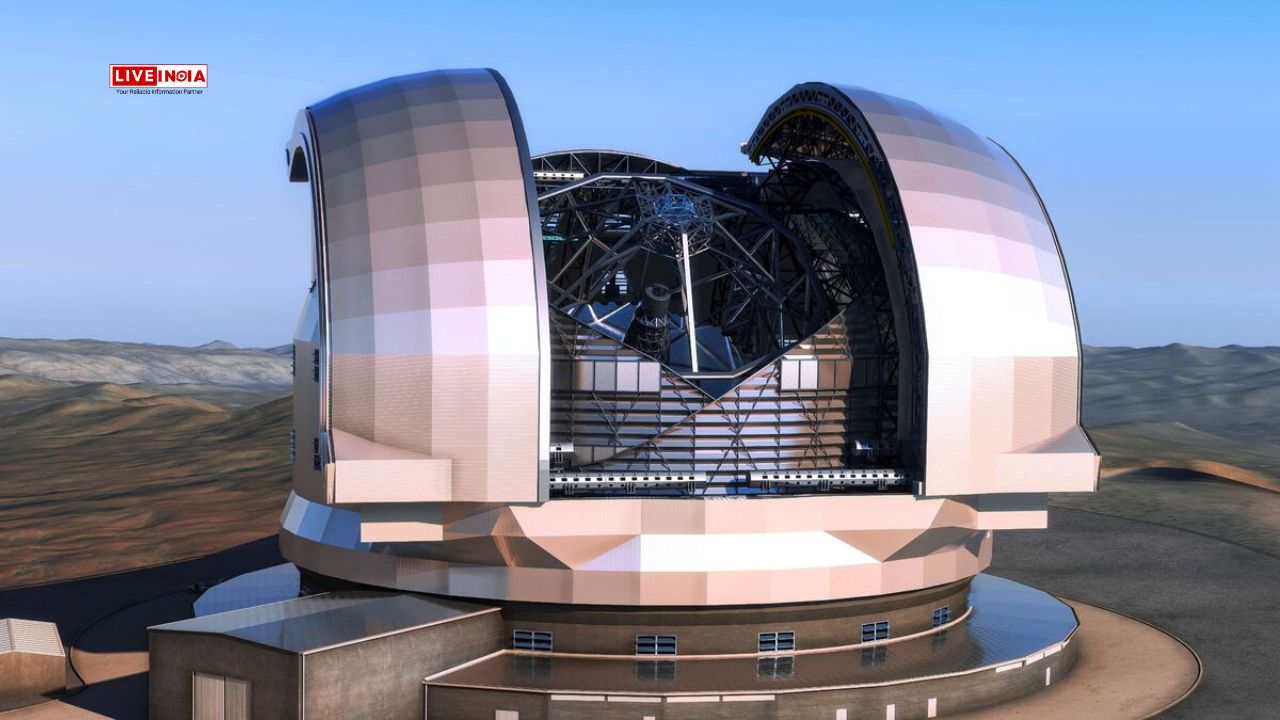


The Extremely Large Telescope (ELT), set to begin operations by 2029, may identify biosignatures on nearby exoplanets like Proxima Centauri b in just one hour
April 4, 2025: New ELT Telescope Could Detect Alien Life Within Hours, Transforming Cosmic Understanding
A groundbreaking telescope being built in Chile may soon redefine humanity’s search for alien life. According to a recent study by researchers from the University of Washington and NASA’s Goddard Space Flight Center, the upcoming Extremely Large Telescope (ELT) could detect signs of life on planets orbiting nearby stars — in mere hours.
Also Read: Why Myanmar’s Earthquake Was So Catastrophic: Scientists Explain the Seismic Forces
The study highlights that ELT, upon completion, could potentially identify biosignatures — chemical markers indicating possible life — on exoplanets like Proxima Centauri b, Earth’s nearest planetary neighbor, in as little as one hour of observation.
Also Read: Saturn’s Iconic Rings to ‘Vanish’ Tonight: Rare Celestial Illusion Stuns Stargazers
“It may also be possible to discriminate uninhabited worlds and rule out biosignature false positives by identifying contextual indicators,” the study noted.
How Will ELT Work?
The ELT is designed to study both transiting and non-transiting planets. It will examine starlight passing through a planet’s atmosphere and also detect reflected light from non-transiting worlds, unlocking crucial details about their composition and potential habitability.
Also Read: God Is Real! Claims Harvard Scientist, Presents Mathematical Formula as Proof
This capability offers a major leap in space exploration, as ELT could be the first observatory capable of studying atmospheres of non-transiting terrestrial exoplanets.
Construction Timeline
Despite construction delays, the first light — when the telescope sees the sky for the first time — is expected in March 2029. Scientific observations will likely begin by December 2030, following the installation and testing of advanced instruments.
ELT’s colossal 39.3-metre-wide primary mirror, made of 798 precisely aligned segments, will be housed in a dome 87 metres wide and 22 storeys tall. The building will rotate with extreme precision to capture and track celestial objects, offering 16 times sharper images than the Hubble Space Telescope.
As humanity edges closer to possibly answering the age-old question — “Are we alone in the universe?” — the ELT promises to be one of our most powerful tools in that search.
Tags:
ELT, alien life detection, Proxima Centauri b, biosignatures, University of Washington, NASA Goddard, ESO, exoplanet atmospheres, Chile observatories, space exploration, new telescope technology, Extremely Large Telescope, Proxima Centauri, extraterrestrial life