
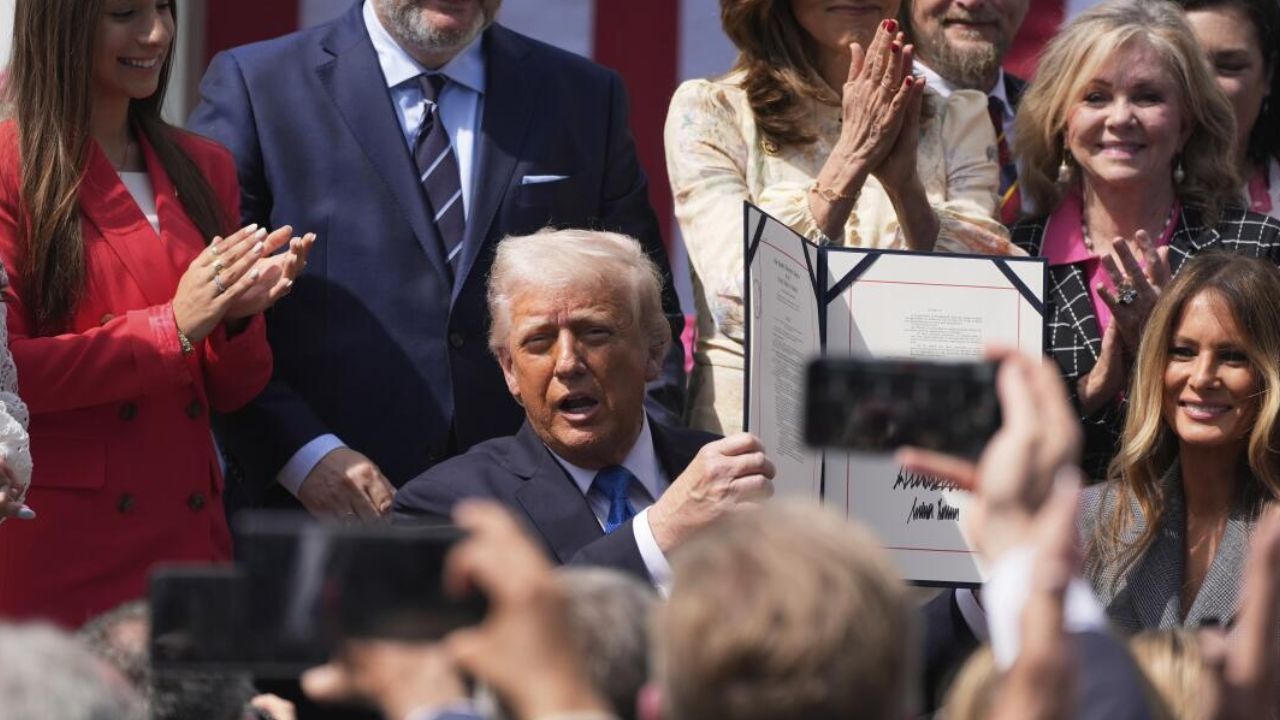


May 20,2025: In a major move to strengthen digital safety and privacy, U.S. President Donald Trump has officially signed the ‘Take It Down Act’ into law, a transformative piece of legislation aimed at curbing the online spread of non-consensual explicit images, including those generated through artificial intelligence.
The law, strongly advocated by First Lady Melania Trump, criminalizes the distribution of both real and computer-generated explicit content shared without the subject’s consent. It also compels tech platforms to remove such content within 48 hours of notification, making it one of the most stringent federal laws addressing AI-generated abuse and revenge porn to date.
At the Rose Garden ceremony, President Trump emphasized the law’s importance:“WE MUST PROTECT OUR CHILDREN!”First Lady Melania Trump added,“Today, through the ‘Take It Down’ Act, we affirm that the well-being of our children is central to the future of our families and America. I am proud to say that the values of Be Best will be reflected in the law of the land.”
The law is particularly timely, as high-profile cases involving non-consensual deepfake images of public figures like Taylor Swift and Rep. Alexandria Ocasio-Cortez have raised alarm in recent years. Ordinary citizens, including teenagers and young women, have also fallen victim to this rapidly evolving threat.
Until now, federal protections focused primarily on minors, and adult victims faced a patchwork of inconsistent state laws. The new federal legislation offers uniform protection, boosts accountability for platforms, and provides clear legal pathways for law enforcement to prosecute offenders.
Advocacy groups welcomed the law. Ilana Beller, organizing manager at Public Citizen, remarked:“AI is new to a lot of us and so I think we’re still figuring out what is helpful to society, what is harmful to society, but non-consensual intimate deepfakes are such a clear harm with no benefit.”The Take It Down Act also marks one of the first significant U.S. federal laws addressing AI-related content, setting a precedent as policymakers around the world grapple with the dual-edged nature of emerging technologies.