
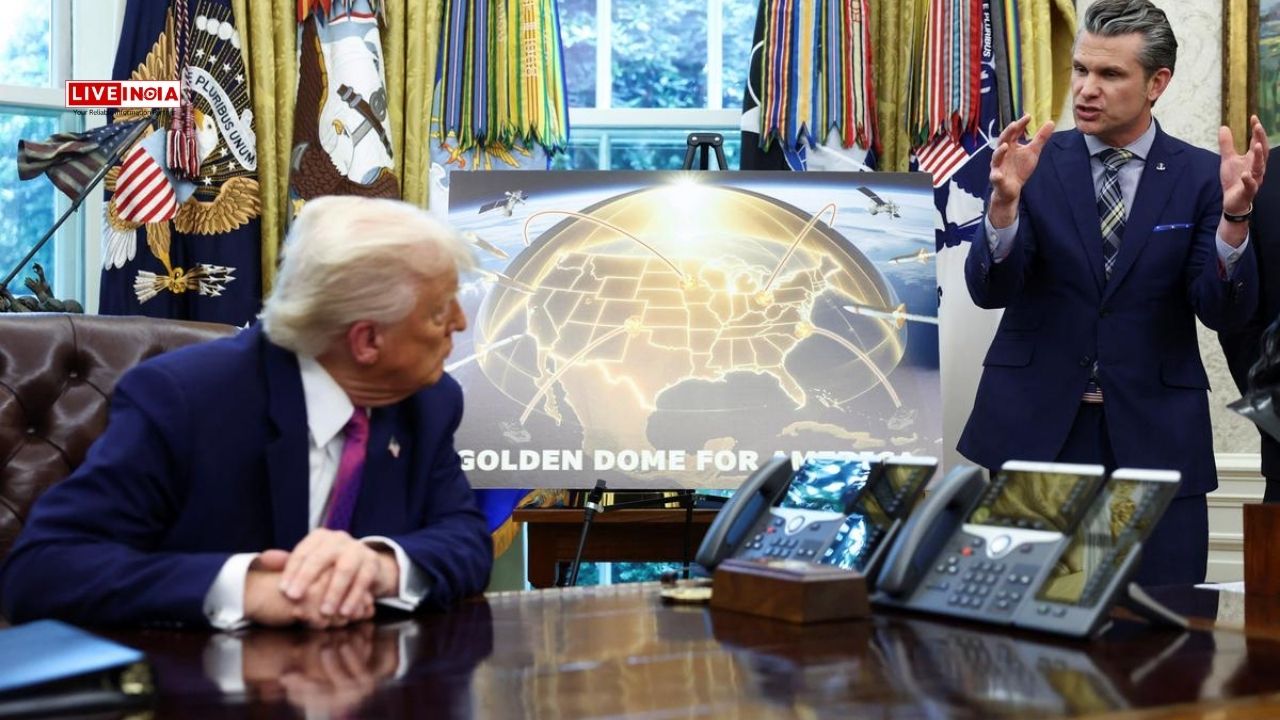


The ambitious system, inspired by Israel’s Iron Dome, aims to intercept global missile threats, including hypersonic and space-launched weapons, with leadership from the U.S. Space Force.
Washington, May 21, 2025 – U.S. President Donald Trump on Tuesday revealed a sweeping plan to develop a cutting-edge missile defense shield called the “Golden Dome,” allocating $25 billion in initial funding and projecting a total cost of around $175 billion.
Speaking at the White House, Trump said the system would be operational within three years and would be capable of intercepting missiles from across the globe—including those launched from space.
Also Read: WHO Adopts Historic First-Ever Global Pandemic Agreement to Strengthen Future Response
“In the campaign I promised the American people I would build a cutting-edge missile defense shield,” said Trump. “Today I am pleased to announce we have officially selected architecture for this state-of-the-art system.”
A Dome Over Land, Sea, and Space
Modeled after Israel’s Iron Dome, the Golden Dome will extend its reach much further. Trump emphasized the system’s ability to counter ballistic, cruise, hypersonic missiles, and drones, using land, sea, and space-based technologies.
The project will be led by U.S. Space Force General Michael Guetlein, with Defense Secretary Pete Hegseth noting its purpose is to protect the U.S. from both conventional and nuclear threats.
While Trump put the long-term cost at $175 billion, a Congressional Budget Office report estimates space-based interceptors alone could cost between $161 billion and $542 billion over two decades.
Global Implications and Pushback
Trump noted that Canada has shown interest in joining the program. However, the announcement has drawn strong opposition from Russia and China, which called it “deeply destabilizing” and warned it could militarize space.
A Kremlin statement following high-level talks with Beijing condemned the initiative, saying it “explicitly provides for a significant strengthening of the arsenal for conducting combat operations in space.”
Strategic Context and Evolving Threats
The 2022 U.S. Missile Defense Review cited the escalating missile capabilities of Russia, China, North Korea, Iran, and non-state actors. China is quickly closing the gap in hypersonic weapons, and Russia continues modernizing its strategic arsenal.
The report also warned of the growing threat from drones, which have played a key role in the Ukraine conflict and Middle East flare-ups.
The U.S. has recently gained critical real-world experience defending against advanced missile systems, aiding allies like Israel and Ukraine, and intercepting threats from Yemen’s Huthi rebels in regional conflicts.
The Golden Dome plan signals a new era in U.S. strategic defense, combining terrestrial and space-based technologies to counter the full spectrum of modern missile threats.
Tags:
Golden Dome, US Missile Defense, Donald Trump, Space Force, Michael Guetlein, Pete Hegseth, Hypersonic Missiles, US Defense Budget, Iron Dome, Russia China Missile Threat, Missile Defense Review, Space Warfare, US Military Technology, North Korea Iran Missile Threat