
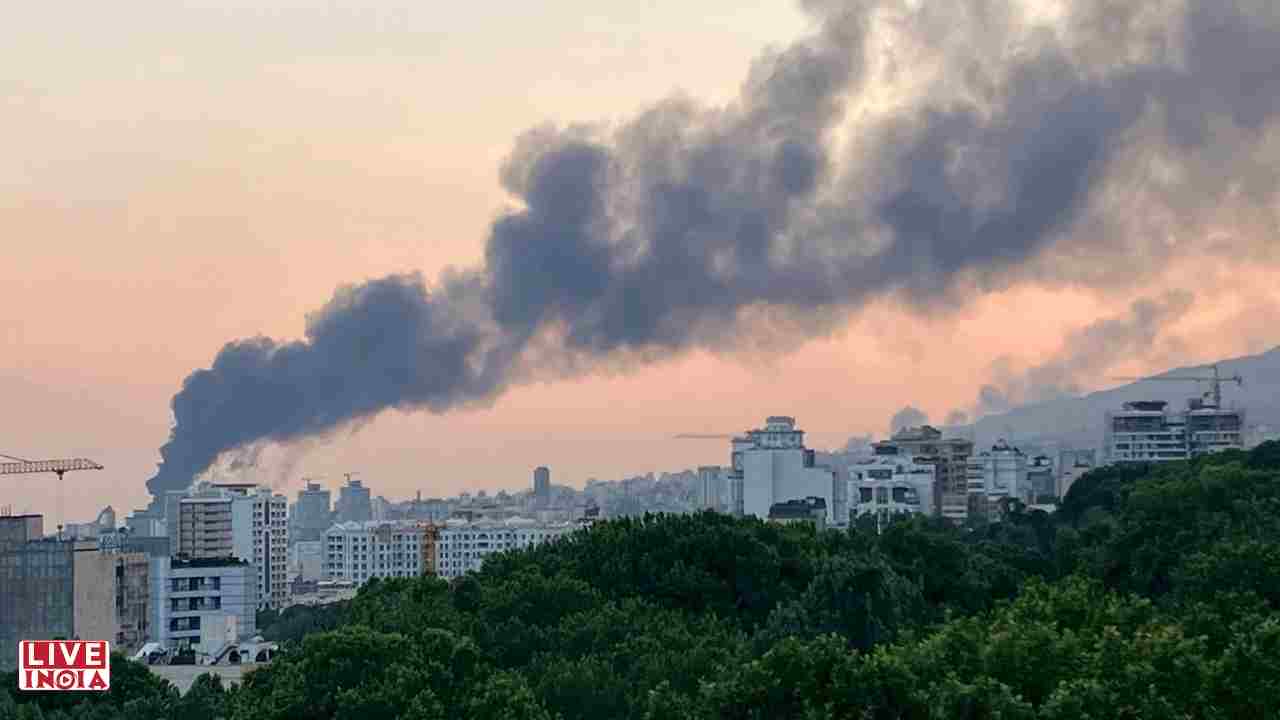


President Donald Trump confirms “very successful” US airstrikes on three Iranian nuclear sites, including the underground Fordow facility, signaling direct American entry into the Israel-Iran conflict.
Washington, June 22 (Reuters): In a dramatic escalation of the ongoing Middle East conflict, U.S. President Donald Trump announced a direct American military strike on three Iranian nuclear sites, including the fortified Fordow facility, which he declared “is gone.” The coordinated airstrikes—executed with B-2 bombers—mark the first major American military intervention in the Israel-Iran conflict, days after Israel launched a preemptive aerial campaign to eliminate what it claims are Iran’s nuclear weapon ambitions.
In a post on Truth Social, President Trump said, “A full payload of BOMBS was dropped on the primary site, Fordow. Fordow is gone.” He congratulated “our great American Warriors” and confirmed that “all planes are safely on their way home.” Trump further called on Iran to end the conflict, declaring, “IRAN MUST NOW AGREE TO END THIS WAR.”
Trump is expected to deliver a televised address from the Oval Office at 10 p.m. EST, signaling the gravity of the development.
According to a senior U.S. official speaking anonymously to Reuters, the strikes involved stealth B-2 bombers, capable of carrying bunker-busting ordnance designed to reach deep underground facilities like Fordow, which is located beneath a mountain near Qom.
Israel’s public broadcaster Kan reported that the U.S. acted in full coordination with Israeli authorities, underlining Washington’s strategic alignment with Tel Aviv in what has now become a multinational conflict.
Context of Escalation:
Israel initiated its campaign against Iran on June 13, claiming that Tehran was on the brink of nuclear weaponization—a claim Iran vehemently denies, maintaining its nuclear program is strictly peaceful.
Despite diplomatic efforts by Western countries, including the EU and the UK, to mediate a ceasefire, tensions have only intensified.
Political Fallout in the US:
The strike has ignited fresh debate in Washington, with Democrats and some Republicans criticizing Trump’s unilateral military action without Congressional authorization. Several lawmakers are calling for an emergency session to review the administration’s war powers.
Human Cost of the Conflict:
According to Iran’s state-run Nour News, citing the Iranian health ministry, at least 430 people have been killed and 3,500 injured since Israeli strikes began.
In Israel, 24 civilians have died due to more than 450 Iranian missile attacks, with 1,272 others injured, 14 critically, as confirmed by the Israeli Prime Minister’s office.
Israel’s Parallel Offensive:
On Saturday, Israeli forces confirmed they had conducted dozens of additional airstrikes in southwestern Iran, continuing their military campaign against Tehran’s alleged weapons development infrastructure.
Notably, Israel maintains a policy of nuclear ambiguity, refusing to confirm or deny its possession of nuclear weapons, though it is widely believed to be a nuclear-armed state.
What’s Next:
As tensions rise and regional stability teeters, all eyes will be on Trump’s Oval Office address, where he is expected to outline next steps. Observers fear this escalation could trigger a broader war in the Middle East involving multiple powers.