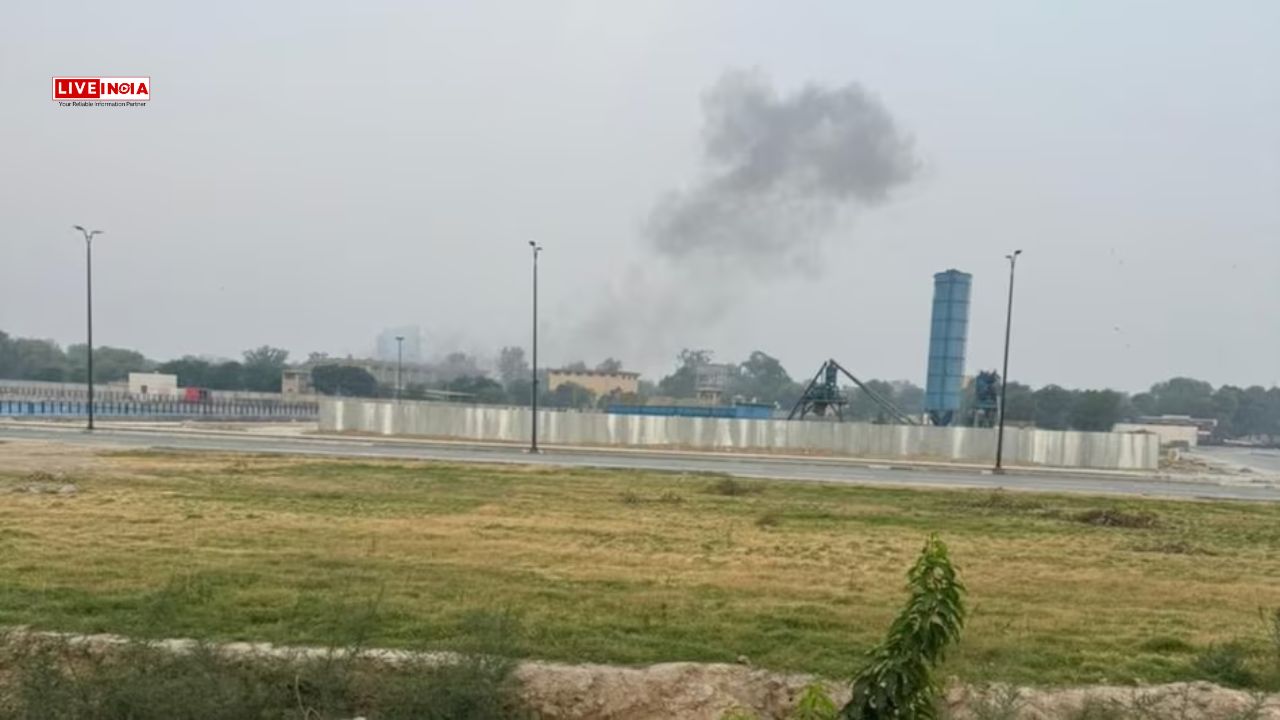
Why India Struck Pakistan’s Air Defence Systems: Centre Explains Post-Operation Sindoor Action
New Delhi | May 8, 2025:
India has justified its early morning strikes on Pakistan’s air defence systems, saying the response was necessitated by Islamabad’s escalatory move to target military installations across northern and western India with drones and missiles—following India’s carefully calibrated Operation Sindoor on terror infrastructure in Pakistan and Pakistan-Occupied Kashmir.
Also Read: India Strikes Back: Air Defence Radars in Pakistan Targeted After Drone, Missile Attacks
In an official statement, the Indian government said:
“Our airstrikes were focused, measured, and non-escalatory. No Pakistani military targets were attacked initially. But we had clearly warned that any assault on Indian military targets would provoke a suitable response.”
Late Wednesday night, Pakistani forces attempted to strike key Indian military sites including Awantipora, Pathankot, Amritsar, Srinagar, Chandigarh, and Bhuj using drones and missiles. The Indian Integrated Counter-UAS Grid and air defence systems successfully intercepted these threats, and debris of intercepted drones and missiles is being recovered from several locations across India as evidence.
Also Read: Former Bangladesh President Abdul Hamid Leaves Country Amid Political Upheaval
On Thursday morning, the Indian Armed Forces launched a calibrated strike on Pakistan’s air defence infrastructure, successfully neutralising a radar system in Lahore.
“This response was in the same domain and of the same intensity as Pakistan’s actions. The message is clear—India will not tolerate escalation,” the statement emphasized.
The government also highlighted continued ceasefire violations along the Line of Control (LoC), particularly in Kupwara, Baramulla, Uri, Poonch, Rajouri, and Mendhar, where 16 civilians, including 5 children and 3 women, were killed due to Pakistani shelling.
India responded with counter-artillery and mortar fire, reiterating its stance that it seeks non-escalation, but will act firmly when provoked.
India launched Operation Sindoor in the early hours of May 7, targeting nine terror bases across Pakistan and PoK linked to Lashkar-e-Taiba and Jaish-e-Mohammed. The operation was launched in retaliation for the April 22 Pahalgam terror attack, in which 26 civilians—including tourists—were killed.
India’s Foreign Secretary Vikram Misri reiterated in a briefing:
“There has been no credible action by Pakistan to dismantle terror infrastructure. In fact, our intelligence suggested impending attacks, compelling us to pre-empt and neutralize threats.”
India maintains that it will continue to act within the bounds of proportionality and responsibility, as long as Pakistan refrains from escalating. However, any direct threat to Indian military or civilian safety will invite decisive and focused retaliation.
Operation Sindoor, India Pakistan tensions, Indian airstrikes, Lahore radar destroyed, Pahalgam attack response, Vikram Misri, Pakistan drone attack, Lashkar-e-Taiba camps, Indian military retaliation, cross-border terrorism, ceasefire violation, LoC shelling, OperationSindoor,
Sunny Deol and Akshaye Khanna face off in a high-stakes courtroom drama of ethics and…
No refund for Vande Bharat and Amrit Bharat tickets cancelled within eight hours of departure…
Services to four destinations suspended till February 28 over regional security concerns February 3, 2026:…
Eight Opposition MPs suspended after repeated disruptions over national security debate February 3, 2026: The…
Makers consider recast after Deepika Padukone’s exit from Kalki 2898 AD 2 February 3, 2026:…
Former India captain calls award a special moment, vows to keep winning matches for the…