
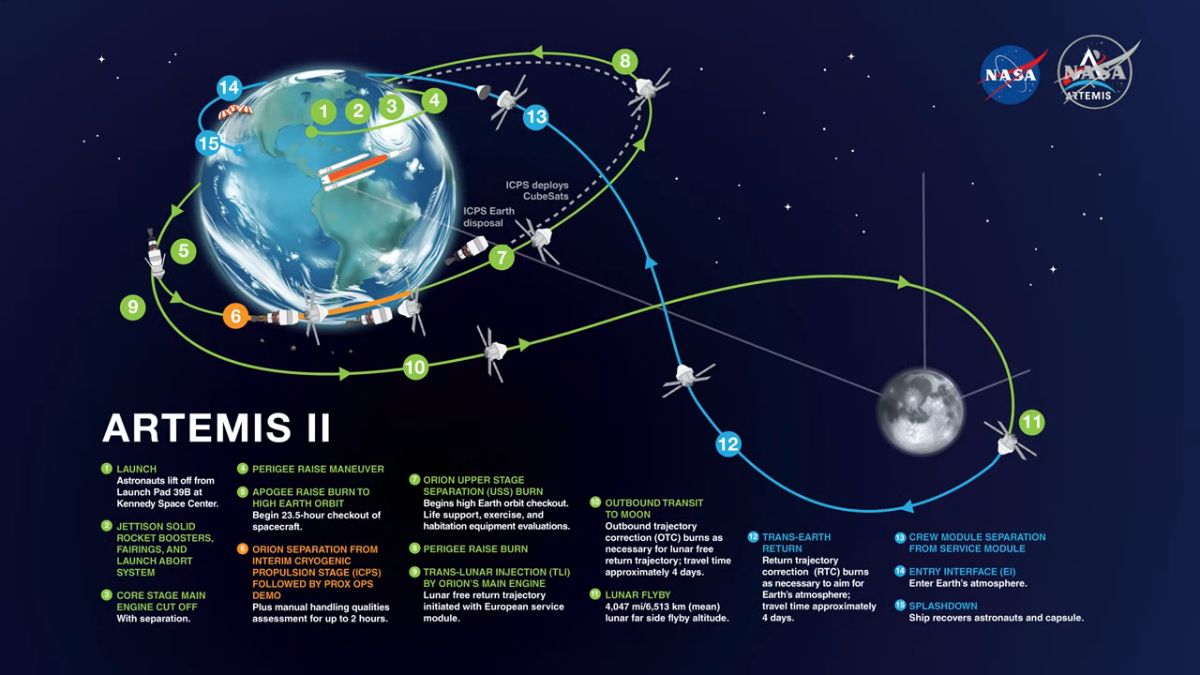


The four astronauts aboard Artemis II are currently en route to the Moon, but the journey is taking longer than many might expect. Launched on April 1, 2026, from Kennedy Space Center, the mission is scheduled to last ten days, with the spacecraft expected to reach the Moon around April 6.
The reason behind the gradual pace lies in the fundamental physics of space travel—particularly the gravitational forces of Earth and the Moon.
Why the Journey Isn’t as Fast as It Seems
Although the Orion spacecraft achieved an impressive escape velocity of around 24,500 miles per hour after its translunar injection burn, the journey to the Moon is not a straight, constant-speed trip.
In reality, travelling away from Earth is like moving “uphill” against its gravitational pull. As a result, the spacecraft gradually slows down, with its speed dropping to nearly 3,400 miles per hour as Earth’s gravity continues to tug it backward.
When the Moon Takes Over
The turning point comes when Orion reaches a region about 41,000 miles from the Moon and roughly 200,000 miles from Earth. At this stage, the Moon’s gravitational pull becomes stronger than Earth’s, causing the spacecraft to accelerate again toward its destination.
This delicate balance between Earth and lunar gravity is what shapes the trajectory and timing of the mission.
First Two Days Focused on Critical Preparations
Before heading toward the Moon, the mission spent its initial two days in Earth’s orbit. During this phase, astronauts carried out essential tasks such as:
- Calibrating onboard instruments
- Testing life-support systems
- Performing engine burns
These steps were crucial to setting up the translunar injection—the manoeuvre that placed Orion on its path to the Moon.
Record-Breaking Milestone in Deep Space
On the sixth day, the crew will pass the Moon’s western hemisphere, coming within approximately 4,000 miles of its surface.
At that point, Artemis II will set a new record for human spaceflight distance, reaching about 252,757 miles from Earth—farther than any humans have ever travelled in space.
Return Journey and Total Distance
After the lunar flyby, the spacecraft will begin its journey back to Earth, which is expected to take another four days. Splashdown is scheduled for April 10, 2026, in the Pacific Ocean.
Over the course of the mission, Orion will travel more than 685,000 miles, marking a major milestone in humanity’s return to deep-space exploration.