
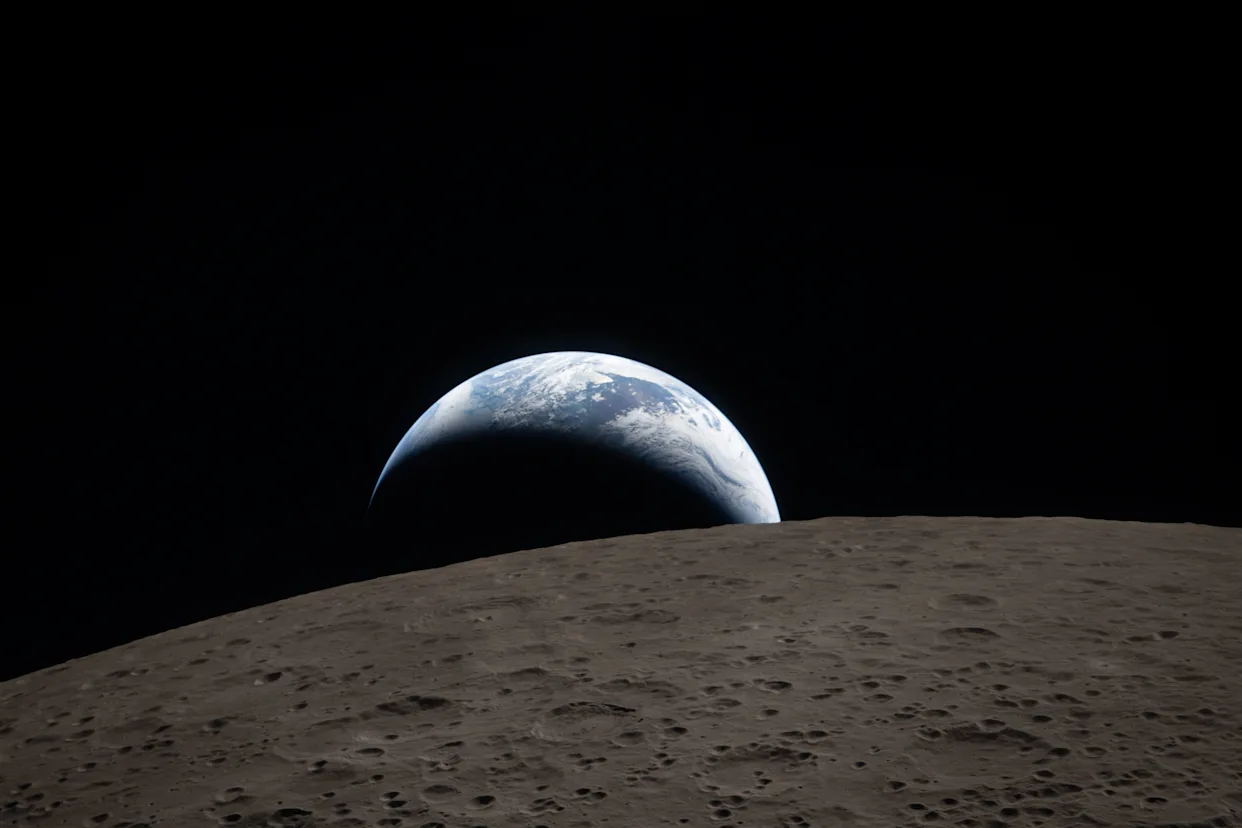


NASA’s Artemis II crew is on the final leg of their 10-day journey home, with the Orion spacecraft scheduled to splash down in the Pacific Ocean today, Friday, April 10, 2026, at 5:07 p.m. PDT (8:07 p.m. EDT).
The mission has been a series of historic firsts, including setting a new record for the farthest distance humans have ever traveled from Earth: 252,756 miles (406,771 km). This achievement officially breaks the 56-year-old record held by the Apollo 13 mission since 1970.
Re-entry: A High-Stakes Descent
The return to Earth is one of the mission’s most critical phases. To ensure a safe landing, the Orion capsule must perform a series of high-precision maneuvers:
Separation: The Crew Module and Service Module are set to separate at 7:33 p.m. ET, with the Service Module burning up in the atmosphere.
Extreme Heat: Orion will hit the atmosphere at nearly 24,000 mph (38,624 km/h), facing temperatures of 5,000°F (2,760°C)—half as hot as the surface of the sun.
Parachute Sequence: At 8:03 p.m. ET, drogue parachutes will deploy at 22,000 feet, followed by three main parachutes at 6,000 feet to slow the capsule for splashdown.
Recovery Operations
The USS John P. Murtha, a U.S. Navy amphibious transport dock, is already in position off the coast of San Diego to recover the four-person crew and the spacecraft.
Extraction: Navy divers and MH-60 Seahawk helicopters will assist the astronauts out of the capsule.
Medical Check: Once aboard the ship, the crew will undergo immediate post-mission medical evaluations.
Flight Home: Within hours, the crew—Reid Wiseman, Victor Glover, Christina Koch, and Jeremy Hansen—will be flown back to NASA’s Johnson Space Center in Houston.
The Crew of Artemis II
This mission represents the most diverse lunar crew in history:
Reid Wiseman (Commander): Led the mission that saw the crew name a lunar crater “Carroll” in honor of his late wife.
Victor Glover (Pilot): The first person of color to fly a mission to the Moon.
Christina Koch (Mission Specialist): The first woman to voyage to the lunar vicinity.
Jeremy Hansen (Mission Specialist): The first non-American (Canadian Space Agency) to leave Earth’s orbit for the Moon.
NASA has confirmed that weather conditions at the splashdown site remain favorable, with light winds and manageable wave heights predicted for this evening’s return.