

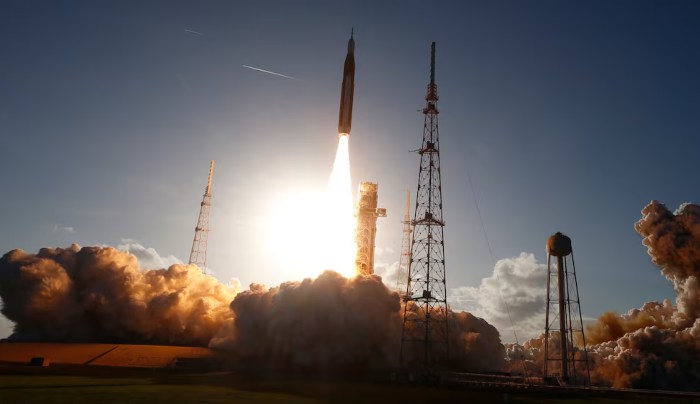


CAPE CANAVERAL, FL — Following a successful liftoff on Wednesday evening, April 1, 2026, NASA’s Artemis II mission is currently in its first major flight phase. The Orion spacecraft, carrying a diverse crew of four, has reached a high Earth orbit where it will remain for approximately 25 hours to test critical life-support systems before “slingshotting” toward the Moon.
1. Launch Highlights
The Space Launch System (SLS) rocket roared to life at 6:35 PM EDT (4:05 AM IST, April 2) from Kennedy Space Center’s Launch Complex 39B.
- The Crew: Commander Reid Wiseman, Pilot Victor Glover, and Mission Specialists Christina Koch and Jeremy Hansen (CSA) are the first humans to travel toward the Moon since 1972.
- Minor Glitches: The countdown faced brief “no-go” alerts due to a battery instrumentation issue and a safety system glitch at the range, but both were resolved by engineers in time for the two-hour launch window.
- Separation Success: Orion successfully separated from the SLS core stage and deployed its four solar array wings, which are now providing continuous electrical power to the capsule.
2. Current Mission Phase: The “High Earth Orbit” Test
As of Thursday morning, April 2, Orion is in a highly elliptical orbit. This “safe zone” allows mission control to verify that the spacecraft can keep the crew alive in deep space.
- The Checklist: Astronauts are currently testing manual maneuvering, communication links, and waste management systems (including a reported minor fix to the onboard toilet).
- The Slingshot: Once these checks are complete (expected around 7:30 PM EDT on Thursday), the Interim Cryogenic Propulsion Stage (ICPS) will fire to put Orion on a free-return trajectory toward the Moon.
3. Where is Orion Right Now?
You can track the mission’s telemetry—including altitude, speed, and distance from Earth—using NASA’s live tools:
- AROW (Artemis Real-time Orbit Website): The primary data visualization tool for Orion’s path.
- NASA App: Features an AR (Augmented Reality) mode to see Orion’s position relative to your current location.
- Virtual Telescope Project: Skywatchers in Europe and parts of Asia may be able to see the spacecraft through high-powered telescopes as it gains altitude.
Artemis II Flight Timeline (April 2026)
| Milestone | Status / Scheduled Time |
| Launch | COMPLETED (April 1, 6:35 PM EDT) |
| Translunar Injection (TLI) | April 2, ~7:30 PM EDT |
| Lunar Flyby | April 5–6 (Closest approach: ~4,700 miles) |
| Maximum Distance | ~252,000 miles from Earth |
| Pacific Splashdown | April 10, 8:06 PM EDT (Planned) |