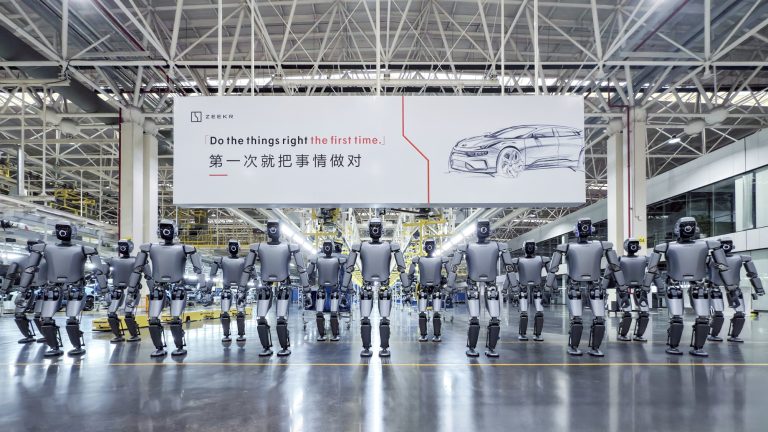
China is accelerating the deployment of artificial intelligence-powered robots across industries as it prepares for a future with a shrinking workforce and an ageing population. From automobile factories to restaurants, AI-enabled humanoid robots are increasingly replacing labour-intensive jobs in what experts describe as one of the biggest technological transformations since the Industrial Revolution.
The move comes as China’s demographic challenges intensify. According to United Nations projections, the country’s working-age population, between 15 and 64 years old, is expected to decline dramatically from a peak of around one billion during the past decade to nearly 300 million by the end of the century.
AI Robots Take Over Labour-Intensive Factory Jobs
At facilities such as Sany Truck Manufacturing in Changsha, Hunan province, humanoid robots are now being used for labour-intensive vehicle assembly work, reducing dependence on human workers, according to a report by the Financial Times.
Huang Tie, Deputy General Manager of Sany Truck Manufacturing, said the shift is unavoidable given China’s demographic reality.
“China’s demographic structure is shifting and the population is gradually shrinking — that is an undeniable reality. For labour-intensive industries, we believe replacing humans with robots is inevitable,” Huang told the publication.
The manufacturing sector is expected to be one of the biggest beneficiaries of AI-powered automation as companies attempt to maintain production despite a declining labour force.
Beijing Bets On AI To Tackle Demographic Crisis
China’s leadership increasingly views AI-driven robotics as a long-term solution to its demographic challenges.
The government is actively encouraging businesses to adopt what it calls “embodied artificial intelligence” across manufacturing plants, logistics networks, retail businesses and healthcare services. AI-powered machines are already being deployed for tasks ranging from factory quality inspections to preparing food in high-end restaurants.
Economists believe the speed of this transition is unprecedented.
“We have not seen a transformation of this speed and scale since the Industrial Revolution,” said Yuhan Zhang, Principal Economist at the China Center of the Conference Board.
China Already Dominates Global Robot Manufacturing
China has already established itself as the global leader in industrial robotics.
According to the International Federation of Robotics, the country now installs more industrial robots than the rest of the world combined. Between 2021 and 2024, the number of industrial robots operating in Chinese factories doubled to around two million units.
The country is also the world’s largest producer of humanoid robots.
A report by Morgan Stanley estimates that China accounted for nearly 90 per cent of the world’s humanoid robot shipments last year, with between 13,000 and 16,000 units delivered globally.
The investment bank also projects that sales of Chinese-made humanoid robots could reach around 50,000 units this year, exceeding every other country.
Xi Jinping Pushes AI And Robotics Strategy
President Xi Jinping has made robotics and artificial intelligence central pillars of China’s industrial strategy.
As of last year, China had 166 industrial robots for every 10,000 manufacturing workers. The Communist Party’s latest Five-Year Plan promotes closer collaboration between humans and machines while encouraging the adoption of AI-powered robots in sectors facing labour shortages or hazardous working conditions.
Earlier this month, local governments and state-owned enterprises were instructed to expand the use of “embodied artificial intelligence” across manufacturing, logistics, retail and healthcare.
The government’s immediate objective is to deploy at least 10,000 AI-powered robots in commercial settings across the country during the current year.
Automation Boom Raises Employment Concerns
While automation may help China address labour shortages, economists warn it could also create significant social and economic challenges.
The Financial Times report noted that China is already struggling with high youth unemployment and a rapidly expanding gig economy following the country’s property market downturn in 2021.
Around 320 million people now work in gig-based jobs, making concerns about automation even more significant.
Experts believe that the rapid adoption of AI-powered robots could reduce employment opportunities for both highly skilled professionals and millions of low-skilled migrant workers, creating fresh challenges for policymakers attempting to balance technological progress with job creation.
As China pushes ahead with its ambitious AI and robotics strategy, the country is positioning itself as the global leader in automation. However, the transition is also likely to reshape its labour market, raising difficult questions about employment, income security and the future of work.