
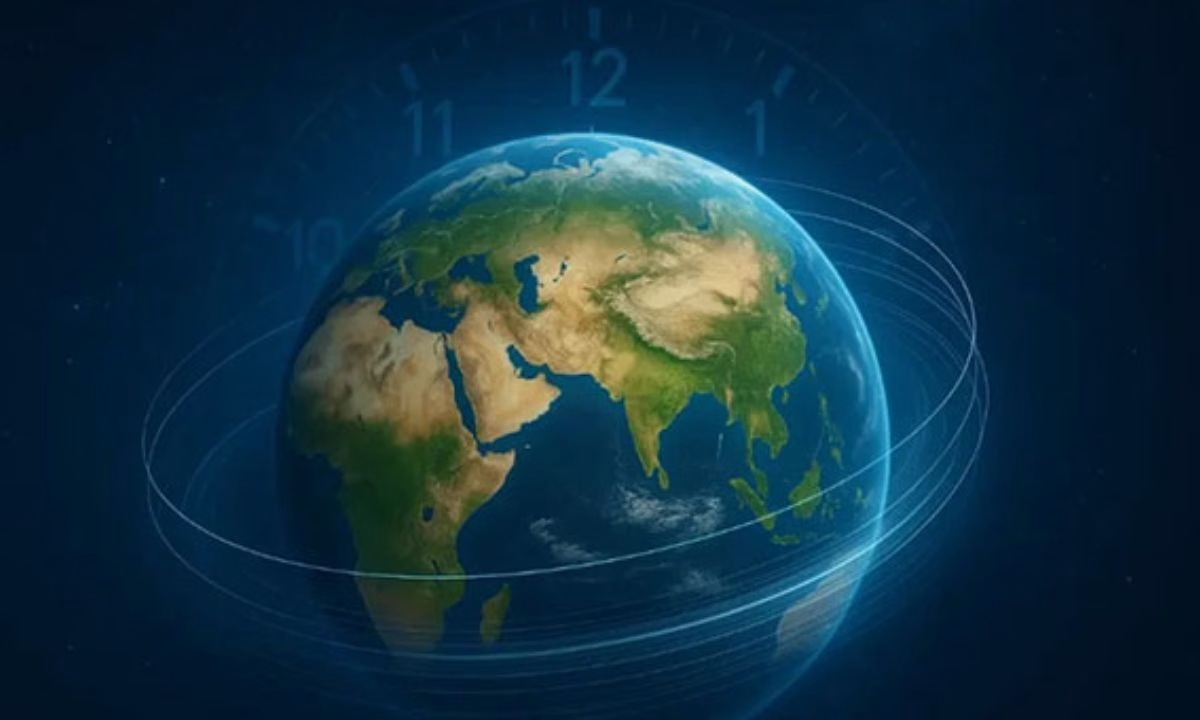


July 23, 2025: For the first time in history, global timekeepers are contemplating a “negative leap second,” meaning one second could be deducted from Coordinated Universal Time (UTC). This unprecedented move is being considered because the Earth‘s rotation is accelerating, with some days recently measuring more than a millisecond shorter than the usual 24 hours.
Why the Concern?
Even minute changes in the planet’s rotation can disrupt sensitive systems like satellites, GPS, and international communication networks. Since 1972, “leap seconds” have been added 27 times to UTC to account for the Earth’s erratic rotation, which has generally been slowing down due to the moon’s tidal friction. However, the recent acceleration is a new phenomenon. The International Earth Rotation and Reference Systems Service and the US Naval Observatory reported that July 10 was the shortest day of the year so far, lasting 1.36 milliseconds less than 24 hours. If this faster pace continues, experts estimate there’s a 40% chance a negative leap second will be implemented by 2035.
Also Read: “World’s Fastest Growing Populations: Africa Leads the Surge”
What’s Making Earth Spin Faster?
The Earth’s rotation is influenced by a combination of factors. Seasonal atmospheric fluctuations, the moon’s gravitational pull, and even the shifting motion of the Earth’s molten core all play a role. Experts note that the moon and tides cause the most immediate variations, speeding up the Earth’s spin when the satellite is at higher or lower altitudes and slowing it down when it’s over the equator. Surprisingly, climate change also plays a part. The melting ice in Greenland and Antarctica redistributes mass around the Earth, which actually tends to slow its rotation. However, current astronomical data and atomic clock observations indicate that the Earth is presently spinning faster than before, creating a complex scenario for timekeepers. As research geophysicist Duncan Agnew of the University of California, San Diego, puts it, observing the Earth’s rotation is like “observing the stock market… There are long-term trends, and then there are peaks and falls.”
Timekeeping, Earth’s Rotation, Leap Second, UTC, Astronomy, Climate Change.