
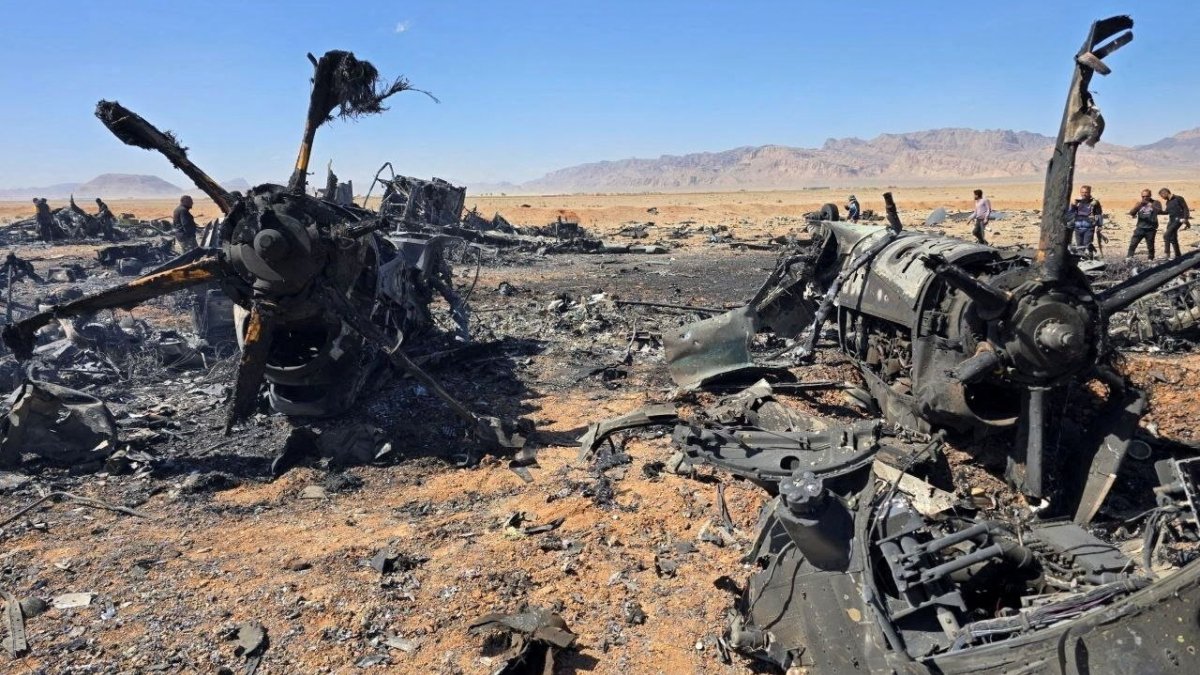


TEHRAN / WASHINGTON — A high-stakes U.S. rescue mission to recover a downed F-15E airman has ignited an explosive new diplomatic row. On Monday, April 6, 2026, the Iranian Foreign Ministry alleged that the “daring” operation announced by President Donald Trump was actually a failed “deception” designed to plunder the Islamic Republic’s enriched uranium reserves.
- The Accusation: A “Nuclear Heist” in Central Iran?
Foreign Ministry spokesman Esmaeil Baghaei raised “many questions and uncertainties” regarding the geography of the U.S. mission.
The Discrepancy: Iran claims the U.S. F-15E pilot was purportedly located in the Kohgiluyeh and Boyer-Ahmad Province, yet the U.S. special operations teams attempted to land in Isfahan province—hundreds of miles away and home to Iran’s most sensitive nuclear research.
The Allegation: “The possibility that this was a deception operation to steal enriched uranium should not be ignored at all,” Baghaei stated, labeling the mission a “disaster” for the United States.
- The U.S. Version: “Mechanical Failure” and Scuttle Orders
The White House and Pentagon presented a vastly different account of the chaotic events in Isfahan.
The Incident: Two MC-130J Commando II transport aircraft, carrying elite special operations forces, reportedly suffered “technical malfunctions” after landing in rugged terrain.
The “Scuttle” Order: To prevent advanced encryption and communication technology from falling into the hands of the IRGC, U.S. commanders ordered the two aircraft to be destroyed using thermite charges.
The Rescue: Despite the loss of the transport planes, President Trump hailed the recovery of the second F-15E crew member as a success, describing the extraction as “daring.”
- Iran’s Counter-Claim: “Completely Foiled”
Tehran’s military spokespeople, cited by Al Jazeera, mocked the U.S. explanation as an attempt to hide a “humiliating defeat.”
The Interception: The IRGC claims their air defense and ground forces successfully intercepted the U.S. aircraft, forcing the emergency landings.
The Evidence: State TV broadcast footage of charred wreckage in Isfahan, claiming it was the site where Tehran’s forces “neutralized” the American transport planes and two accompanying helicopters.
Strategic Significance: Why Isfahan?
The location of the crash has heightened global anxiety due to Isfahan’s role as Iran’s “Nuclear Heart.”
| Site | Strategic Importance |
| Isfahan Nuclear Technology Centre | Iran’s largest nuclear complex; handles uranium conversion and fuel production. |
| Khatami (Shekari) Air Base | Home to Iran’s fleet of F-14 Tomcat fighter jets and major defense manufacturing. |
| Geographic Context | Historically known as “Nesf-e-Jahan” (Half of the World), it is the crown jewel of Iran’s strategic interior. |
The Wider War Context
This incident occurs just as Artemis II astronaut Christina Koch shared a full-view image of the Moon’s Orientale Basin from space—a stark, peaceful contrast to the escalating “Power Plant Day” ultimatums on Earth. As the 8 PM Tuesday deadline for the Strait of Hormuz approaches, the Isfahan incident has effectively ended any hope of the 45-day ceasefire proposal recently floated by regional mediators.