
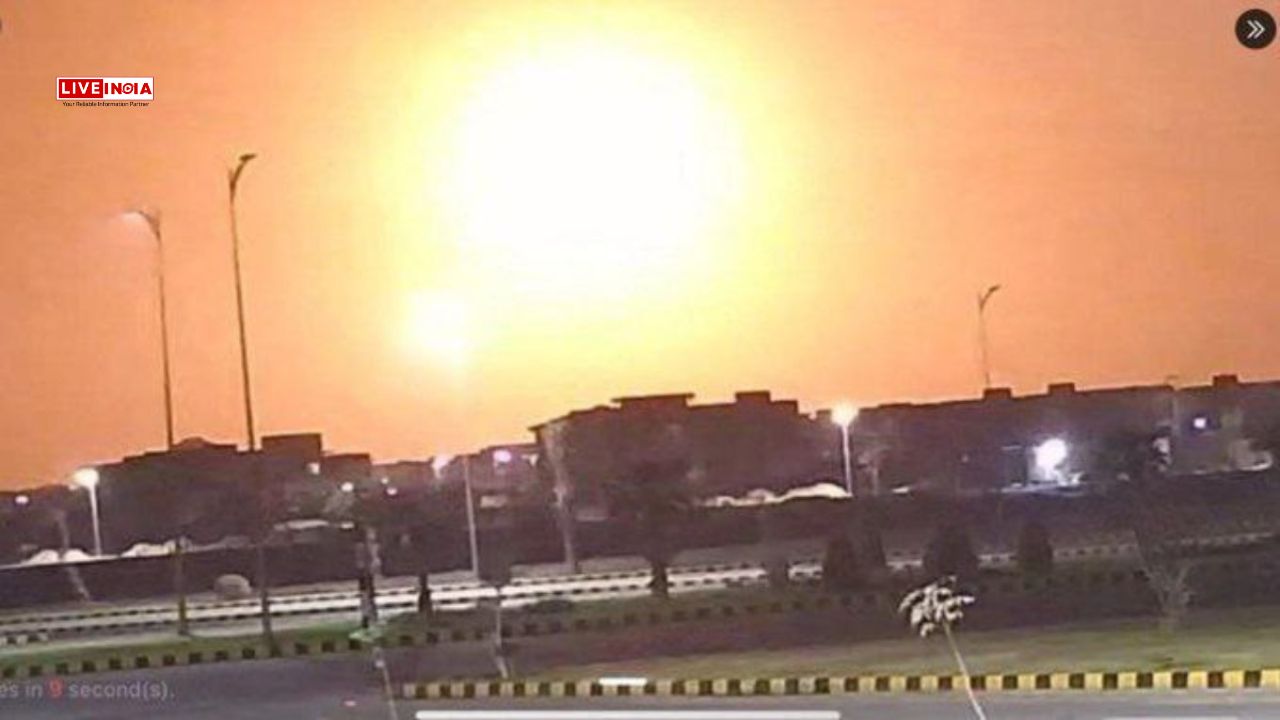


Crowds captured the moment of impact as Indian SCALP missiles and smart bombs hit terror camps in Pakistan and PoK; visuals reveal scale and precision of the overnight operation.
May 7, 2025: New Delhi – Visuals from the early hours of Wednesday have surfaced online, capturing the moment Indian missiles hit terror camps in Pakistan and Pakistan-Occupied Kashmir (PoK) as part of Operation Sindoor, a coordinated tri-services response to the April 22 Pahalgam terror attack.
Also Read: Operation Sindoor Fallout: Airports Across Northern India Shut Amid Escalating Tensions
The videos, sourced from Pakistani social media accounts, show massive orange fireballs, panicked voices, and blinding explosions — offering the first ground-level look at India’s precision military strikes.
The Strikes as Captured on Video
One clip shows a crowd gathered on a roadside in the dark, watching as the horizon lights up in an orange glow. Within moments, a missile whistles through the air, detonating with a thunderous explosion that shakes the camera. A massive fireball erupts, and plumes of smoke envelop the area. Panic ensues, with bystanders heard shouting prayers and scrambling for safety.
Pakistan pic.twitter.com/XuGFEMYjat
— Mossad Commentary (@MOSSADil) May 6, 2025
Another dashboard camera video records a second explosion moments after the word “bomb” is spoken by a passenger. The bright blast is visible in the distance beyond police checkpoints.
Operation Sindoor pic.twitter.com/dllF4NRkl6
— Shehzad Jai Hind (Modi Ka Parivar) (@Shehzad_Ind) May 6, 2025
What Weapons Were Used?
India deployed SCALP long-range air-launched cruise missiles, Hammer smart bombs, and loitering munitions — also known as kamikaze drones — capable of hovering over target zones before delivering precise payloads.
Also Read: Sensex, Nifty 50 Likely to Open Lower Amid India-Pakistan Tensions Post Operation Sindoor
These weapons enabled deep-strike capabilities without crossing into Pakistani airspace.
What Sites Were Targeted?
The strikes at 1:44 am IST hit nine locations associated with Jaish-e-Mohammed, Lashkar-e-Taiba, and Hizbul Mujahideen — all groups with a history of attacks on India, including Pulwama (2019) and 26/11 Mumbai (2008). Among the targets were key facilities in Bahawalpur, Kotli, and Muzaffarabad.
India had earlier shared intelligence with global powers, including the US, Russia, China, and the EU, indicating Pakistan’s “deep state” was complicit in planning the Pahalgam massacre, which left 26 people dead, including 25 Indian tourists and one Nepali citizen.
Pakistan’s Retaliation and Casualties
In the hours following the Indian strikes, Pakistan’s Army opened artillery fire along the Line of Control (LoC) and International Border, killing three Indian civilians.
India responded with a “proportionate” counter-attack, and sources confirmed casualties on the Pakistani side, though no official figures have been released.
Tags: Operation Sindoor, Indian military strike, SCALP missile, Hammer bomb, Jaish-e-Mohammed, Lashkar-e-Taiba, Pahalgam attack, LoC shelling, India Pakistan tensions, drone strikes, OperationSindoor,