
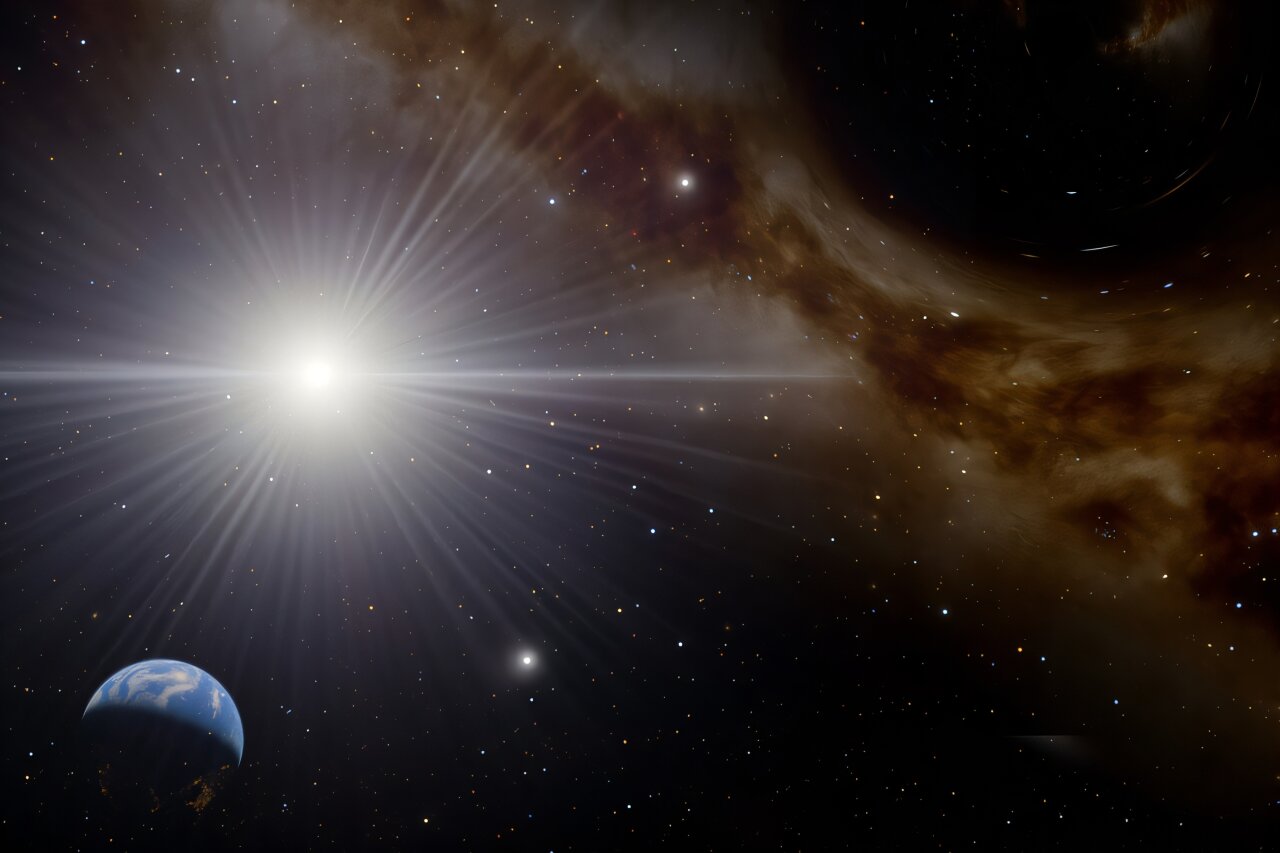


Researchers from University of Massachusetts Amherst suggest an ultra-high-energy neutrino detected by KM3NeT could be evidence of a primordial black hole explosion and new forms of dark matter.
Ultra-Powerful ‘Ghost Particle’ Detected Beneath Mediterranean Sea
In February 2023, an extraordinarily powerful subatomic particle—commonly called a “ghost particle” or neutrino—struck a detector deep beneath the Mediterranean Sea, leaving scientists searching for answers.
The neutrino carried energy levels roughly 100,000 times greater than the maximum energy generated by the Large Hadron Collider, the world’s most powerful particle accelerator.
Because no known cosmic process could explain such extreme energy, the discovery quickly became one of the most puzzling events in modern astrophysics.
Now, physicists at the University of Massachusetts Amherst believe they may have identified a possible explanation—one that could reshape scientific understanding of the early universe.
Primordial Black Hole Explosion May Explain The Signal
According to a recently published study in the journal Physical Review Letters, researchers suggest the neutrino may have originated from the explosive end of a primordial black hole (PBH).
Primordial black holes are believed to have formed in the earliest moments after the universe began—shortly after the Big Bang. Unlike typical black holes, which form when massive stars collapse, primordial black holes are thought to be:
- Much smaller
- Less massive
- Formed under extreme early-universe conditions
Scientists propose that as these tiny black holes lose mass over time through a process known as Hawking radiation, their temperature rises dramatically.
Eventually, this process could trigger a final, violent explosion—releasing enormous amounts of energy and particles, including ultra-high-energy neutrinos like the one detected.
Why The Discovery Was So Puzzling
One of the major challenges scientists faced was the lack of similar detections in other major experiments.
For instance, the IceCube Neutrino Observatory—one of the largest neutrino detectors in the world—has not recorded any particles with comparable energy levels.
This discrepancy raised an important question:
Why was such an extreme particle detected in one experiment but not another?
The Role Of A Hypothetical ‘Dark Charge’
To solve this puzzle, researchers introduced the idea of black holes carrying a “dark charge.”
This theoretical charge would interact with a hypothetical particle called a dark electron, linked to the mysterious field of dark matter.
According to the proposed explanation:
- Black holes with a dark charge would suppress emissions at energy levels detectable by IceCube
- At the same time, they would allow emissions at much higher energy levels
- This could explain why the particle was detected by KM3NeT but not by IceCube
If confirmed, this theory could provide indirect evidence for new forms of matter that have never been observed directly.
A Discovery That Could Change Our Understanding Of The Universe
The findings suggest that the neutrino may represent more than just a rare particle event—it could be a glimpse into conditions that existed billions of years ago.
If primordial black holes are confirmed as the source, the discovery could help scientists:
- Understand the nature of dark matter
- Study the earliest moments of the universe
- Test predictions about black hole evaporation
- Identify new forms of fundamental particles
Although the theory remains under investigation, researchers say the event demonstrates the importance of large-scale neutrino detectors and international collaborations in solving cosmic mysteries.
What Happens Next?
Scientists are now looking for additional ultra-high-energy neutrino detections to test their hypothesis. Future observations from detectors such as KM3NeT and IceCube could either confirm or challenge the idea of primordial black hole explosions.
For now, the mysterious “ghost particle” detected beneath the Mediterranean remains one of the most intriguing clues yet in the search to understand the hidden structure of the universe.