
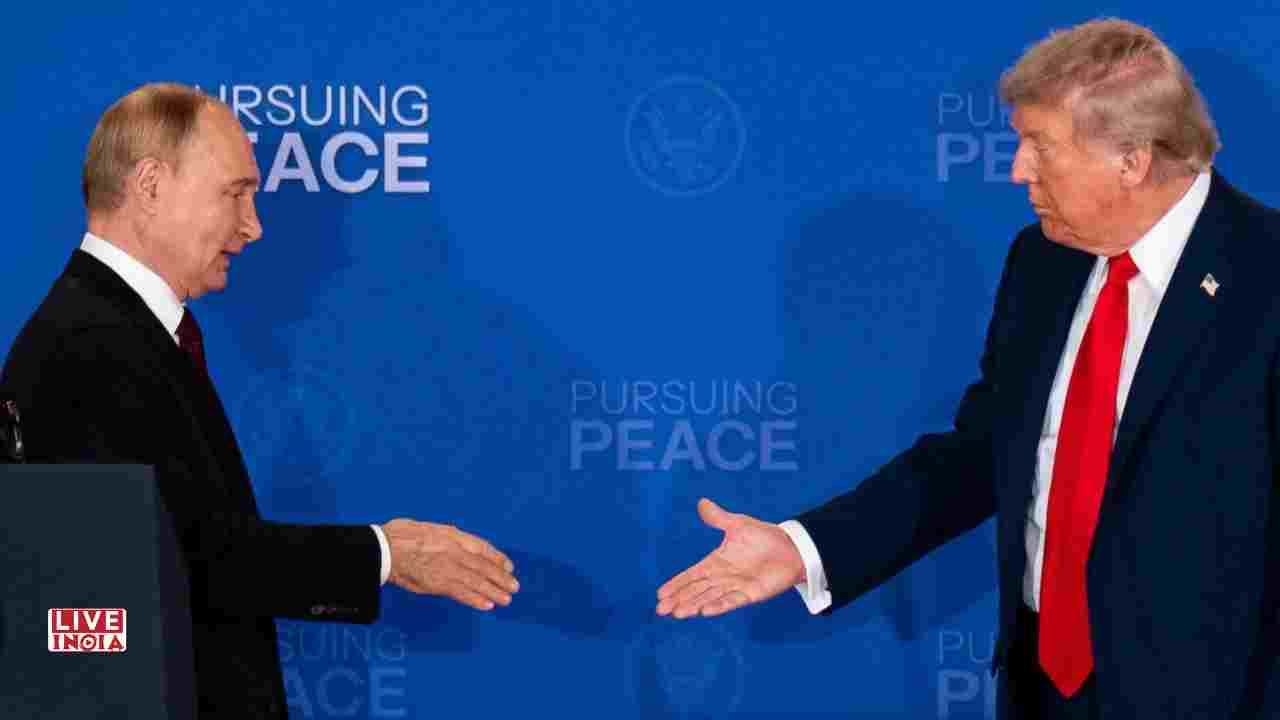


In a historic and highly-anticipated meeting in Alaska, Russian President Vladimir Putin and President Donald Trump held candid talks, with Putin publicly backing Trump’s repeated claims that he could have prevented the conflict in Ukraine.
ANCHORAGE, ALASKA — The icy air of Alaska, a state that serves as a literal bridge between Russia and America, was filled with a sense of both profound history and fresh political intrigue on Friday. After nearly three hours of closed-door discussions, a joint press conference revealed the stunning headlines that the world had been waiting for: Vladimir Putin, the head of the Russian state, stood alongside Donald Trump and declared with full confidence that the war in Ukraine would have never happened if Trump had been in office in 2022.
This statement, while a cornerstone of Trump’s own narrative for months, was the first time it received direct, public validation from the Russian leader himself. “Today, when President Trump says had he been the President back then, there would have been no war, I am quite sure it would indeed be so,” Putin stated, his words carrying the weight of a geopolitical chess move. He went on to reveal that he had tried to warn the previous U.S. administration, led by Joe Biden, that escalating tensions were a “big mistake” that could lead to a point of no return.
The meeting itself was a study in symbolism and carefully chosen words. Putin praised the “constructive atmosphere of mutual respect” and thanked Trump for the proposal to meet in Alaska. He leaned into the idea of a shared, neighborly relationship, even citing the mere four-kilometer distance between the two countries’ islands in the Bering Strait. “Good Afternoon, dear neighbour! Very good to see you in good health,” Putin recalled saying to Trump upon his arrival, a sentiment that felt a world away from the frosty rhetoric of recent years.
The choice of Alaska as the location was anything but random. Putin used the opportunity to reminisce about a shared history, pointing to the state’s historical ties to Russia, from its orthodox churches and Russian-origin geographical names to its crucial role during World War II. He spoke with emotion about the “dangerous and treacherous” airbridge that transported military supplies from the U.S. to the Soviet Union, praising the pilots of both nations who “risked their lives and gave it all for their community.” He even spoke of a memorial in Magadan, Russia, dedicated to the joint effort, where both the U.S. and Russian flags fly.
“We will always remember other historical examples when our countries defeated common enemies together in the spirit of battle camaraderie,” Putin declared, painting a picture of a partnership that could, and should, be rebuilt.
For the Russian media, the summit was a moment of pure triumph. The sight of Trump applauding Putin as the Russian leader disembarked his plane was seen as a sign of respect and a literal rolling out of the red carpet. For the Russian public, it was a moment of pride and vindication, a sign that their country was once again being treated as an equal on the world stage.
Putin acknowledged the difficult truth that relations between the U.S. and Russia had hit a “record low” since the Cold War. He said a personal meeting was “long overdue” and confessed that he and Trump had maintained a “very good direct contact,” speaking frankly on the phone multiple times. He also made a point of mentioning that Trump’s Special Envoy, Steve Witkoff, had traveled to Russia on several occasions, a detail that hints at a quiet, persistent effort to maintain a back channel of communication.
The summit was a reminder that even when official ties are at their most fragile, personal relationships and a shared sense of history can become the unexpected building blocks for a potential thaw. While the world watches with bated breath, one thing is clear: the conversation has shifted, and the future of U.S.-Russia relations seems to be, for better or worse, in a new, more personal, and deeply complex chapter.