
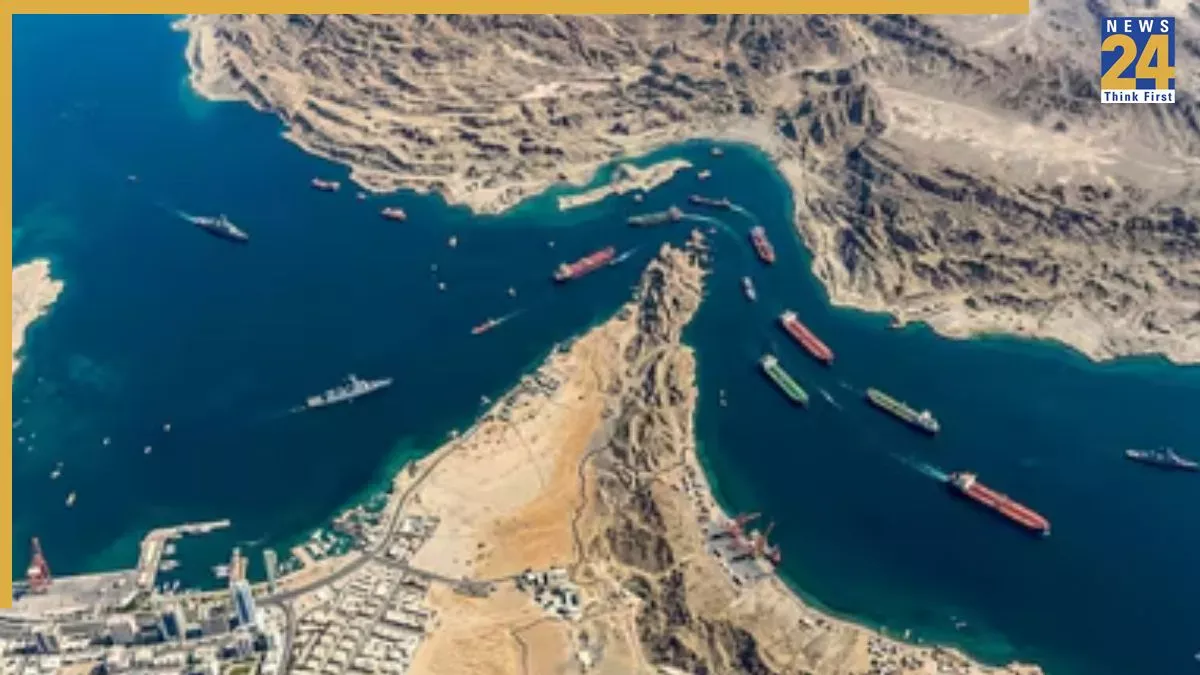


Even as officials from the United States and Iran gathered in Islamabad on Saturday to negotiate a lasting end to the ongoing conflict, a serious and less visible threat began to surface — missing naval mines in the Strait of Hormuz.
Reports suggest that Iran has been unable to fully account for all the naval mines it deployed in the waterway, raising fresh concerns about maritime safety and the long-term viability of any peace agreement.
The development comes amid Donald Trump claiming that the United States had already begun the process of “clearing” the Strait — a statement that contrasts with the complex reality on the ground.
How Did the Mines Get There?
Iran began deploying naval mines in March after the conflict escalated, reportedly using small boats to scatter explosives across the Strait of Hormuz, according to multiple reports.
US officials later described the operation as poorly coordinated and inefficient, noting that it relied on decentralised teams operating without a strict chain of command.
In several instances, mines were laid in ways that allowed them to drift away from their original positions — a factor that now complicates efforts to locate them.
The result, according to intelligence reports, is that one of the world’s busiest shipping lanes was seeded with explosives, many of which are no longer traceable to precise locations.
What Types of Naval Mines Were Used?
US intelligence agencies have reportedly identified at least two types of Iranian naval mines deployed in the Strait.
Maham 3 Mine
The first type is the Maham 3, a buoyant, moored naval mine weighing approximately 300 kilograms.
Key features include:
- Floats just below the water surface
- Equipped with acoustic sensors
- Can detect passing ships from about 10 feet away
- Capable of detonating even when ships have non-magnetic hulls
This makes the Maham 3 particularly dangerous for vessels moving through busy shipping lanes.
Maham 7 Mine
The second type is the Maham 7, a 220-kilogram bottom mine designed to sit on the seabed.
Its design makes it even harder to detect.
Key features include:
- Placed directly on the seabed
- Can function in waters as shallow as 10 feet
- Built to evade sonar detection
- Much more difficult to locate compared to floating mines
These characteristics significantly increase the complexity of mine-clearing operations.
Why Naval Mines Are So Difficult to Remove
Naval mines are widely considered among the most difficult maritime weapons to neutralise.
Mine-clearing ships must operate at extremely slow speeds, making them vulnerable to potential missile, drone, or artillery attacks.
Traditionally, the United States Navy relies on specialised littoral combat ships equipped with mine-sweeping tools.
However, these vessels are currently not stationed in the Strait of Hormuz.
Adding to the challenge:
- Four Avenger-class mine countermeasure ships stationed in Bahrain were decommissioned in September 2025
- These ships exited the region in January 2026 — just weeks before the conflict began
- No multinational mine-clearing mission has yet been formally approved
Some modern mine-clearing methods include:
- Underwater drones for detection
- Remote-controlled vehicles to detonate explosives
- Divers to neutralise mines manually
However, these operations require extensive planning and coordination.
Can the Strait of Hormuz Be Cleared?
In theory, yes — but experts warn it could take months before the waterway is fully safe.
Estimates suggest that clearing the Strait may require up to 16 mine countermeasure vessels, while the US Navy currently operates only seven suitable ships.
European nations are believed to have stronger mine-clearing capabilities.
Countries such as:
- Poland
- United Kingdom
- France
- Turkey
maintain significant mine-clearing fleets and have historically supported similar operations.
During conflicts such as the Gulf War and the Iraq War, the United States relied heavily on European allies for mine-clearing support.
Historical examples illustrate the scale of the challenge.
After Iraq deployed more than 1,000 mines during the Gulf War in 1991, it took over a dozen allied vessels nearly two months to clear the coast of Kuwait, averaging just over one mine per day.
In some cases, naval mines from World War II remain underwater today because clearing them remains too costly and complex.
Similarly, mines deployed by Houthi movement in the Red Sea during the Yemeni Civil War have remained hazardous for years.
Why This Crisis Matters for Peace Talks
The issue of unaccounted naval mines adds a major layer of complexity to ongoing diplomatic negotiations.
Abbas Araghchi, Iran’s foreign minister, acknowledged after the ceasefire that the Strait would reopen “with due consideration of technical limitations.”
US officials interpret this wording as an indirect admission that Iran may not currently have the capability to quickly locate or remove all the mines it deployed.
Estimates suggest Iran possesses between 2,000 and 6,000 naval mines in total.
Even if political negotiations succeed, the physical danger at sea could remain for months.
Why the Strait of Hormuz Is Critical
The Strait of Hormuz is among the world’s most strategically vital waterways.
Roughly 20% of global oil shipments pass through the narrow passage under normal conditions.
Until the mines are safely located and removed, large-scale commercial shipping may remain restricted — potentially affecting global oil supplies, shipping costs, and energy markets.
In short, while diplomatic agreements may be signed at the negotiating table, the true reopening of the Strait will depend on painstaking work beneath the surface of the water.