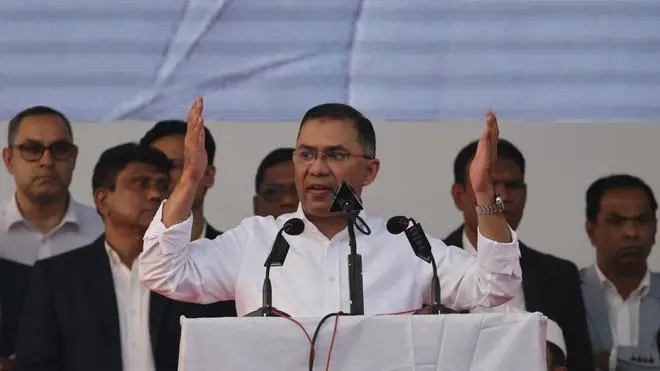
Bangladesh has entered a crucial political moment as Bangladesh Nationalist Party (BNP) leader Tarique Rahman returned to Dhaka after nearly 17 years in exile, just weeks before the country’s parliamentary elections. His arrival has dramatically reshaped the electoral contest and positioned him as one of the central figures in the race for power.
Rahman, the eldest son of former prime minister Khaleda Zia, landed in Dhaka on December 25, 2025, drawing massive crowds of supporters across the country. Addressing rallies, he promised to restore peace and stability and build a Bangladesh “we all dream of,” signalling a full-scale political comeback.
Often called the “dark prince” for operating largely behind the scenes during his mother’s tenure, Rahman was widely believed to wield significant influence in government between 2001 and 2006, when Khaleda Zia served as prime minister. Critics described him as a shadow power centre, while supporters viewed him as the natural political heir of the BNP.
Elections after political upheaval
The February 12 parliamentary elections are Bangladesh’s first since the ouster of former prime minister Sheikh Hasina. Her government fell after a violent student-led protest movement that began over job quota reservations for families of 1971 war veterans and later expanded into a nationwide anti-government campaign.
Following the turmoil, Nobel laureate economist Muhammad Yunus has been heading an interim administration since August 2024, tasked with stabilising governance and overseeing democratic transition.
Voters are also participating in a national referendum on the July Charter 2024, which proposes institutional reforms aimed at strengthening democracy and preventing a return to authoritarian rule.
BNP’s hopes and challenges
Rahman’s return has energised BNP supporters who see him as the party’s strongest chance to regain power after years in opposition. Large rallies and visible public mobilisation suggest a revival of the party’s organisational network.
However, questions remain about whether public enthusiasm can translate into electoral victory. Analysts point out that Bangladesh remains politically polarised after years of confrontation between the Awami League and the BNP, and the post-protest political environment is still fragile.
If the BNP wins and Rahman consolidates control of the party, he could emerge as the country’s next prime minister — a development that would mark a major shift in Bangladesh’s political trajectory.
Bahrain says it intercepted dozens of missiles and drones amid escalating Iran conflict March 6,…
Parties direct Lok Sabha members to attend Parliament as Budget Session resumes on March 9…
Congress leader tells students public life demands resilience, values and readiness to face hardships March…
In traditional Indian medicine, immunity is deeply connected with overall body balance. According to Ayurveda,…
After the vibrant celebrations of Holi, many people are left dealing with colour stains, dryness,…
Think tank analysis highlights soaring military expenses as conflict enters its first week March 6,…