
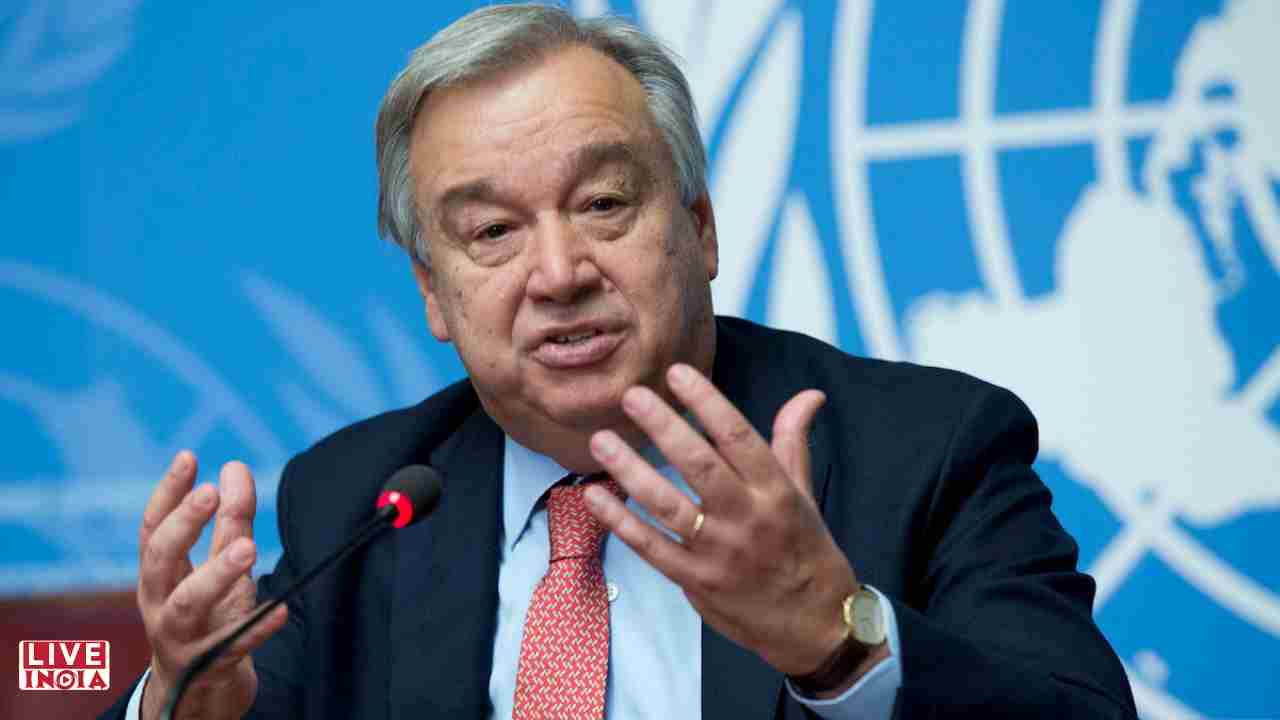


Following US airstrikes on Iran’s nuclear facilities, UN Secretary-General Antonio Guterres calls for urgent global de-escalation and a return to diplomacy during emergency Security Council session.
New York [US], June 23 — In a stern and emotionally charged address, United Nations Secretary-General Antonio Guterres urged the international community “not to give up on peace,” following the United States’ recent precision airstrikes on Iran’s key nuclear sites. Speaking at an emergency session of the UN Security Council in New York, Guterres warned that the U.S. bombing of Iranian nuclear facilities marked a “perilous turn” in an already fragile Middle East, and implored all sides to choose diplomacy over retaliation.
During Sunday’s emergency Security Council meeting convened under the agenda “threats to international peace and security,” Secretary-General Guterres condemned the escalation of military action and emphasized the critical need to avoid plunging the region into deeper chaos. He stressed that the time to act was now — with reason, restraint, and urgency.
“We cannot – and must not – give up on peace,” Guterres said, lamenting that his earlier appeal for diplomacy made just two days prior in the same chamber went unheeded. “Instead, the bombing of Iranian nuclear facilities by the United States marks a perilous turn in a region that is already reeling,” he said.
Guterres warned of a looming spiral of retaliation, which could endanger civilian lives and global stability. He called on all parties to protect innocent people, uphold maritime security, and prioritize diplomatic channels to resolve tensions around Iran’s nuclear program.
Reaffirming the need for a “credible, comprehensive, and verifiable solution”, he demanded full access for International Atomic Energy Agency (IAEA) inspectors to Iranian nuclear sites. He reiterated that Iran must honor its obligations under the Non-Proliferation Treaty and international law.
“The people of the region cannot endure another cycle of destruction,” Guterres declared. “To avoid it, diplomacy must prevail. Safe maritime navigation must be guaranteed. We must act — immediately and decisively — to halt the fighting and return to serious, sustained negotiations on the Iran nuclear programme.”
The emergency session followed a dramatic escalation after the U.S. carried out coordinated strikes on three of Iran’s critical nuclear facilities — Fordow, Natanz, and Isfahan — on Saturday, local time. U.S. officials have framed the strike as a defensive measure in response to perceived imminent threats and regional hostilities.
In a joint media briefing, U.S. Defense Secretary Pete Hegseth and Air Force General Dan Caine, Chairperson of the Joint Chiefs of Staff, confirmed the success of the operation. They stated that the strikes were launched with precision and that “the military had obliterated Iran’s nuclear ambitions.”
“The President’s orders were clear,” Hegseth said. “We neutralized a critical threat and sent a direct message. America will act decisively to protect its allies and interests.”
While military officials touted the mission as a success, global leaders and diplomats, including the UN chief, are now focused on preventing the crisis from widening.
In closing, Guterres highlighted the stark crossroad facing the international community: “One path leads to wider war, deeper human suffering, and serious damage to the international order. The other leads to de-escalation, diplomacy, and dialogue. We know which path is right.”
“We cannot — and must not — give up on peace,” he concluded, echoing his message with resolute urgency.