
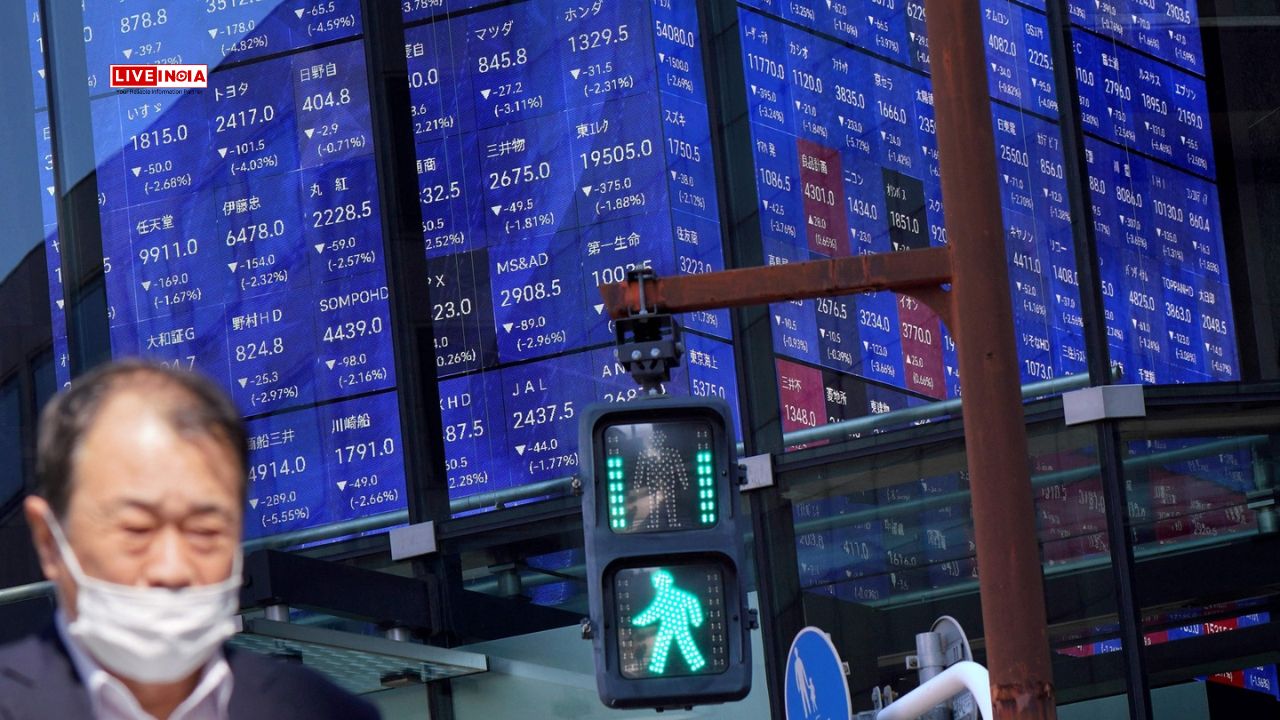


Triggered by massive sell-offs and rising fears of a ‘Black Monday,’ Japan suspends futures trading to prevent panic as global markets tumble following Trump’s tariff escalation.
April 7, 2025: Japan suspended trading of its major stock futures—including Nikkei 225 and Topix contracts—on Monday morning after a circuit breaker mechanism was triggered, signaling sharp market volatility. The suspension comes amid heightened global panic following US President Donald Trump’s new tariff policy, which sent Wall Street and Asian markets into a tailspin.
Also Read: Global Markets Crash as Panic Deepens Over Trump’s Tariff Blitz
In early trading, the Nikkei 225 plummeted 7.35%, following Friday’s 2.75% drop, while South Korea’s Kospi fell 4.8%, adding to concerns of a “Black Monday”-style crash.
Trump’s controversial “Liberation Day” tariff announcement last week, introducing 10% baseline duties on all imports and additional reciprocal tariffs, has ignited fears of a global trade war. On Friday, the Dow Jones lost 2,231 points, marking its worst single-day performance since the pandemic. This marked two consecutive days of over 1,500-point losses, a first in history.
Also Read: Trump’s Tariffs Trigger Global Response: Over 50 Countries Seek Trade Talks With US
What is a Circuit Breaker?
A circuit breaker is an automatic market mechanism designed to halt trading temporarily when asset prices experience sudden and extreme movements—either upward or downward. In this case, the Japan Exchange Group (JPX), which operates the Tokyo Stock Exchange and Osaka Exchange, activated the breaker to prevent panic selling and provide a cooling-off period for investors.
Also Read: Black Monday Revisited: What Happened in 1987 and Why Experts Fear a Repeat in 2025
These systems aim to stabilize markets by giving traders time to digest information and reassess strategies, thereby avoiding irrational sell-offs or buying frenzies.
Global Markets in Freefall
The halt in Japan follows massive overnight declines in US futures, with the Dow Jones and S&P 500 dropping over 4%, and fears that today’s trading could see one of the largest single-day declines since 1987’s Black Monday, when the Dow collapsed 22.6% in one session.
China is expected to follow suit once markets reopen after a long weekend, especially after Beijing slapped a 34% tariff on US goods in retaliation.
A gauge of US-listed Chinese companies fell 8.9% on Friday, further adding fuel to the fire.
Analysts Fear 1987 Repeat
Speaking on CNBC, market analyst Jim Cramer warned of a potential 1987-style crash. “If the President doesn’t extend an olive branch or create incentive structures for fair-trading nations, we might be looking at a repeat of history,” he said. “We’ll know by Monday.”
What Happens Next?
With markets teetering globally, all eyes are on how US, European, and Asian central banks and leaders respond to the ongoing turmoil. The circuit breaker in Japan may be just the beginning of similar safeguards being triggered across other global exchanges.
Stay tuned for updates on whether April 7 will indeed be remembered as the next Black Monday.
Tags:
Japan stock market, Nikkei 225 futures, Topix futures, circuit breaker, Black Monday fears, Trump tariffs, Dow Jones crash, S&P 500 plunge, global market selloff, Osaka Exchange, Tokyo Stock Exchange, Japan Exchange Group, US China trade war, financial markets, recession fears