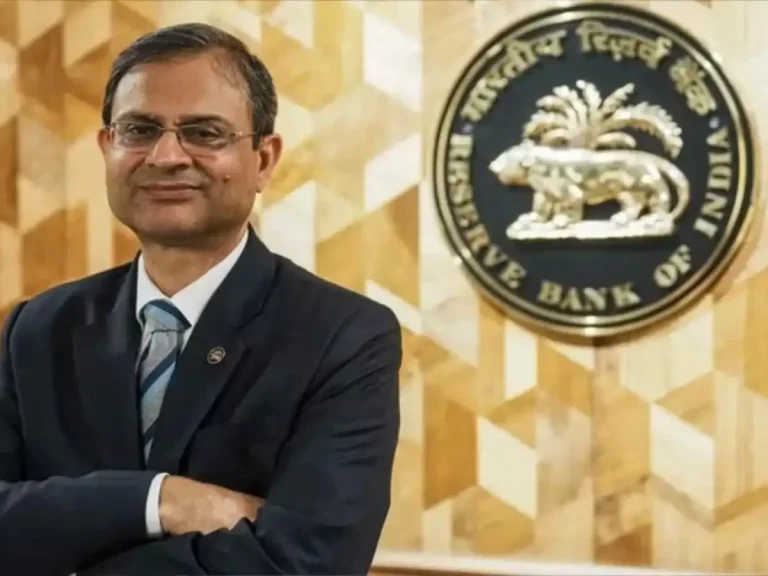
The Reserve Bank of India (RBI) on Friday left key interest rates unchanged while maintaining its neutral monetary policy stance, signalling caution amid mounting global uncertainties and emerging risks to economic growth.
While the central bank refrained from changing borrowing costs, it revised its inflation outlook upward and lowered its growth forecast for the current financial year. The RBI also unveiled a series of measures aimed at attracting foreign capital and strengthening India’s external sector resilience.
Here are the five biggest takeaways from the latest Monetary Policy Committee (MPC) meeting.
1. RBI Keeps Repo Rate Unchanged At 5.25%
The six-member Monetary Policy Committee unanimously voted to keep the benchmark repo rate unchanged at 5.25%, in line with market expectations.
The central bank also retained other key policy rates:
- Standing Deposit Facility (SDF) Rate: 5.00%
- Marginal Standing Facility (MSF) Rate: 5.50%
The decision reflects the RBI’s balancing act between supporting economic growth and containing inflationary pressures amid a challenging global environment.
2. Neutral Policy Stance Retained
The RBI chose to maintain its neutral stance, giving policymakers flexibility to respond to evolving economic conditions.
The central bank highlighted increasing uncertainty in global financial markets and warned that geopolitical tensions, supply chain disruptions and volatile energy prices could create fresh challenges for inflation, liquidity and financial stability.
The MPC emphasised the need to remain agile and data-dependent as risks continue to evolve.
According to the RBI, disruptions in global trade and rising commodity prices could simultaneously slow economic growth while fuelling inflation, creating a difficult policy environment for central banks worldwide.
3. Inflation Forecast Raised To 5.1%
One of the most significant announcements was the upward revision in the inflation outlook.
The RBI now projects Consumer Price Index (CPI) inflation at 5.1% for FY27, compared with its earlier estimate of 4.6%, representing a 50-basis-point increase.
Governor Sanjay Malhotra noted that inflation risks remain tilted to the upside.
Key observations from the RBI include:
- Core inflation remained stable at 3.7% during March and April.
- Fuel inflation remained relatively subdued.
- Government bond yields have firmed up.
- Global energy market volatility poses a significant inflation risk.
The central bank cautioned that renewed pressure on crude oil prices and supply-chain disruptions could further complicate the inflation outlook in the coming months.
4. Growth Forecast Lowered To 6.6%
Alongside higher inflation projections, the RBI also lowered its economic growth estimate.
The central bank now expects real GDP growth for FY27 at 6.6%, down from the previous forecast of 6.9%.
Governor Malhotra said that external developments continue to pose downside risks to India’s growth trajectory.
According to the RBI:
- Rising energy costs may weigh on consumption and investment.
- Supply-chain disruptions could affect industrial activity.
- Global economic uncertainty remains elevated.
- Domestic economic indicators continue to show resilience despite external challenges.
The RBI noted that high-frequency economic indicators suggest domestic demand remains relatively steady, even amid ongoing geopolitical tensions and global economic headwinds.
However, policymakers acknowledged that risks to both growth and inflation have increased significantly, prompting a more cautious outlook.
5. RBI Announces Measures To Boost Foreign Capital Inflows
In a move aimed at strengthening India’s external sector and attracting overseas capital, the RBI unveiled several measures focused on foreign investment and foreign currency inflows.
Easier Access To Government Bonds For Foreign Investors
The central bank announced that all newly issued:
- 15-year government securities
- 30-year government securities
- 40-year government securities
will be opened to Foreign Portfolio Investors (FPIs), making it easier for overseas investors to participate in India’s sovereign debt market.
Support For Overseas Borrowing By CPSEs
The RBI also introduced a facility to support External Commercial Borrowings (ECBs) raised by Central Public Sector Enterprises (CPSEs).
For ECBs with maturities between three and five years, the central bank will bear the subsidy cost associated with hedging requirements, reducing borrowing expenses and encouraging overseas fundraising.
This facility will remain available until September 30.
FCNR(B) Deposit Window Opened
Additionally, authorised public sector banks will be allowed to raise Foreign Currency Non-Resident (Bank) [FCNR(B)] deposits with maturities ranging from three to five years.
The temporary measure is also valid until September 30 and is aimed at boosting foreign currency inflows into the banking system.
RBI Signals Caution Amid Global Uncertainty
The latest policy decision underscores the RBI’s increasingly cautious approach as it navigates a complex economic environment marked by geopolitical tensions, fluctuating energy prices and global financial market volatility.
While India’s domestic economy continues to show resilience, the central bank has clearly signalled that risks to both inflation and growth have intensified. Going forward, policymakers are expected to closely monitor incoming data before making any changes to interest rates.