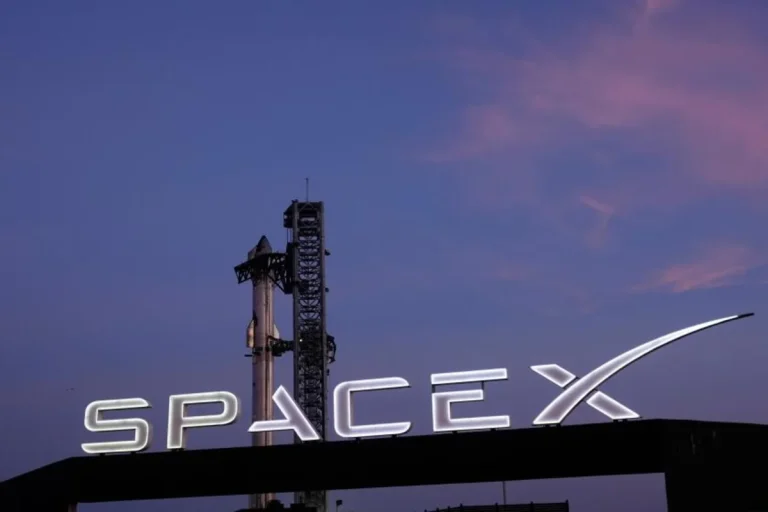
Shares of SpaceX fell sharply on Friday, putting the aerospace and artificial intelligence company on course to erase more than $1 trillion in market value from its post-listing peak as investors reacted to a delayed Starship launch and growing valuation concerns.
The stock dropped as much as 6.9% during trading before trimming some losses to $122.12 per share. At that level, SpaceX’s market capitalisation stood at approximately $1.61 trillion, down from $2.64 trillion recorded at the close on June 16, just three days after its blockbuster initial public offering.
The decline leaves the stock trading below its $135 IPO price, reversing much of the enthusiasm that followed what was billed as the largest initial public offering in history.
Starship Launch Delay Triggers Investor Concerns
Friday’s sell-off came after SpaceX called off a planned Starship launch due to an engine-related issue.
The company later confirmed it would make another launch attempt, while CEO Elon Musk said on X that two Raptor engines would be replaced, likely pushing the next launch to early next week.
Joe Gilbert, portfolio manager at Integrity Asset Management, said the timing of the setback has weighed on investor sentiment.
“The failed launch’s timing is suboptimal to the story, but failed launches are always a risk to the story.”
He added that investors are becoming more cautious.
“Investors are de-risking positions and rethinking valuations as optimism is slowly eroding from the space and depressing lofty multiples simultaneously.”
Analysts Say Development Risks Are Expected
Despite the market reaction, several analysts maintained that technical setbacks are an expected part of Starship’s ambitious development programme.
Raymond James analyst Brian Gesuale said occasional delays are inevitable given the complexity of the reusable rocket system.
“Anomalies like this will continue to be inherent to Starship’s aggressive development — pushing the boundaries of reusability, payload capacity, and rapid cadence for Starlink V3 deployment and future NASA Artemis missions.”
Gesuale noted that even with the latest delay, a launch next week would reduce the interval between Starship missions to less than 60 days, compared with a 221-day gap between previous flights.
Starship Central To SpaceX’s Long-Term Vision
Starship remains the cornerstone of SpaceX’s long-term strategy.
The fully reusable rocket is expected to power the expansion of the company’s Starlink satellite internet network, support future NASA Artemis Moon missions, enable space-based data centres and, ultimately, transport humans to the Moon and Mars.
According to the company’s IPO prospectus, SpaceX has invested more than $15 billion in Starship’s development.
Analysts at Royal Bank of Canada, Ken Herbert and Jonathan Atkin, believe the rocket’s ability to dramatically reduce launch costs could unlock new growth opportunities, including orbital computing infrastructure.
However, they cautioned that achieving a reliable reusable launch schedule remains essential.
“We can appreciate that the path to de-risking is a non-linear one, and believe the non-linear cadence is something investors could be forced to embrace as well.”
Bullish Outlook Faces Near-Term Challenges
Earlier this month, SpaceX joined the Nasdaq-100 Index and received a wave of positive analyst coverage.
The stock currently carries an average 12-month price target of $235.34, reflecting continued optimism about its long-term growth prospects.
However, investors are also watching upcoming insider lock-up expirations, which could increase the supply of shares in the market over the coming months.
Mark Malek, Chief Investment Officer at Siebert Financial, said some investors are reassessing their expectations following the stock’s rapid rise after listing.
“If we factor in the lock-ups expiring in the future, many investors have probably re-thought their initial theses, and prospective ones who have been watching from the sidelines are waiting for lower entry points, which have a good chance of emerging as its valuation gets rightsized.”
AI-Focused IPO Momentum Faces A Test
SpaceX’s decline has also raised questions about the sustainability of the recent boom in artificial intelligence-linked IPOs.
Artificial intelligence formed a key part of the company’s investment story, with SpaceX highlighting plans to build orbital data centres capable of serving what it estimates to be a $26.5 trillion total addressable market.
The record-breaking IPO also fuelled one of Wall Street’s strongest quarters for equity capital markets, generating the highest advisory revenues for major investment banks since 2021.
While Friday’s sell-off reflects growing caution over valuation and execution risks, analysts continue to view Starship as the company’s most critical long-term growth driver.