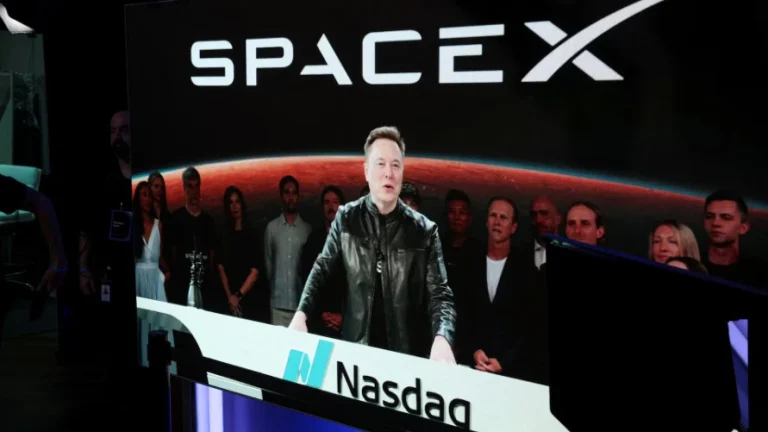
SpaceX shares continued their weak run on Wednesday, falling to their lowest level since the company’s stock market debut. The stock briefly traded below its initial public offering (IPO) price before recovering slightly by the closing bell.
The Elon Musk-led company ended the session down 0.6% at $135.27, only marginally above its IPO price of $135 per share. The decline marked the fourth straight day of losses for the stock.
The recent drop reflects a sharp change in investor sentiment after SpaceX enjoyed a strong rally during its first few trading sessions.
SpaceX Shares Lose Early Momentum
SpaceX entered the stock market with significant excitement. The company’s shares surged nearly 50% during the first three trading days, attracting strong investor interest.
However, the rally proved short-lived. Over the next three sessions, the stock lost almost a quarter of its value, erasing much of its early gains.
When a newly listed company’s stock falls below its IPO price within weeks of listing, it often weakens investor confidence. Such declines can make it harder for companies to regain market momentum.
Investors Shift Focus to AI Business
Market experts believe investors are becoming more cautious about SpaceX’s growing focus on artificial intelligence.
Dec Mullarkey, Managing Director at SLC Management, said investors are increasingly looking at the company’s AI ambitions through its xAI business rather than its traditional space operations.
He added that the heavy investment required for AI infrastructure has raised concerns about future profitability. As a result, some investors are questioning how quickly those investments can generate meaningful cash flow.
Lock-Up Expiry Could Add More Selling Pressure
Another factor worrying investors is the upcoming expiration of the company’s share lock-up period.
Early investors have so far been restricted from selling their holdings. However, those restrictions are expected to end after SpaceX releases its first quarterly earnings report in the coming weeks.
If a large number of early shareholders decide to sell their stock after the lock-up expires, additional selling pressure could push the share price lower.
Index Inclusion Boosted Initial Demand
SpaceX also benefited from strong buying by passive investment funds shortly after its IPO.
The company joined the Nasdaq 100 Index in July after Nasdaq revised its listing rules, allowing newly listed large-cap companies to qualify for inclusion after just 15 trading days instead of waiting three months.
In addition, SpaceX became part of the Russell 1000 Index only two weeks after its IPO.
Bloomberg Intelligence analyst Rob Du Boff estimated that these index additions generated at least $5.4 billion in buying from index-tracking funds.
While that supported the stock initially, broader weakness in technology and AI-related shares has now started to weigh on its performance.
AI Market Weakness Adds to Pressure
Technology stocks have recently faced renewed selling as investors reassess spending on artificial intelligence.
The Nasdaq 100 Index also declined on Wednesday, with semiconductor companies leading the losses.
Brian Mulberry, Chief Market Strategist at Zacks Investment Management, said several factors are hurting investor sentiment at the same time. These include concerns over AI profitability, broader market uncertainty, and public attention surrounding Elon Musk.
He noted that profitability will become one of the key measures investors use to evaluate SpaceX in the coming quarters.
Wall Street Remains Bullish Despite Recent Fall
Despite the recent decline, many analysts continue to maintain a positive outlook on SpaceX.
Following the end of the post-IPO quiet period, several investment banks released optimistic research reports on the company.
Raymond James issued one of the most bullish forecasts, setting a price target of $800 per share.
According to Bloomberg data, more than 80% of analysts covering SpaceX currently recommend buying the stock or hold an equivalent positive rating.
The average analyst price target stands at approximately $238 per share, suggesting potential upside of around 76% from current trading levels.
Why Investors Are Watching Closely
The next few weeks could prove important for SpaceX investors. The company’s first quarterly earnings report, combined with the expiration of lock-up restrictions, may influence the stock’s direction.
At the same time, investors will closely monitor the company’s progress in artificial intelligence, profitability, and future growth strategy as market expectations continue to evolve.