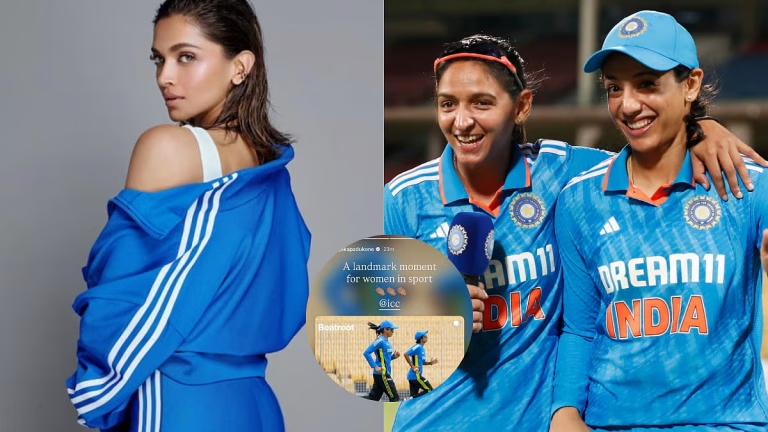
Global cinematic icon and advocate Deepika Padukone has publicly thrown her immense digital weight behind a progressive structural overhaul in international sports.
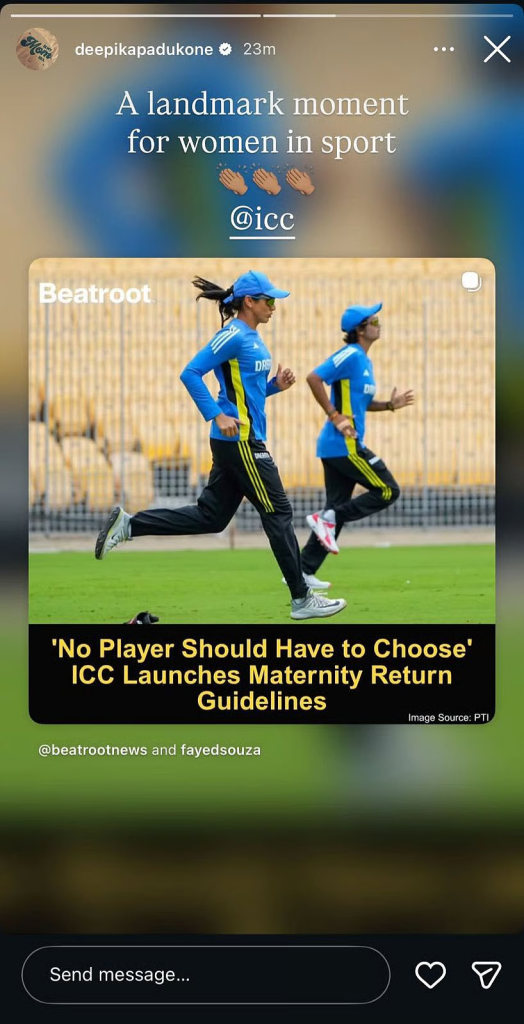
Taking to her Instagram Stories, the actress lauded the International Cricket Council’s (ICC) newly introduced “Return to Play Post-Pregnancy Guidelines” for female cricketers, labeling the policy framework a definitive “landmark moment for women in sport.” The public endorsement resonates deeply with Padukone’s established brand identity, which heavily emphasizes institutional support systems, work-life balance, and women’s professional empowerment across high-pressure industries.
Padukone’s appreciation arrives at a uniquely poetic moment in her own life, as she is currently expecting her second child with husband Ranveer Singh. This intersection of personal experience and public advocacy has amplified the conversation surrounding systemic workplace support for mothers. Observers point out that Padukone has consistently and silently pushed for progressive working parameters within Bollywood as well including trade chatter surrounding structured eight-hour shifts for nursing mothers making her support for the global cricketing community a natural extension of her values.
“The continued growth of women’s cricket must be built on opportunity, inclusion and care for our players at every stage of their lives and careers. No player should have to choose between motherhood and representing her country at the highest level.” — ICC Chairman Jay Shah Unveiling the Landmark Global Mandate
Policy Registry: The ICC Post-Pregnancy “6 Rs” Structural Model
| Framework Phase | Tactical Operational Focus & Support Deliverables (June 2026) |
| Stage 1 & 2: Ready & Review | Early physiological recovery monitoring coupled with psychological well-being checks |
| Stage 3 & 4: Restore & Recondition | Gradual introduction of customized training routines and cricket-specific conditioning |
| Stage 5 & 6: Return & Refine | Official re-entry into competitive match play alongside continuous neural-physical tracking |
| Mandated Venue Logistics | Provision of dedicated feeding spaces at stadiums, travel assistance, and childcare |
| Medical Project Lead | Managed directly by Cricket Australia’s team physician, Dr. Philippa Inge |
Shifting the Narrative From Sacrifice to Career Longevity
The newly introduced guidelines serve as an adaptable template designed to help member boards craft localized maternal protection laws without jeopardizing elite athletic talent. At its core, the policy addresses the emotional and physiological friction points that traditionally forced female athletes into premature retirement following childbirth. Veteran West Indies leg-spinner Afy Fletcher, who successfully returned to international cricket after giving birth to her son, heavily championed the move, noting that while physical rehabilitation is grueling, the emotional anxiety of missing dedicated childcare facilities at venues is an even larger hurdle.
Padukone’s decision to amplify this structural change aligns seamlessly with her recent national assignment. She was recently appointed India’s first-ever Mental Health Ambassador by the Union Ministry of Health and Family Welfare, reinforcing her dedication to systemic shifts rather than superficial updates. By highlighting the ICC’s progressive framework, the Piku actress has successfully highlighted a universal corporate truth: when top-tier institutions actively protect maternal welfare, they do not just retain elite talent they pave a sustainable road for future generations to excel without compromise.