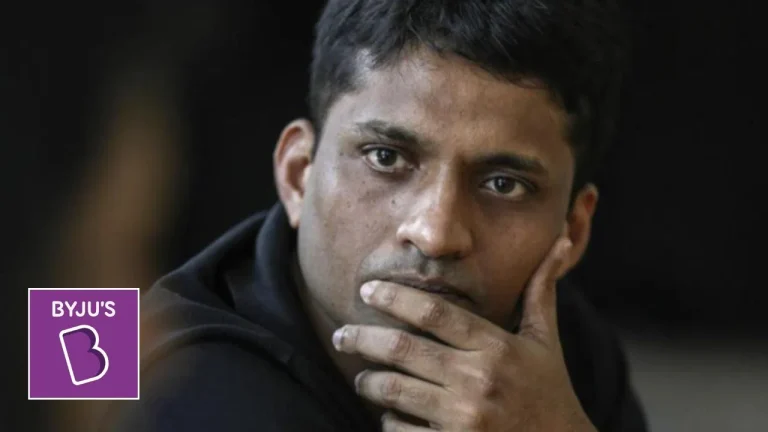
There was a time when Byju’s looked completely unstoppable. Its prominent logo sat proudly on the Indian cricket team’s jersey, global tech investors lined up to pour billions into its coffers, and millions of parents across India bought into the promise that technology could revolutionize their children’s education.
At its absolute peak in 2022, the company commanded a jaw-dropping valuation of $22 billion, transforming founder Byju Raveendran into one of India’s most celebrated and recognizable startup icons.

The mighty have faced a catastrophic fall. In a dramatic escalation of the company’s multi-year downward spiral, a Singapore court has officially sentenced Byju Raveendran to six months in jail for contempt of court. The harsh ruling comes after the founder repeatedly disobeyed strict court orders tied to his financial assets, asset disclosures, and ownership documents. This legal hammer marks the darkest chapter yet in what has now become the single biggest corporate collapse in the history of India’s startup ecosystem.
Aggressive Expansion and the Pandemic Peak
Founded in 2011 under its parent entity, Think & Learn Pvt Ltd, Byju’s initially grew by targeting India’s deeply rooted focus on academic excellence and competitive examinations. The company’s timing was perfect; as smartphone penetration exploded across Tier-1 and Tier-2 Indian cities, online learning shifted from a luxury to a mainstream necessity. The onset of the COVID-19 pandemic in 2020 supercharged this growth trajectory. With schools abruptly shut and students confined to their homes, market demand reached unprecedented levels, and global venture funds rushed to write massive checks.
Flush with investor cash, Byju’s embarked on a hyper-aggressive global expansion strategy. The company spent nearly $3 billion on high-profile corporate acquisitions, snapping up premier educational institutions like Aakash Educational Services, Great Learning, and US-based Epic at breakneck speed. To the public, the company projected absolute invincibility, spending hundreds of millions on celebrity endorsements, massive prime-time ad campaigns, and high-stakes sports sponsorships. However, beneath the dazzling multi-million dollar marketing blitz, structural and financial vulnerabilities were quietly compounding.
The $1.2 Billion Loan and Missing Millions
The turning point in the company’s fortunes arrived in November 2021, when Byju’s secured a massive $1.2 billion foreign term loan from overseas institutional lenders. While initially celebrated as a milestone proving Indian tech firms could command massive international credit, the debt quickly became the anchor dragging the company down. Lenders grew increasingly nervous as Byju’s continuously delayed filing its audited financial statements, prompting serious governance concerns and intense scrutiny from India’s Ministry of Corporate Affairs regarding revenue recognition practices.
When the delayed financial numbers for FY21 were finally made public, the results sent shockwaves through the investor community, revealing that losses had ballooned to an staggering Rs 4,588 crore. Market confidence completely evaporated when top-tier global auditing firms, including Deloitte and BDO Global’s India affiliate, abruptly resigned from their positions, citing severe communication gaps and extended delays. By early 2023, institutional relations collapsed entirely as international lenders accused Byju’s of breaching loan terms and illegally hiding or shifting roughly $533 million from the term loan through an opaque web of cross-border subsidiaries and shell companies.
International Legal Warfare and Insolvency
The legal war quickly expanded into a chaotic, multi-jurisdictional battleground. While US lenders moved aggressively through Delaware and New York courts to seize control of the US subsidiary Byju’s Alpha, Singapore emerged as a critical new legal front. A subsidiary of the sovereign wealth fund Qatar Investment Authority (QIA) pursued relentless legal action tied to share transfers and asset disputes stemming from the original acquisition financing of Aakash Educational Services. Raveendran’s repeated failure to comply with Singaporean judicial orders regarding asset transparency dating back to April 2024 ultimately triggered his six-month prison sentence.
Simultaneously, operational crises exploded back home in India. In July 2024, the National Company Law Tribunal (NCLT) officially admitted insolvency proceedings against Think & Learn Pvt Ltd over an ironic twist of fate: an unpaid debt of Rs 158 crore owed to the Board of Control for Cricket in India (BCCI) for the very sponsorship deal that once symbolized its market dominance. As courts fought for corporate control, Byju’s operational machinery ground to a halt; employee salaries were chronically delayed, mass layoffs decimated teams, and high-profile board members resigned in rapid succession.
A Stark Cautionary Tale
Today, the venture that once promised to redefine global digital education is fighting a fragmented war for survival across three continents. In a brutal economic correction, global institutional investors have aggressively marked down the company’s valuation from $22 billion to near zero, with Forbes subsequently slashing Byju Raveendran’s personal net worth to nothing.
Though Raveendran has publicly pushed back, alleging criminal collusion among restructuring professionals, the damage to his legacy appears absolute. The spectacular implosion of Byju’s stands as a stark, definitive cautionary tale for India’s startup ecosystem regarding the fatal dangers of governance deficits, opaque financials, and debt-fueled, unbridled expansion.