

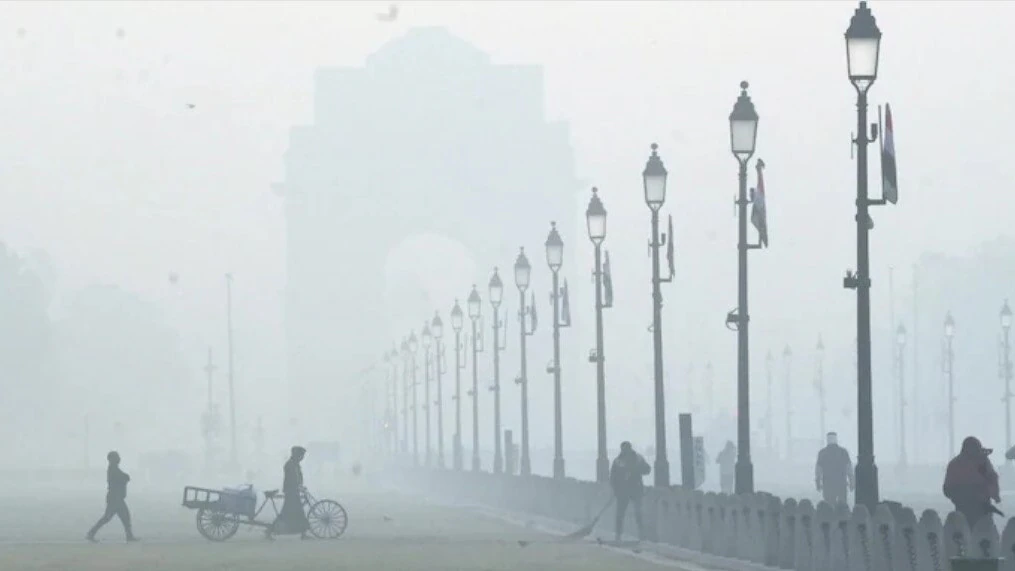


The national capital woke up to its coldest morning of the season so far; AQI improves to ‘poor’ category (298) but local hotspots remain in the ‘severe’ zone.
January 11, 2026: The national capital woke up to a windy and biting Sunday morning on January 11, 2026, with the mercury dipping to 6.6 degrees Celsius. While the chilly winds and Saturday’s light drizzle brought some relief to the city’s choking smog, a thin grey layer continued to obscure visibility in several parts of the city.
In a rare moment of environmental respite, the overall Air Quality Index (AQI) showed significant improvement, falling into the ‘poor’ category with an average reading of 298, down from the ‘very poor’ levels of 361 recorded on Saturday.
Local Hotspots: Where the Air Still Bites
Despite the overall city average dipping below the 300-mark, several high-density areas continued to report hazardous levels of pollution. Nehru Nagar remained the most polluted spot in the capital today.
| Location | AQI (Sunday, 7 AM) | Category |
| Nehru Nagar | 359 | Very Poor |
| Jahangirpuri | 347 | Very Poor |
| Anand Vihar | 339 | Very Poor |
| RK Puram | 336 | Very Poor |
| Siri Fort | 334 | Very Poor |
| Chandni Chowk | 334 | Very Poor |
| Wazirpur | 327 | Very Poor |
| Dwarka Sec-8 | 308 | Very Poor |
Weather Watch: Cold Wave Tightens Grip
The India Meteorological Department (IMD) has warned that the relief from pollution may be short-lived as a deepening cold wave settles over North India.
- The Record: Saturday saw the minimum temperature plunge to 4.2°C, making it the coldest January day since 2024.
- The Forecast: A Yellow Alert remains in place for Sunday and Monday. Temperatures are expected to hover between 4°C and 6°C, with moderate to dense fog likely to impact morning flights and train schedules.
- Wind Factor: Northwest winds traveling at speeds of up to 10-15 kmph are helping disperse surface-level pollutants, but a drop in wind speed expected by Monday evening could see the AQI spike back into the ‘Very Poor’ territory.
Health Advisory
Health experts suggest that while the AQI has marginally improved, the combination of low temperatures and PM2.5 levels remains a risk for those with respiratory conditions.
“The cold air traps pollutants closer to the ground. Even with an AQI of 298, vulnerable groups—children and the elderly—should avoid heavy outdoor exertion during early morning and late evening hours,” advised a senior official from the CPCB.