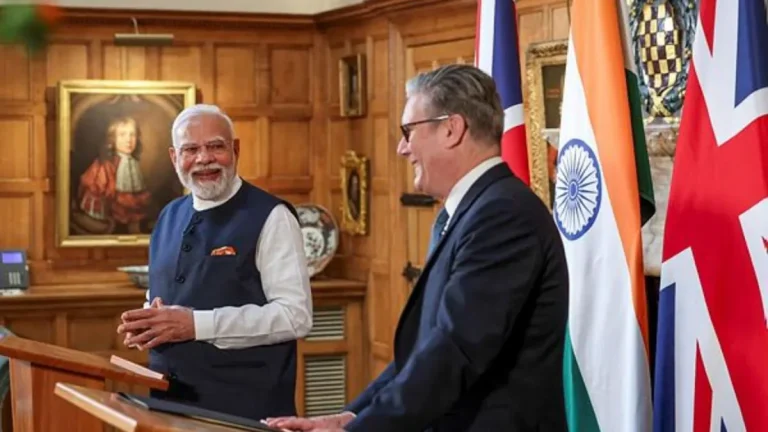
New Delhi: India and the United Kingdom have announced that their landmark Comprehensive Economic and Trade Agreement (CETA) will come into force on July 15, 2026, marking a significant milestone in bilateral economic relations and opening a new chapter in trade, investment and professional mobility between the two countries.
Alongside the trade agreement, the Double Contribution Convention (DCC) — a social security pact aimed at preventing dual social security payments by temporary workers — will also become operational on the same date.
One of the most notable gains for Indian professionals under the DCC is the extension of the exemption period from three years to five years, a move expected to reduce employment costs and enhance the competitiveness of Indian workers and businesses operating in the United Kingdom.
PM Modi Calls It A Historic Milestone
Prime Minister Narendra Modi welcomed the development, describing it as a landmark moment in India-UK relations.
In a post on X, Modi said the agreement would significantly strengthen bilateral trade and investment while creating fresh opportunities for Indian farmers, workers, MSMEs, startups and innovators.
The Prime Minister noted that the agreement would contribute meaningfully to India’s long-term goal of becoming a developed nation under the Viksit Bharat 2047 vision.
Years Of Negotiations Culminate In Major Agreement
The foundations for the agreement were laid in May 2021 through the India-UK Enhanced Trade Partnership and the India-UK Roadmap 2030, which envisioned elevating ties to a Comprehensive Strategic Partnership and doubling bilateral trade to $100 billion by 2030.
After years of negotiations, both governments have now finalized the implementation timeline, paving the way for one of India’s most comprehensive trade arrangements with a major developed economy.
What CETA Means For India
Commerce and Industry Minister Piyush Goyal said the simultaneous implementation of CETA and the DCC would unlock significant opportunities for Indian exports.
According to the minister, the agreement grants Indian exporters immediate duty-free access on 99 percent of tariff lines, removing long-standing tariff barriers and boosting the competitiveness of Indian products in the UK market.
Industries expected to benefit include:
- Textiles and apparel
- Leather and footwear
- Marine products
- Engineering goods
- Processed food products
- MSMEs and manufacturing exporters
The minister said the deal would help Indian businesses compete on equal terms and expand their presence in one of the world’s largest consumer markets.
Beyond Traditional Trade
The agreement consists of 30 chapters and is being positioned as a next-generation trade pact that goes beyond conventional tariff reductions.
Apart from goods and services, the agreement covers areas such as:
- Digital trade
- Telecommunications
- Financial services
- Intellectual property rights
- Government procurement
- Investment facilitation
The inclusion of government procurement is particularly significant, as it appears in a bilateral trade agreement for the first time between India and the UK.
Relief For Indian Professionals In The UK
The Double Contribution Convention is expected to provide substantial benefits to Indian professionals working temporarily in Britain.
Under the pact:
- Indian workers on temporary assignments in the UK will not have to contribute to both Indian and British social security systems simultaneously.
- The exemption period has been increased from three years to five years.
- Companies sending employees to the UK are expected to see lower employment-related costs.
- Indian professionals will enjoy greater mobility and financial savings during overseas assignments.
The measure is expected to benefit sectors such as information technology, consulting, engineering and financial services, where temporary overseas deployments are common.
Sensitive Sectors Protected
While the agreement opens large sections of trade, India has retained safeguards for several sensitive agricultural sectors.
Products protected from extensive market access commitments include:
- Dairy products
- Cereals
- Millets
- Edible oils
- Oilseeds
- Apples
- Several vegetable products
The government said these protections were necessary to safeguard domestic farmers and agricultural interests while pursuing broader trade liberalisation.
A Major Step In India’s Global Trade Strategy
The Commerce Ministry described the simultaneous implementation of CETA and the DCC as a structural shift in India’s global trade architecture.
By combining expanded market access with improved mobility provisions for professionals, the agreements are expected to deepen economic ties between India and the UK while supporting India’s ambition of becoming a global manufacturing, innovation and services hub.