
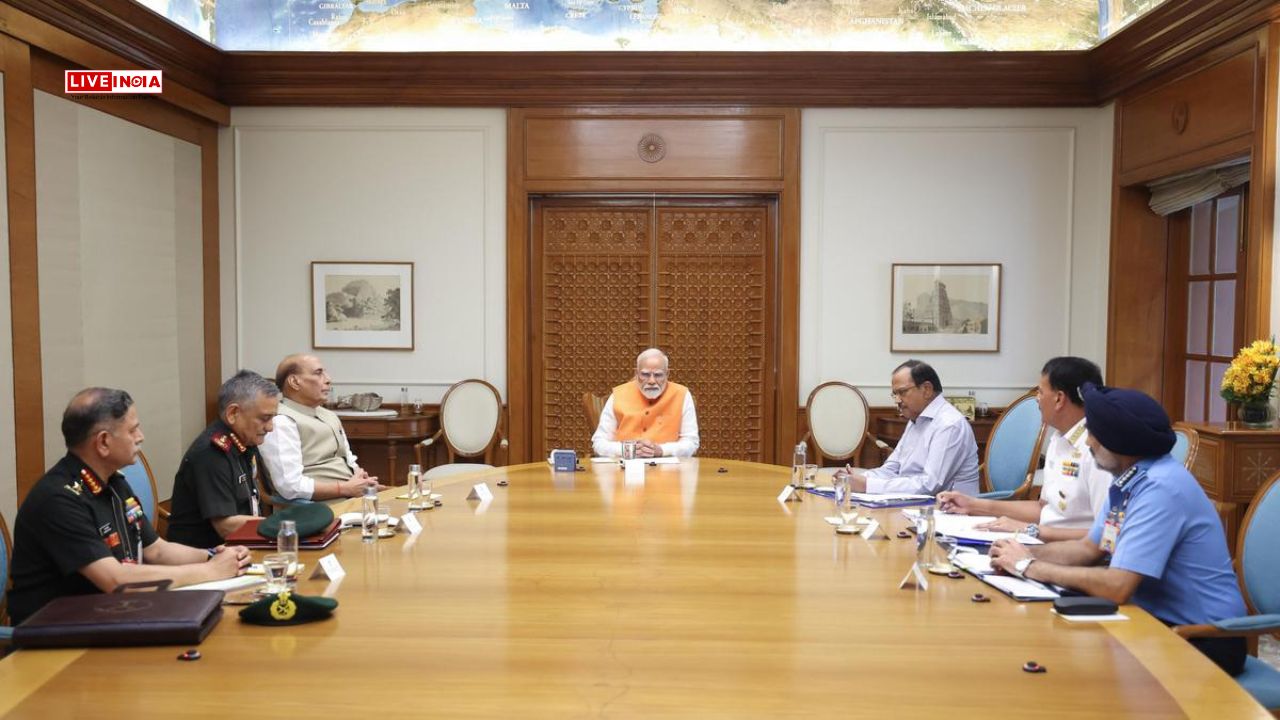


Ahead of the Cabinet Committee on Security meeting, Prime Minister Narendra Modi led a crucial review on India’s response to the Pahalgam terror attack and ongoing tensions with Pakistan.
April 29, 2025: PM Modi Leads High-Level Security Review With Rajnath Singh, NSA Doval Ahead Of Cabinet Committee Meeting
Prime Minister Narendra Modi chaired a critical high-level meeting at his Delhi residence on Tuesday, reviewing the fallout from the Pahalgam terror attack and the evolving security situation in Jammu and Kashmir. The meeting, which lasted over 90 minutes, underscores the urgency with which the government is handling the situation.
Key attendees included Defence Minister Rajnath Singh, National Security Advisor Ajit Doval, and Chief of Defence Staff General Anil Chauhan.
The meeting took place a day before the Cabinet Committee on Security (CCS) — India’s top decision-making body on national security — is scheduled to convene for the second time in just seven days. According to sources, the CCS session will be followed by meetings of the Cabinet Committee on Political Affairs (CCPA) and the Economic Affairs Committee.
Also Read: Viral Video: Jagmeet Singh Breaks Down, Resigns, After Crushing Defeat in Canada Polls
The CCS comprises Prime Minister Modi, Home Minister Amit Shah, Finance Minister Nirmala Sitharaman, External Affairs Minister S. Jaishankar, and Defence Minister Rajnath Singh.
This sequence of high-profile consultations signals India’s deep strategic planning in response to both the deadly Pahalgam attack and Pakistan’s persistent support for cross-border terrorism.
Also Read: Kashmir on High Alert: Four Counter-Terror Operations Underway After Pahalgam Attack
Plan So Far: Visa Cancellations, Indus Water Treaty Suspension
India has already initiated a series of measures:
- Visas for Pakistani nationals — except for Pakistani Hindus and those with long-term visas — were revoked last week.
- The Indus Waters Treaty, a crucial water-sharing agreement signed in 1960, was suspended, a move Pakistan called “an act of war.”
- Nearly 1,000 Pakistani nationals have returned home since the visa revocations took effect.
- Home Minister Amit Shah has directed Chief Ministers to identify and expel Pakistani nationals staying in India illegally.
In retaliation, Pakistan expelled Indian diplomats, closed its airspace to Indian-operated airlines, and suspended key bilateral agreements, including the Simla Agreement.
Pakistani Defense Minister Khawaja Muhammad Asif warned of the potential for escalated tensions, describing the situation as “critical.”
Pahalgam Terror Attack: 26 Lives Lost
On April 22, terrorists affiliated with The Resistance Front, a proxy of banned terror group Lashkar-e-Taiba, attacked tourists at the popular Baisaran meadows near Pahalgam, killing 26 civilians. A massive manhunt is underway to track the perpetrators.
Indian intelligence agencies have presented evidence of Pakistan’s involvement to diplomats from key nations, including the United States, Russia, China, Japan, and several European countries.
Returning early from a foreign trip to Saudi Arabia, Prime Minister Modi avoided Pakistan’s airspace and pledged swift justice. Addressing the nation in English, he warned that those responsible for the heinous attack would be hunted down and brought to justice.
Tags:
PM Modi, Rajnath Singh, Ajit Doval, Pahalgam Terror Attack, Jammu and Kashmir, India Pakistan tensions, Cabinet Committee on Security, National Security, Cross-Border Terrorism