
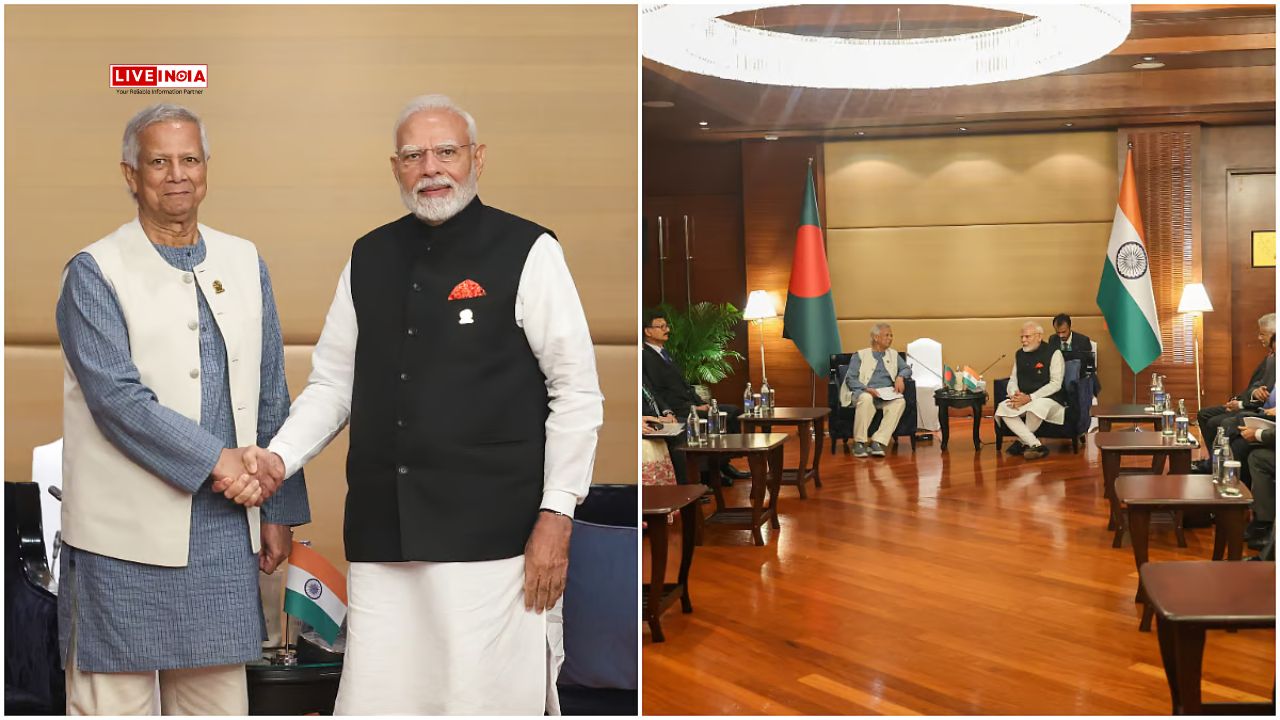


First meeting since regime change in Dhaka sees focus on regional security, strained ties, and growing China-Bangladesh proximity
April 4, 2025: PM Modi, Muhammad Yunus Hold First Talks Since Bangladesh Regime Change
In a highly anticipated diplomatic encounter, Prime Minister Narendra Modi met with Muhammad Yunus, Chief Advisor of Bangladesh’s interim government, on the sidelines of the BIMSTEC Summit in Bangkok. This marked their first meeting since the political upheaval in Dhaka that ousted the Sheikh Hasina-led Awami League government in August 2024.
Also Read: PM Modi, Bangladesh’s Yunus Sit Together At Bangkok Summit Dinner Amid Bilateral Tensions
Accompanied by External Affairs Minister S. Jaishankar and National Security Advisor Ajit Doval, PM Modi’s meeting with Yunus comes at a time when Delhi-Dhaka relations are noticeably strained. Bangladesh’s warming ties with China, alongside controversial comments by Yunus regarding India’s northeastern states, have triggered fresh anxieties in New Delhi.
Frosty Ties Since Regime Change
Since Sheikh Hasina’s departure and her reported refuge in India, New Delhi has voiced concerns over the treatment of minorities in Bangladesh and the rise in Islamist activity under the new interim leadership. Dhaka has brushed off international scrutiny, maintaining that minority welfare is its internal matter.
Also Read: Coup Rumours in Bangladesh: Army Chief General Zaman’s Meetings Spark Political Turmoil
Tensions spiked further after Yunus, during a visit to China, referred to India’s Northeast as a “landlocked region” and labeled Bangladesh the “guardian of the ocean” for the Seven Sister states. He suggested that Bangladesh could act as an extension of the Chinese economy for the region — remarks that did not sit well with Indian authorities.
Strong Reactions from Northeast Leaders
Assam Chief Minister Himanta Biswa Sarma slammed Yunus’s comments, calling them “offensive” and “condemnable.” In a detailed statement, Sarma reiterated the vulnerability of the Chicken’s Neck Corridor — a narrow stretch in West Bengal connecting the Northeast to mainland India — and called for robust infrastructure development, including alternative routes that bypass the corridor entirely.
He warned that such statements reflect deeper strategic calculations and are not to be taken lightly.
A Diplomatic Balancing Act
The meeting comes just days after PM Modi’s letter to Yunus on Bangladesh’s Independence Day, wherein he emphasized the importance of shared history and mutual sensitivity. “We remain committed to advancing this partnership…based on mutual sensitivity to each other’s interests and concerns,” the letter read.
With China’s increasing footprint in Bangladesh and the future of India-Bangladesh cooperation hanging in the balance, today’s dialogue signals a cautious but necessary engagement between the two South Asian neighbors. Whether this leads to a recalibration of ties or further strategic distance remains to be seen.
Tags:
PM Modi, Muhammad Yunus, BIMSTEC summit, India-Bangladesh relations, Sheikh Hasina, Northeast India, Chicken’s Neck Corridor, Dhaka-Beijing ties, Ajit Doval, S Jaishankar, Assam, Himanta Biswa Sarma, Bangladesh minorities, Yunus China visit