
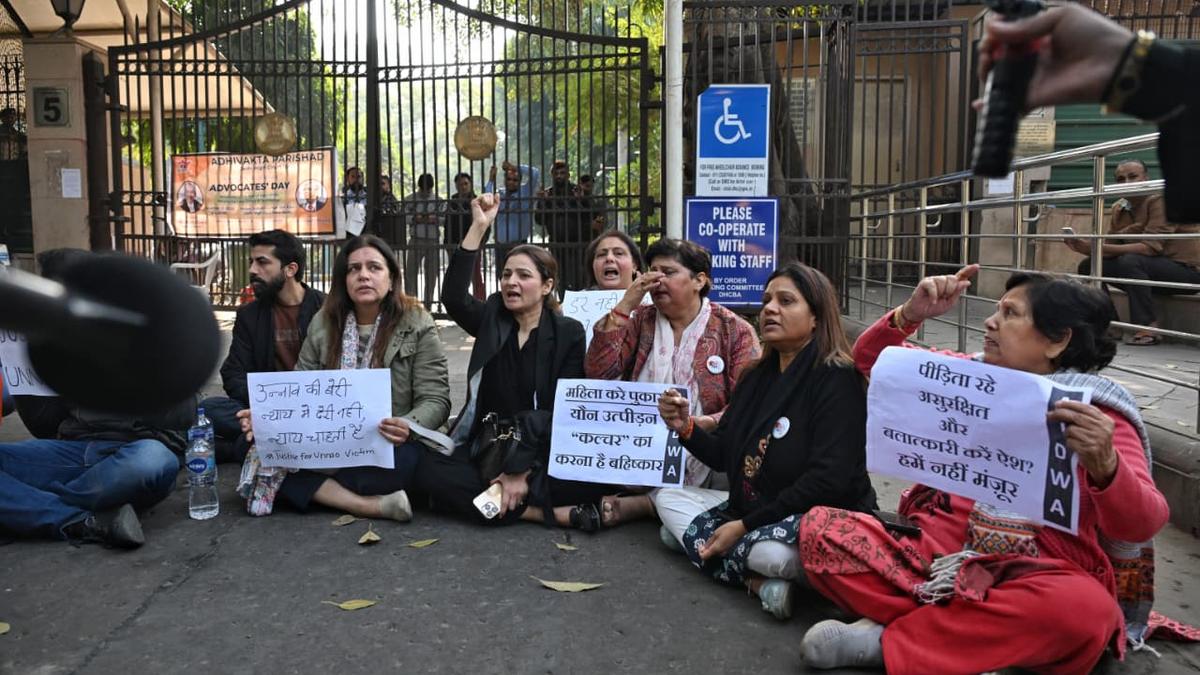


The Unnao rape survivor and women activists stage a defiant demonstration after the court suspends the former MLA’s life sentence
December 26, 2025: The gates of the Delhi High Court became a site of intense public outcry on Friday, December 26, 2025, as scores of protesters, including women activists and the Unnao rape survivor’s mother, demonstrated against the court’s decision to grant conditional bail to expelled BJP leader Kuldeep Singh Sengar.
The Protest: “Stop Protecting Rapists”
Tensions peaked on Friday morning as demonstrators gathered near the court premises, holding placards and chanting slogans like “Balatkariyo ko sanrakshan dena band kro” (Stop protecting rapists).
- Activists Involved: Members of the All India Democratic Women’s Association (AIDWA) joined activist Yogita Bhayana, who called the bail order a “big failure” of the legal system.
- Police Action: Security personnel were seen using megaphones to warn the crowd that demonstrating outside the court is illegal. Protesters were given a five-minute ultimatum to disperse or face legal action, with officials directing them to continue their protest at Jantar Mantar.
The Survivor’s Fear: “A Death Sentence for Us”
The 24-year-old survivor, who now resides in Delhi under CRPF protection, expressed profound terror following the court’s order on Tuesday.
“HC decision is like ‘kaal’ (death) for us,” the survivor told reporters. “He is a powerful man who gets his men to do his dirty work. When my car met with an ‘accident’ in 2019 that killed my relatives, he didn’t do it himself—his henchmen did. His being out makes us all targets.”
Her mother echoed this sentiment, stating they have “lost faith in the High Court” and vowed to take their fight to the Supreme Court.
Why Was Sengar Granted Bail?
The division bench of Justices Subramonium Prasad and Harish Vaidyanathan Shankar suspended Sengar’s sentence primarily on technical and constitutional grounds:
- Public Servant Status: The court held a “prima facie” view that an MLA does not qualify as a ‘public servant’ under the specific sections of the POCSO Act (Section 5c) and IPC (Section 376(2)b) used for his conviction. This effectively downgraded the “aggravated” nature of the crime for the purpose of bail.
- Time Served: The bench noted that Sengar has served seven years and five months in prison, suggesting that continued incarceration during a pending appeal would violate his rights under Article 21.
- Apprehension vs. Law: The judges remarked that courts cannot deny bail merely out of “apprehension” that security agencies might fail to protect the victim.
The Bail Conditions:
- Personal Bond: ₹15 lakh with three sureties.
- Geographical Restriction: Sengar is barred from entering a 5-km radius of the survivor’s Delhi residence.
- Reporting: He must stay in Delhi and report to the local police station every Monday at 10:00 AM.
CBI and Supreme Court Intervention
Despite the High Court’s relief, Sengar remains in jail for now. He is still serving a 10-year sentence for the custodial death of the survivor’s father, a case in which he has not yet been granted bail.
Meanwhile, the CBI confirmed on Thursday that it will file a Special Leave Petition (SLP) in the Supreme Court to challenge the bail, arguing that the High Court ignored Sengar’s “criminal antecedents” and his capacity to influence witnesses.