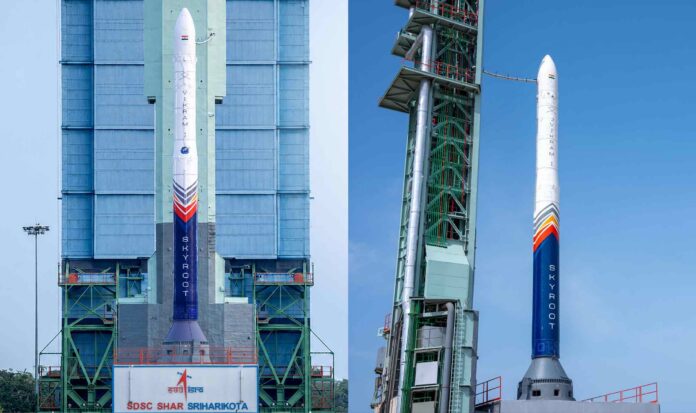
India’s private space sector is on the brink of a historic milestone as Hyderabad-based Skyroot Aerospace prepares to launch Vikram-1, the country’s first privately developed orbital-class rocket. The maiden mission, named Mission Aagaman, is scheduled for lift-off at 11:30 am on Saturday from the First Launch Pad at the Satish Dhawan Space Centre (SDSC-SHAR), Sriharikota.
The mission marks the first attempt by an Indian private company to place payloads into orbit from Indian soil. Unlike Skyroot’s Vikram-S mission in 2022, which was a suborbital technology demonstrator, Vikram-1 is designed to reach Low Earth Orbit (LEO) and deploy multiple payloads at an altitude of around 450 kilometres above Earth.
Built for the growing small satellite market, the four-stage Vikram-1 rocket can carry payloads weighing up to 350 kg to Low Earth Orbit and 260 kg to Sun-synchronous Orbit. The launch vehicle uses three solid-fuel stages and a restartable liquid-fuel upper stage, enabling accurate satellite deployment into designated orbits.
Mission Aagaman is primarily a technology demonstration flight aimed at validating the rocket’s propulsion, stage separation, guidance, navigation, avionics and orbital insertion systems before Skyroot begins commercial launch operations. The mission will carry multiple technology demonstration payloads from Indian and international customers, along with a handwritten postcard by Prime Minister Narendra Modi bearing the words “Vande Mataram.”
What is Low Earth Orbit?
Low Earth Orbit is the region of space extending from approximately 160 km to 2,000 km above Earth’s surface. Vikram-1’s target altitude of 450 km falls within this range, making it suitable for Earth observation, communication, scientific research and technology demonstration missions.
LEO is widely preferred because it requires less energy to reach, enables high-resolution Earth imaging and provides lower communication delays compared to higher orbits.
A Milestone for India’s Private Space Industry
Founded in 2018 by former ISRO engineers Pawan Kumar Chandana and Naga Bharath Daka, Skyroot Aerospace became India’s first private company to launch a rocket into space with Vikram-S in 2022. Since then, the company has expanded its launch vehicle programme and aims to provide affordable, on-demand launch services for the global small satellite market.
The Vikram-1 mission also highlights the rapid growth of India’s private space ecosystem following the government’s decision to open the sector to private participation in 2020. A successful launch would validate Skyroot’s technology and strengthen India’s position in the global commercial satellite launch industry.